August 28, 2026 · 10 min read
The Difference Between Topical Authority and Publishing a Lot of Content
A large content library can still be shallow, repetitive, and commercially disconnected. Authority comes from the quality and coherence of the information system—not the post count.
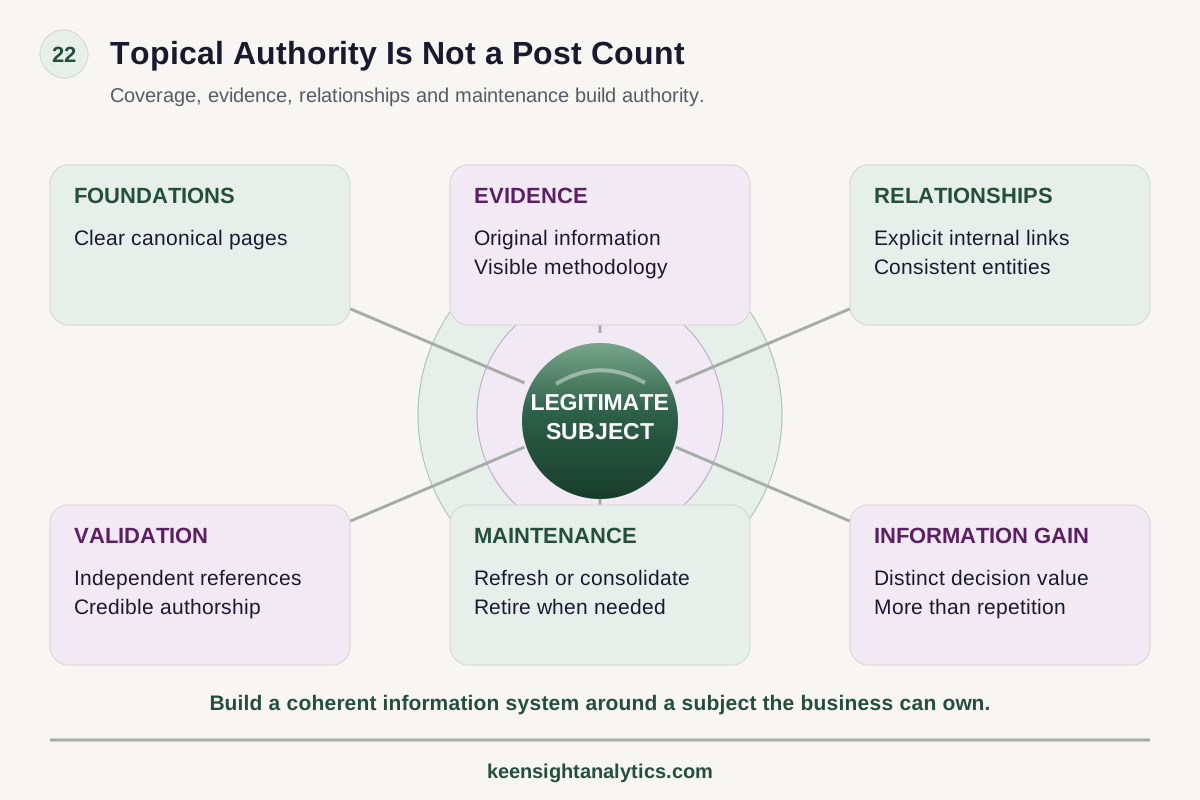
The framework
Topical authority is not a post count
Coverage, evidence, relationships and maintenance work together.
Foundations
Clear canonical pages.
Evidence
Original information and visible methodology.
Relationships
Explicit internal links and consistent entities.
Validation
Independent references and credible authorship.
Maintenance
Refresh, consolidate or retire when needed.
Information gain
Distinct decision value beyond repetition.
Build a coherent information system around the subject.
Authority next step
Before pursuing links, decide whether the market is missing evidence, a reusable resource, distribution, or all three.Publishing 100 articles about a topic does not automatically make a site authoritative on that topic.
Volume can create coverage, but coverage and authority are not the same thing. A site can publish hundreds of posts that repeat consensus advice, overlap with one another, cite no primary evidence, and connect poorly to the products or services the company actually provides. Another site can publish far fewer pages and still become the more useful reference because its information is clearer, deeper, better connected, and independently validated.
The practical SEO question is therefore not, “How much content do we need?” It is, “What body of evidence would make this site a credible and useful destination for the subject areas in which the business actually deserves visibility?”
1. Start with the subject the business can legitimately own
Topical authority should begin with business reality. A company should not try to become authoritative on every adjacent keyword just because a tool reports search volume.
Define the subject around the company’s real expertise, products, services, customers, data, and operating experience. A technical SEO firm can credibly build depth around search diagnostics, site architecture, measurement, migrations, and AI-search visibility. It does not become more authoritative by publishing unrelated lifestyle or business-trend content.
Focus creates stronger evidence because the company has more to say, more to show, and more commercial reason to maintain the material.
2. Distinguish coverage from repetition
Useful coverage means answering different questions with pages that have different jobs. Repetition means creating many URLs that paraphrase the same answer.
A coherent SEO topic may include:
- a foundational explainer;
- a commercial service page;
- a technical methodology page;
- a decision comparison;
- an applied industry article;
- a measurement framework;
- original research;
- a tool, checklist, template, or dataset;
- case evidence when real evidence exists.
Those assets reinforce one another because they answer different parts of the same problem. Five near-identical “SEO checklist” posts do not.
3. Build a topic model before an editorial calendar
An editorial calendar answers when something will be published. A topic model answers why the page should exist.
Map the subject into concepts, commercial decisions, failure modes, buyer questions, technical mechanisms, measurements, and proof. Then assign an existing or planned page to each meaningful role.
This exercise often reveals that the site already has enough pages but lacks depth, consolidation, or internal relationships. The next SEO project may therefore be a rewrite or merge rather than another batch of net-new content.
4. Make foundational pages genuinely foundational
Many sites build “pillar pages” that are simply very long blog posts. Length is not what makes a page foundational.
A strong foundational page defines the subject, establishes terminology, explains the main mechanisms, links to deeper subtopics, and gives readers a clear path into commercial or specialist material. It becomes the page other content can reference without restating the basics every time.
When foundational pages are weak, every new article has to reconstruct the topic from scratch. That creates redundancy and inconsistent terminology.
5. Use internal links to express relationships
Internal links are not proof of authority by themselves, but they make the architecture legible.
Link from definitions to applications, from applications to commercial pages, from research to methodology, from industry pages to relevant services, and from commercial pages to the evidence that helps buyers evaluate the offer.
A useful internal link should answer a reader’s next question. It should not exist only because an SEO spreadsheet says two pages share a keyword.
For example, a page diagnosing stalled organic growth might link to a failure-layer prioritization explainer, a Search Intelligence Report, and the relevant technical or managed-search service depending on the problem.
6. Add information gain
A topic becomes more defensible when the site adds something the existing search results do not already provide.
Information gain can come from:
- original data;
- transparent methodologies;
- decision frameworks;
- first-party technical documentation;
- expert analysis of edge cases;
- calculators or tools;
- maintained reference tables;
- real operational constraints and tradeoffs.
Rewriting the consensus in different wording may satisfy a publishing quota but does little to strengthen the site as a reference source.
7. Support claims with evidence
Authority is weakened by unsupported certainty.
When a page makes a factual claim, cite an authoritative source where appropriate. When the conclusion is based on KeenSight’s own framework, label it as a framework rather than presenting it as a universal ranking law. When evidence is illustrative, say so.
This matters especially in AI search, local search, legal, financial, medical, and other areas where simplistic claims can mislead readers.
8. Keep entities consistent
A coherent site should identify companies, authors, services, locations, products, and relationships consistently.
Names, service definitions, author biographies, organization information, and structured data should reinforce visible content rather than conflict with it. This improves user trust and reduces ambiguity about who is responsible for the information.
9. External validation is different from self-declared expertise
A company can say it is an authority. The market decides whether to reference it.
Independent links, citations, mentions, association references, media coverage, partner references, reviews, academic citations, documentation references, and community discussion can all contribute to an external evidence footprint depending on the industry.
This is why authority-building cannot be reduced to on-site content production. A strong content system creates things worth referencing; distribution and real-world reputation determine whether other organizations actually reference them.
10. Do not confuse backlinks with arbitrary link volume
External backlinks matter because they can represent independent discovery and reference, but link quantity alone is a poor strategy.
A relevant industry association citing a methodology can be more meaningful than dozens of unrelated low-quality links. A maintained dataset may earn fewer but stronger references than a generic infographic distributed widely.
The objective should be to create legitimate reasons for relevant organizations to reference the work.
11. Maintain the corpus
Authority decays when the content portfolio becomes stale.
Review pages for obsolete information, broken links, unsupported claims, outdated screenshots, discontinued products, changed regulations, and overlapping intent. Consolidate pages that no longer need to exist separately. Refresh pages whose role is still valid but whose evidence has aged.
A maintained 80-page corpus can be stronger than a neglected 800-page archive.
12. Measure authority at the topic level
Do not judge authority from one keyword or one domain-level metric.
Measure whether the site gains visibility across strategically important query groups, whether more of the relevant SERP surface is captured, whether commercial pages improve alongside supporting content, whether the site earns independent references, and whether the brand increasingly appears in relevant AI-search source and recommendation sets.
Also measure losses. Authority should produce resilience across a topic, not one fragile ranking.
13. A practical authority-building sequence
- Define the subjects directly connected to the business’s real expertise and growth goals.
- Map foundational, commercial, applied, research, comparison, and resource roles.
- Audit existing pages before creating new ones.
- Strengthen the canonical foundational and commercial pages first.
- Create missing content only where it has a distinct decision role.
- Add original evidence, tools, methodologies, or expert analysis where possible.
- Connect the corpus with useful internal links.
- Distribute genuinely referenceable assets to relevant audiences.
- Measure topic-level visibility, external references, and commercial contribution.
- Refresh, consolidate, and retire content as the subject evolves.
Topical authority is an information system
Publishing volume can support authority when each new page adds a useful role. Volume becomes a liability when the site confuses keyword permutations with expertise.
The better standard is coherence: clear foundational pages, useful depth, original evidence, credible authorship, strong internal relationships, commercial relevance, and independent validation.
Build that system and the number of articles becomes a secondary question.
When this becomes authority work
Create something worth referencing before asking for references.
Use content or research production to create defensible information gain. Use Digital PR when the asset is already strong and legitimate distribution is the missing layer. Search Intelligence can help determine which competitive evidence gap is worth solving first.Topical authority is an operating concept
Use “topical authority” here as shorthand for coherent, credible subject coverage—not as the name of a public Google score. There is no universal topical-authority metric marketers can directly optimize.
The practical objective remains useful: distinct page roles, evidence, internal relationships, expertise, maintenance, and legitimate external references that make the subject easier to understand and verify.
Turn topical coverage into an authority operating model—not a publishing quota
If the real uncertainty is whether the market gap comes from missing coverage, weak internal relationships, thin evidence, or stronger competitors, use Search Intelligence before committing to a large publishing plan. Once the missing page roles and evidence needs are known, Search Content Production can provide finite execution capacity without making volume itself the strategy.
Use Digital PR & Search Authority when the remaining gap is third-party evidence, source ownership, earned references, or distribution. Use Interactive Tools when a repeatable decision can become a calculator, assessment, or other utility worth citing. Choose managed KeenSight Search when coverage, internal discovery, authority, competition, and measurement must be reprioritized together over time. The companion analyses on original research and link-worthy resources show how authority can be earned with reference value rather than publishing frequency.
Decision checkpoint
Before asking for links, decide what would make the asset worth referencing.
Authority work is strongest when the underlying information is useful enough to deserve independent references before outreach begins.- 01Information gainDoes the asset contain original data, a maintained utility, a defensible framework, or a reference that is difficult to replace?
- 02Citation utilityCan a publisher easily understand what the asset proves, how it was produced, and which statement it can support?
- 03Distribution gapIs the missing layer the asset itself, legitimate outreach/distribution, or both?
What Strong Topical Authority Requires
Distinct page roles
Coverage should answer different decisions rather than multiply keyword variants.
Information gain
Original evidence, frameworks, tools, and technical depth make the corpus more useful and defensible.
Coherent architecture
Internal links should connect foundational, applied, commercial, research, and industry pages logically.
External validation
Independent references matter because authority cannot be established only by self-description.
Authority building
Build something defensible, then distribute it legitimately.
Compare other ways to get help
Find the authority gaps that actually constrain visibility
Search Intelligence can separate content gaps from technical, authority, and competitive constraints before you add another publishing cadence.
Keep Reading
Build Content Around Revenue
Prioritize editorial work around buyer decisions and commercial destinations.
Read article →Why More Blog Posts Can Be Wrong
Diagnose whether content volume is actually the next constraint to solve.
Read article →Information Gain and Search
Review how differentiated information strengthens a search content portfolio.
Read explainer →Make it specific
See what the market looks like for your company.
The free visibility preview turns a broad search topic into a limited personalized baseline.