August 28, 2026 · 10 min read
Why Publishing More Blog Posts Is Often the Wrong SEO Strategy
Content production is a capability, not a diagnosis. Before adding another publishing cadence, determine whether the site actually needs new pages—or needs better architecture, stronger commercial assets, remediation, or authority.
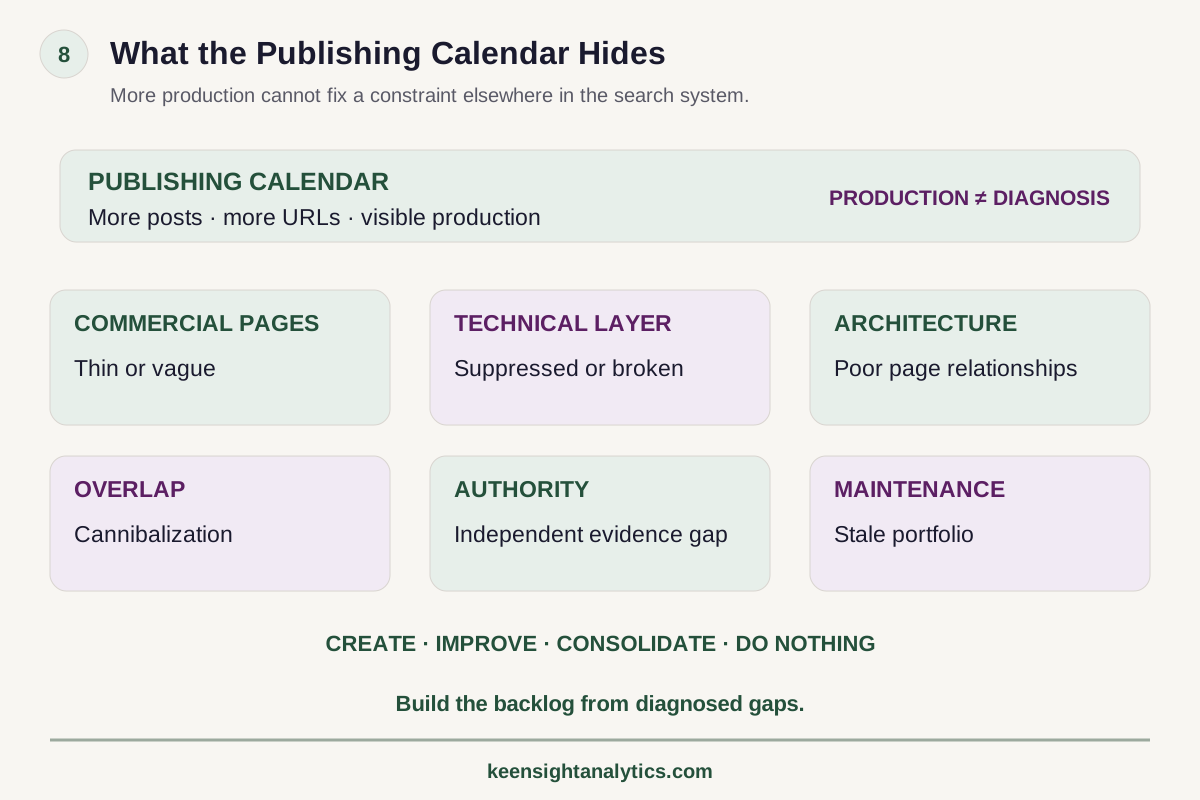
The framework
What the publishing calendar hides
More production cannot fix a constraint elsewhere in the search system.
Commercial pages
Thin or vague decision information.
Technical layer
Suppressed or broken output.
Architecture
Poor page relationships.
Overlap
Cannibalization.
Authority
Independent evidence gaps.
Maintenance
A stale portfolio.
Create, improve, consolidate or do nothing—based on diagnosed gaps.
SEO next step
Apply the framework to a real commercial page set before adding more activity to the roadmap.When organic growth stalls, “publish more content” is one of the easiest recommendations to make. It feels productive, creates visible output, fits a monthly calendar, and gives the team something to report.
It is also frequently the wrong next move.
A site can publish every week while service pages remain thin. It can add fifty articles while important pages are not properly indexed. It can expand the blog while three old posts cannibalize the same intent. It can create more informational traffic while competitors win the category through stronger product pages, local visibility, original research, documentation, or independent authority.
The question is not “should we create content?” It is which information is missing from the search system, and is a new blog post actually the right asset?
1. Publishing volume is not a search strategy
A publishing calendar answers an operational question: how often will the team produce something? An SEO strategy answers a different question: which search constraints or opportunities should the business address, in what sequence, and why?
Those two can overlap. If the market has meaningful unanswered demand and the company can create differentiated content, a publishing program can be valuable. But volume is an output metric. It does not prove that the pages serve distinct intents, strengthen commercial destinations, earn authority, or improve competitive visibility.
A company that publishes twelve strong, necessary pages in a year can have a better content strategy than one that publishes 120 interchangeable articles.
2. The commercial pages may be the real problem
Before expanding editorial content, inspect the pages closest to revenue.
Do service pages clearly explain scope, fit, methodology, constraints, pricing logic, deliverables, location coverage, and next steps? Do product and category pages contain enough decision information? Do location pages provide real local evidence? Do comparison pages help buyers understand tradeoffs?
If the answer is no, the content team may be building a large discovery layer on top of a weak commercial foundation.
Improving three high-value service pages can create more value than adding ten broad informational posts because those pages are the destinations the rest of the content system should support.
3. The technical layer may be suppressing everything
New content cannot solve a technical access problem. If important pages are blocked, incorrectly canonicalized, poorly rendered, trapped in duplicate URL families, buried by internal architecture, or damaged by migration errors, publishing more simply adds assets to a system that cannot distribute them effectively.
Check the affected page groups before assigning the problem to content. A sudden sitewide or template-level decline deserves technical investigation. Use the SEO prioritization across failure layers framework to determine whether technical remediation should happen first.
When the constraint is finite and technical, a fixed Technical SEO Project may be more appropriate than an ongoing content retainer.
4. Existing content may already cover the demand
Many sites have a production problem disguised as a coverage problem. They already have pages for the target topics, but the pages are weak, overlapping, outdated, or poorly connected.
Before creating a new URL, search the existing portfolio. Which pages receive impressions for the query? Which URLs rotate? Which old posts contain useful links or history? Which pages were built for an earlier version of the product or market?
The correct action may be to improve, consolidate, redirect, or reposition an existing asset. New URLs create maintenance obligations and can fragment signals when the existing page already owns part of the intent.
5. Cannibalization is usually a portfolio-design issue
Teams sometimes treat cannibalization as a mysterious penalty. More often, it is a sign that the site created several pages without assigning distinct jobs.
If five articles all target “technical SEO audit” with slightly different titles, search systems and users have to infer which one is authoritative. Internal links may send conflicting signals. Updates become harder because no one knows which page should survive.
Fix the portfolio design. Decide which page owns the primary intent, which adjacent questions deserve distinct assets, and which URLs should consolidate. Then use internal links to make the hierarchy clear.
6. Authority may be the constraint, not content quantity
A site can have excellent on-page coverage and still lose in a competitive market because stronger sources have more relevant independent evidence.
That evidence may include links, original research, expert recognition, reviews, documentation, professional affiliations, partner ecosystems, citations, or brand familiarity. Publishing another generic article does not necessarily close that gap.
If competitors are repeatedly referenced because they produce original data, a better response may be research. If a local business lacks independent reviews and association presence, reputation and local authority may matter more. If a software company is missing from technical ecosystem documentation, integration and partner evidence may be the stronger lever.
7. Search demand may not justify the page
Not every keyword variation deserves its own URL. Search tools can generate thousands of related phrases, but many represent the same underlying intent.
Before approving a new article, ask whether a user would genuinely benefit from a distinct page. If the answer can be covered naturally inside an existing authoritative page, adding another URL may create more maintenance cost than search value.
This is especially important for local and industry permutations. Swapping the city or industry name while leaving the substance unchanged creates a larger site, not necessarily a better one.
8. The content may be attracting the wrong audience
Traffic growth can reward a bad editorial strategy if the program is measured only on sessions.
A B2B company can rank for broad definitions used by students and practitioners while qualified buyer discovery stagnates. A local service company can attract national informational traffic that never converts. A software business can generate thousands of visits around free tools while losing vendor-comparison visibility.
Segment performance by intent and page role. Ask whether the content supports the commercial categories the company wants to grow, not merely whether the sessions increased.
9. Publishing can become a substitute for maintenance
Editorial teams often receive more recognition for launching new articles than for maintaining old ones. That creates content debt.
Important pages become outdated. Statistics age. Product names change. Internal links break. Competing articles accumulate. Legal or regulatory guidance becomes stale. Old CTAs point to retired offers.
A mature content program reserves capacity for refreshes, consolidation, redirects, source updates, internal-link maintenance, and pruning. The portfolio should become more useful over time, not merely larger.
10. More content is correct when there is a demonstrated gap
The argument is not “stop blogging.” New content is the right strategy when the business can show that:
- a meaningful buyer question or search intent is not adequately served by an existing page;
- the new page has a distinct role in the site architecture;
- the business can provide useful information that is not merely a paraphrase of competitors;
- the page connects to a real commercial or authority objective;
- the technical system can support discovery and indexation;
- the team has a plan to maintain the page after publication.
Under those conditions, publishing is not a quota. It is targeted asset creation.
11. Use a “new page versus improve existing” decision
For every proposed article, run a short decision check:
Create a new page when the intent is distinct, the existing portfolio does not serve it well, and the business can add meaningful information.
Improve an existing page when the page already has the right job but lacks depth, freshness, examples, evidence, or commercial clarity.
Consolidate when multiple pages compete for the same intent and one stronger canonical asset can serve the need.
Do nothing when the proposed topic has weak commercial relevance, no distinct intent, or no credible information gain.
“Do nothing” is an underrated SEO decision.
12. Build the content backlog from diagnosed gaps
Replace the question “what should we write this month?” with “what search or buyer gap remains unresolved?”
Sources for that backlog can include competitive win/loss analysis, Search Console queries, sales objections, support questions, internal site search, AI-search prompt patterns, local visibility gaps, product documentation needs, content decay, and commercial-page audits.
Score each gap by commercial proximity, strategic priority, visibility opportunity, differentiation potential, internal-link value, authority potential, and effort. The resulting backlog may contain articles, but it should also contain service-page improvements, comparisons, research, resources, technical fixes, and consolidation work.
13. Separate content production from content ownership
A company can outsource writing while retaining strategy. It can keep writing internal while outsourcing research and measurement. It can have an incumbent agency execute while an independent provider benchmarks results.
Do not assume that identifying a content need means the same vendor should own every related function. KeenSight’s commercial model intentionally separates measurement, one-time diagnosis, fixed technical remediation, and recurring managed search because those are different ownership needs.
The operating model should be explicit about who decides, who produces, who implements, and who measures.
14. Judge the portfolio, not the publication streak
The strongest content programs are not necessarily the ones with the longest archive. They are the ones where each important page has a job, commercial destinations are strong, supporting content is differentiated, internal links create useful paths, outdated assets are maintained, and new pages are added because the market actually needs them.
That may result in a lower publishing cadence and better search performance. It may also create a more useful website for customers—which is the more durable objective.
The strategy is choosing what information deserves to exist
Content production becomes strategic when the team can explain why a page should exist, what decision it supports, where it fits, what new information it contributes, how it connects to revenue, and how its success will be evaluated.
If the only rationale is “we need four posts this month,” the calendar is driving the strategy backward.
When this becomes recurring search work
Managed Search fits when several constraints have to move together.
Use managed KeenSight Search when technical foundations, commercial architecture, content, authority, and measurement require ongoing ownership. Use Search Intelligence first when the dominant constraint is still unclear.Use a stop/go publishing test
Before approving a new article, ask: Is there uncovered demand? If no, stop. Does an existing page already serve it? Improve or consolidate. Is the intended page technically eligible? Fix access first. Is the gap mainly authority or proof? Build evidence and distribution. Does the proposed page have a distinct portfolio role? If no, do not publish it.
Choose create, improve, consolidate, or fix before buying production
If the team cannot yet explain whether the next intervention should be a new page, an improvement, a consolidation, a commercial landing page, a technical fix, or authority work, use Search Intelligence to resolve the uncertainty before scaling output. The Free Visibility Preview is appropriate only when you need a limited market signal before deciding whether deeper diagnosis is justified.
Use Search Content Production only after “create” or “refresh” is already the evidence-backed decision. Choose managed KeenSight Search when the create-versus-improve tradeoff is part of a recurring portfolio that must stay coordinated with technical, authority and competitive work. The revenue-first content framework and page disposition decision tree provide the adjacent tests.
Decision checkpoint
Confirm whether the problem is a page decision, a diagnosis problem, or a recurring ownership problem.
Broad SEO symptoms often combine technical, content, architecture, authority, competitive, and measurement constraints.- 01Commercial roleCan you name the affected page set, buyer decision, or search segment rather than describing the problem only as “SEO”?
- 02Dominant constraintDo you have evidence for the primary failure layer and evidence that argues against the alternatives?
- 03Operating modelCan an internal team execute a prioritized plan, or do several constraints require recurring external ownership?
Before You Publish Another Article
Check the failure layer
New content cannot fix blocked pages, migration defects, broken architecture, or a purely authority-driven constraint.
Audit the existing portfolio
Improve or consolidate pages that already own the intent before adding another competing URL.
Demand a distinct job
A new page should serve a real buyer or search need that cannot be handled cleanly by an existing canonical asset.
Plan maintenance
Every new URL creates future work: updates, links, source review, consolidation decisions, and measurement.
SEO next steps
Move from broad search symptoms to the right level of ownership.
Compare other ways to get help
Find the actual constraint before expanding production
If organic growth is stalled, start with evidence. A Free Visibility Preview can surface the initial problem; deeper Search Intelligence can determine whether the next move is technical, content, authority, measurement, or managed execution.
Keep Reading
Build Content Around Revenue
Prioritize commercial journeys and decision support instead of raw search volume.
Read article →Technical, Content, Authority, or Competition?
Diagnose the dominant SEO failure layer before selecting the remedy.
Read article →Content Decay vs Competitive Displacement
Determine whether an existing asset weakened or the market improved around it.
Read explainer →Make it specific
See what the market looks like for your company.
The free visibility preview turns a broad search topic into a limited personalized baseline.