August 28, 2026 · 9 min read
What Makes an SEO Resource Worth Linking To?
A resource earns references when citing it is more useful than recreating it. Distinctive utility—not the label ‘linkable asset’—creates the reason to link.
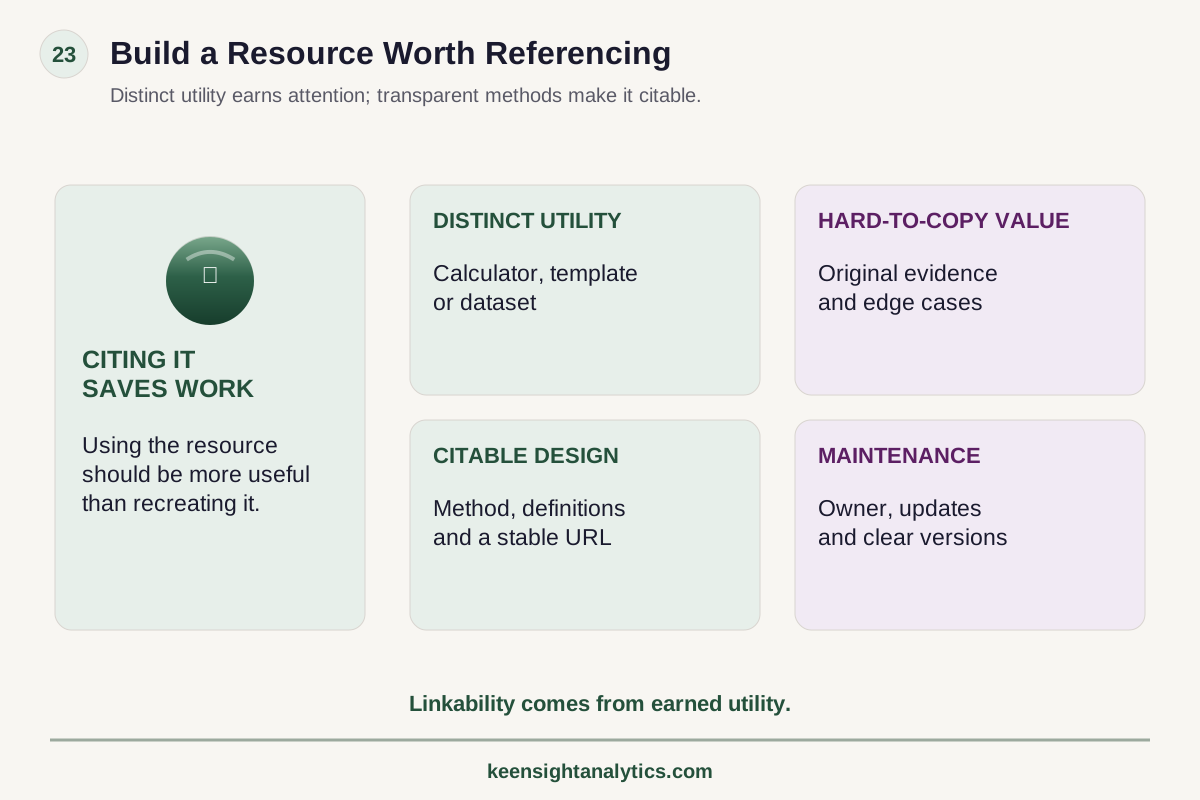
The framework
Build a resource worth referencing
Citing the resource should save work.
Distinct utility
A calculator, template or dataset.
Hard-to-copy value
Original evidence and edge cases.
Citable design
Method, definitions and a stable URL.
Maintenance
Owner, updates and clear versions.
Linkability comes from earned utility.
Authority next step
Before pursuing links, decide whether the market is missing evidence, a reusable resource, distribution, or all three.Most “linkable assets” are not actually worth linking to.
They may be attractive, long, or professionally designed, but if another publisher can reproduce the value in ten minutes, there is little reason to cite the original page.
A resource becomes referenceable when it contains something reusable, difficult to reconstruct, unusually clear, or continuously maintained. The best test is simple: would another writer, analyst, operator, or buyer save meaningful effort by citing this page instead of rebuilding the information themselves?
1. Utility comes before promotion
Start by identifying the job the resource performs.
A calculator helps someone estimate. A template helps someone execute. A dataset supplies evidence. A reference table saves lookup time. A visual framework clarifies a complex model. A checklist reduces omissions. A guide can become a reference when it resolves edge cases better than the alternatives.
If the asset has no clear operating job beyond “attract links,” the market will usually notice.
2. Choose a format that creates reusable value
Common referenceable formats include:
- original datasets and benchmarks;
- calculators and interactive estimators;
- decision trees and scoring frameworks;
- templates and worksheets;
- maintained standards or reference tables;
- technical documentation;
- methodology libraries;
- maps, visual models, and comparative matrices;
- comprehensive guides that handle difficult edge cases.
The format should match the problem. A calculator is not automatically better than a table. Interactivity should reduce work, not add novelty.
3. Add something competitors cannot copy cheaply
Generic checklists are rarely durable link assets because hundreds already exist.
Distinctive value may come from proprietary-but-publishable data, a transparent scoring methodology, a maintained collection process, expert review, software functionality, difficult synthesis, or a particularly strong visual explanation.
The objective is not to make the asset impossible to imitate. It is to create enough information gain that citing the original remains the easier and more responsible choice.
4. Make the methodology visible
If a tool produces a score, explain the inputs. If a benchmark publishes a number, explain the sample. If a checklist reflects expert judgment, explain the decision logic.
Opaque tools can still attract links, but transparent resources are easier for serious publishers to trust because they can assess what the output means.
5. Solve edge cases, not only the obvious case
A shallow resource explains the 80% case. A strong reference also helps when the situation is ambiguous.
For example, a page-pruning decision tree should distinguish pages with low traffic but strong backlinks, pages with strategic commercial value, duplicate pages with overlapping intent, expired inventory, thin location pages, and pages that should remain accessible but not indexed.
Edge cases create reference value because they are where experienced practitioners need help.
6. Make the resource easy to cite
Use a stable canonical URL, a specific title, visible publication or update date, author or organization attribution, clear section headings, and anchors that allow another writer to point to the exact material they need.
For data assets, include labels, units, definitions, source notes, and methodology. For tools, explain what the result represents and what it does not represent.
A writer should not have to reverse engineer the page before citing it.
7. Keep access friction proportional to the value exchange
Gating every useful asset behind a form can reduce referenceability.
If the primary objective is organic citations and discovery, publish enough of the useful material openly that another site can evaluate and reference it. A downloadable worksheet can still be offered, but the page should retain meaningful standalone value.
Lead generation and referenceability are different objectives; design the experience deliberately.
8. Maintenance is part of the product
Reference assets decay.
A tax table, platform comparison, API reference, local-search measurement guide, or AI-search source benchmark loses value when it becomes outdated. Assign an owner, review cadence, and update trigger.
Show the last meaningful update date. If methodology changes, version it. If a tool is retired, provide a useful successor or explanation rather than allowing a high-value URL to rot.
9. Design for both human use and search discovery
A resource can be excellent and still difficult to discover.
Give the page a clear search intent, crawlable text that explains the problem and the output, useful internal links, accessible labels, and a structure that does not hide all meaning inside JavaScript or an image.
The resource should work as a destination even for someone who lands directly from search.
10. Build distribution into the plan
Useful assets need discovery.
Identify the people who already publish, teach, advise, or operate around the problem. That might include trade associations, journalists, educators, consultants, analysts, newsletters, partner ecosystems, or professional communities.
Outreach should lead with utility: what the resource helps their audience do, what evidence it contains, and why it is different from existing references.
11. Earn the link instead of prescribing the anchor text
When an independent publisher chooses to reference the resource, let the citation be natural.
The objective is not to manufacture an exact-match anchor profile. It is to create legitimate editorial reasons for relevant sites to cite a useful page.
12. Measure the quality of references
Count links, but also evaluate who is linking and why.
Useful dimensions include:
- relevance of the referring site;
- whether the link is editorial and contextual;
- whether the resource receives repeated citations over time;
- whether references introduce qualified traffic;
- whether the asset is cited in AI-search answers or secondary publications;
- whether the resource strengthens visibility for the topic it supports.
13. Build assets that reinforce commercial expertise
A linkable asset should ideally sit inside the company’s real area of expertise.
A search consultancy might build a local visibility measurement worksheet, an AI-source monitoring framework, a migration risk checklist, or an SEO market-share benchmark. Those assets reinforce the same topics the company wants to be trusted for.
Random viral assets can earn attention while doing little to strengthen commercial authority.
14. A pre-production linkability test
Before investing in an asset, ask:
- Who specifically would use or cite this?
- What task does it make easier?
- What information or functionality is distinctive?
- Why would citing us be easier than recreating the answer?
- Can the method or output be trusted?
- Can the URL remain stable and maintained?
- Does it reinforce a subject the business genuinely owns?
- How will relevant publishers discover it?
If the team cannot answer those questions, the asset may need a stronger concept before production.
Linkability is earned utility
Links are not created by calling something an “ultimate guide.” They are created when the page becomes the most efficient, credible, or reusable reference for a real problem.
Build assets people need. Make them easy to verify and cite. Maintain them. Then distribute them to the audiences for whom the resource solves a genuine problem.
When this becomes authority work
Create something worth referencing before asking for references.
Use content or research production to create defensible information gain. Use Digital PR when the asset is already strong and legitimate distribution is the missing layer. Search Intelligence can help determine which competitive evidence gap is worth solving first.A quick linkability rubric
Score a resource from 1–5 on uniqueness, reusability, verification, maintenance, and citation convenience. A generic checklist may be reusable but low on uniqueness. A maintained calculator with transparent assumptions may score highly across all five.
The rubric does not predict links; it forces the team to build something another publisher would rationally prefer to reference instead of recreating.
Choose the asset format before choosing the promotion channel
A resource earns links because it gives another page a reason to reference it. If the audience problem, source gap, or competitive reference pattern is still unclear, use Search Intelligence before building the asset. If the winning format is a guide, template, benchmark page, or other static reference, Search Content Production can provide the finite production capacity.
If the utility depends on inputs, calculations, comparisons, scoring, or a repeatable decision, use Interactive Tools instead of forcing the idea into another article. Once a genuinely reference-worthy asset exists, Digital PR & Search Authority is the distribution path for relevant earned coverage and source relationships. Choose managed KeenSight Search when asset creation, internal authority flow, outreach, and measurement need recurring coordination. For an evidence-first asset model, see the original-research framework.
Decision checkpoint
Before asking for links, decide what would make the asset worth referencing.
Authority work is strongest when the underlying information is useful enough to deserve independent references before outreach begins.- 01Information gainDoes the asset contain original data, a maintained utility, a defensible framework, or a reference that is difficult to replace?
- 02Citation utilityCan a publisher easily understand what the asset proves, how it was produced, and which statement it can support?
- 03Distribution gapIs the missing layer the asset itself, legitimate outreach/distribution, or both?
A Link-Worthy Resource Usually Has
Distinctive utility
It saves time, supplies evidence, enables a decision, or performs a useful task.
Transparent logic
Readers can understand where the numbers, recommendations, or outputs come from.
Stable citation surface
The URL, title, sections, dates, and definitions make accurate referencing easy.
Ongoing maintenance
The resource stays reliable after launch instead of becoming a stale campaign artifact.
Authority building
Build something defensible, then distribute it legitimately.
Compare other ways to get help
Build assets that deserve references
KeenSight can connect content strategy, original research, interactive tools, and digital PR when authority is the real search constraint.
Keep Reading
Create Original Research That Earns Links
Design a study with transparent methodology and independent reference value.
Read article →Topical Authority vs Content Volume
Place linkable assets inside a coherent authority system.
Read article →Interactive Tools
See where calculators and reusable tools fit into growth architecture.
Explore service →Make it specific
See what the market looks like for your company.
The free visibility preview turns a broad search topic into a limited personalized baseline.