August 28, 2026 · 10 min read
How to Create Original Research That Earns Links and Search Visibility
The best research assets do not start with link building. They start with a question the market cannot answer well from existing sources.
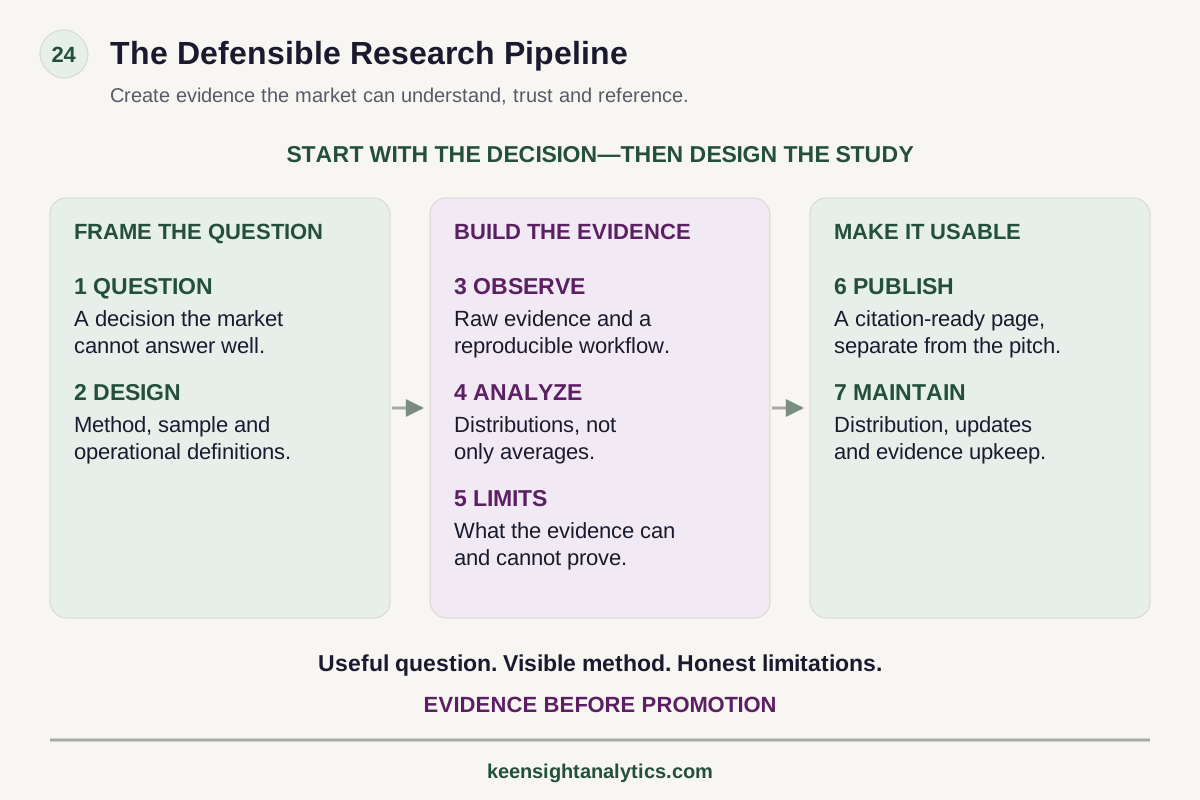
The framework
The defensible research pipeline
Start with the decision, then design the study.
Frame the question
Identify a decision the market cannot answer well; define method, sample and operations.
Build the evidence
Observe reproducibly, analyze distributions and state what the evidence cannot prove.
Make it usable
Publish a citation-ready page, separate from the pitch; maintain evidence and distribution.
Useful question. Visible method. Honest limitations.
Authority next step
Before pursuing links, decide whether the market is missing evidence, a reusable resource, distribution, or all three.Original research can be one of the strongest assets in an SEO program because it creates something other websites may have a legitimate reason to cite.
But “run a survey and publish an infographic” is not a research strategy. Weak studies are easy to ignore, difficult to trust, and often built around a headline the team wanted before the data existed.
A useful research program begins with a market uncertainty, uses a methodology readers can evaluate, publishes enough detail to be verifiable, and distributes the findings to people who already care about the question.
1. Start with the decision, not the dataset
Ask what buyers, practitioners, journalists, analysts, or operators repeatedly want to know but cannot answer easily.
Examples include:
- how search visibility varies across an industry;
- which sources appear most often in AI-search answers for a category;
- how local visibility changes across a metro area;
- what technical defects occur most often in a defined site population;
- how content portfolios differ between gaining and losing competitors;
- how search-market share is distributed across major brands.
The question should be useful even if the result is inconvenient to your commercial narrative.
2. Define what the research can and cannot prove
Before collecting data, define the unit of analysis, sample, time period, inclusion criteria, exclusions, variables, and intended inference.
A study of 50 SaaS websites cannot support a universal claim about all B2B companies. A one-week AI-search sample cannot establish a permanent ranking factor. A local grid in Phoenix does not prove what happens in every metro.
Scope creates credibility because readers can understand where the findings apply.
3. Choose a research format that fits the question
Different questions require different methods:
- observational benchmark: measure a defined market at a point in time;
- longitudinal study: repeat the same measurement to observe change;
- survey: collect self-reported attitudes or behavior;
- content analysis: classify pages, citations, sources, or features;
- technical crawl study: measure observable site implementation patterns;
- experiment: manipulate a controlled variable where the design can support causal inference.
Do not call an observational correlation an experiment simply because the result is interesting.
4. Design the sample before looking at results
Sampling after seeing the data invites bias.
Document how sites, prompts, queries, locations, respondents, or pages enter the study. If the sample is convenience-based, say so. If categories are weighted, explain the weights. If some records are excluded because of missing data, state the rule.
For recurring benchmarks, preserve a stable core sample and version changes deliberately.
5. Define terms operationally
Research becomes difficult to trust when key terms are vague.
If you measure an AI-search “recommendation,” define what counts as a recommendation versus a mention or citation. If you measure “technical health,” identify the checks and severity rules. If you measure “visibility,” explain the position weights or coverage method.
Operational definitions turn subjective interpretation into a repeatable method.
6. Preserve raw observations and a reproducible workflow
Keep the underlying data, collection date, query set, scripts or tools used, transformations, and calculation logic organized enough that the study can be audited internally.
You may not publish every raw record if privacy, licensing, or contractual constraints prevent it. But the public methodology should still describe the process well enough for a reader to understand how the headline findings were produced.
7. Report distributions, not only averages
Averages hide useful structure.
If the average site has 40% local-search coverage, show the distribution across markets. If a domain appears in 18% of AI-search source observations, show which prompt categories drive the appearance. If a technical problem affects 30% of sites, explain whether the issue is concentrated in one platform or site type.
Segmented findings are often more useful and more citeable than one headline statistic.
8. Publish limitations prominently
Limitations are not a weakness. Hidden limitations are.
Explain sample size, geographic constraints, tool limitations, missing data, prompt instability, observational design, seasonality, and any other factor that could affect interpretation.
This is especially important for AI-search studies because outputs can vary across time, interface, geography, and prompt wording.
9. Build the page for citation
A research page should make it easy for another writer to reference the exact claim they need.
Use a stable URL, clear study title, publication and update date, methodology section, labeled charts, accessible tables, definitions, segment breakdowns, and concise findings. Where appropriate, provide downloadable data or a methodology appendix.
A vague landing page that forces readers to submit a form before seeing the study is much less useful as a reference asset.
10. Separate the study from the sales pitch
The research can connect naturally to a relevant service, but the findings should stand on their own.
If every chart concludes that the reader must buy your service, independent publishers will be less comfortable citing the work. Keep methodology and findings neutral. Place the commercial next step after the evidence.
11. Distribution is part of the research plan
Useful research can still fail if nobody relevant sees it.
Before publishing, identify journalists, industry newsletters, associations, analysts, practitioner communities, partners, podcasts, and specialist publications that already discuss the question.
Outreach should explain why the finding matters to their audience—not why you want a backlink.
12. Turn one study into a maintained evidence system
The strongest research assets often become recurring benchmarks.
A quarterly AI-search source study, annual local visibility benchmark, or recurring technical-site census can build cumulative value because readers can compare periods instead of treating each study as a one-off campaign.
Version the methodology carefully so changes do not destroy comparability.
13. Connect research to the rest of the site
Research should feed the information architecture.
Link findings to relevant explainers where readers need definitions, to industry pages where the data has vertical implications, to service pages where the study identifies a real problem, and to related blog analysis that interprets the result.
Likewise, foundational content should link back to the research when it provides evidence for a claim.
14. Measure research success beyond backlinks
External backlinks are valuable, but they are only one outcome.
Also measure:
- relevant referring domains and citations;
- brand mentions;
- organic visibility for the research question;
- AI-search source inclusion where applicable;
- newsletter and media pickup;
- qualified traffic into related commercial pages;
- repeat use of the methodology or dataset by the market.
15. A defensible research workflow
- Choose an unanswered or poorly answered market question.
- Define the inference, sample, variables, and limitations before collection.
- Choose a method appropriate to the question.
- Collect and preserve raw observations consistently.
- Analyze distributions and meaningful segments.
- Write findings before writing promotional copy.
- Publish methodology, definitions, dates, and limitations.
- Make charts, tables, and references easy to cite.
- Distribute the study to audiences already interested in the question.
- Measure references, visibility, and commercial contribution separately.
Research earns links when the market needs the evidence
The strongest backlink strategy is not manufacturing reasons for people to link. It is producing something they would be worse off without citing.
Answer a real question, show your work, publish the limitations, and make the result easy to use. That creates a durable asset for search, AI discovery, digital PR, and buyer trust.
When this becomes authority work
Create something worth referencing before asking for references.
Use content or research production to create defensible information gain. Use Digital PR when the asset is already strong and legitimate distribution is the missing layer. Search Intelligence can help determine which competitive evidence gap is worth solving first.A research design in one paragraph
Example: study how often 200 mid-market B2B SaaS homepages clearly state pricing structure. Define the population and inclusion rules, freeze a collection date, define “pricing structure disclosed,” double-check a sample for consistency, segment by company size, publish the definitions and limitations, and release the findings with a reusable table.
The study earns credibility because another reader can understand exactly what was measured and what the result does not prove.
Separate research design, asset production, and earned distribution
Original research only becomes an authority asset when the question, method, dataset, findings, and limitations are credible enough for someone else to reference. Use Search Intelligence when the market question, source gap, or competitive opportunity still needs diagnosis. Use Search Content Production when the research plan is already defined and the remaining need is a report, data story, supporting pages, or editorial production.
Use Digital PR & Search Authority when the asset is ready and the constraint is earned distribution to journalists, publishers, associations, analysts, or other relevant sources. Use Interactive Tools when the dataset or methodology creates more value as a calculator, explorer, benchmark, or assessment than as a static report. Choose managed KeenSight Search when research, content, internal linking, authority acquisition, and measurement form a recurring program. Before selecting the format, apply the linkability test to the proposed asset.
Decision checkpoint
Before asking for links, decide what would make the asset worth referencing.
Authority work is strongest when the underlying information is useful enough to deserve independent references before outreach begins.- 01Information gainDoes the asset contain original data, a maintained utility, a defensible framework, or a reference that is difficult to replace?
- 02Citation utilityCan a publisher easily understand what the asset proves, how it was produced, and which statement it can support?
- 03Distribution gapIs the missing layer the asset itself, legitimate outreach/distribution, or both?
What Makes Research Referenceable
Useful question
Start with a market uncertainty that buyers, practitioners, or publishers genuinely need answered.
Transparent method
Define the sample, variables, collection process, exclusions, and limits before promoting the result.
Citable output
Stable URLs, clear findings, charts, tables, methodology, and definitions make references easier.
Relevant distribution
Put the work in front of journalists, associations, analysts, and practitioners who already care about the issue.
Authority building
Build something defensible, then distribute it legitimately.
Compare other ways to get help
Turn search-market questions into defensible evidence
KeenSight Search Intelligence can identify competitive and visibility questions worth investigating before a research asset is designed.
Keep Reading
What Makes a Resource Worth Linking To?
Design tools and references that are useful enough to earn independent citations.
Read article →Topical Authority vs Content Volume
Build authority through coherent evidence rather than publishing quantity.
Read article →Information Gain and Search
Understand why differentiated information strengthens a search corpus.
Read explainer →Make it specific
See what the market looks like for your company.
The free visibility preview turns a broad search topic into a limited personalized baseline.