August 28, 2026 · 11 min read
How to Build a Content Strategy Around Revenue Instead of Search Volume
Search volume is useful demand context. It should not decide the editorial roadmap by itself. Start with what the business sells, how buyers decide, and where search can influence that decision.
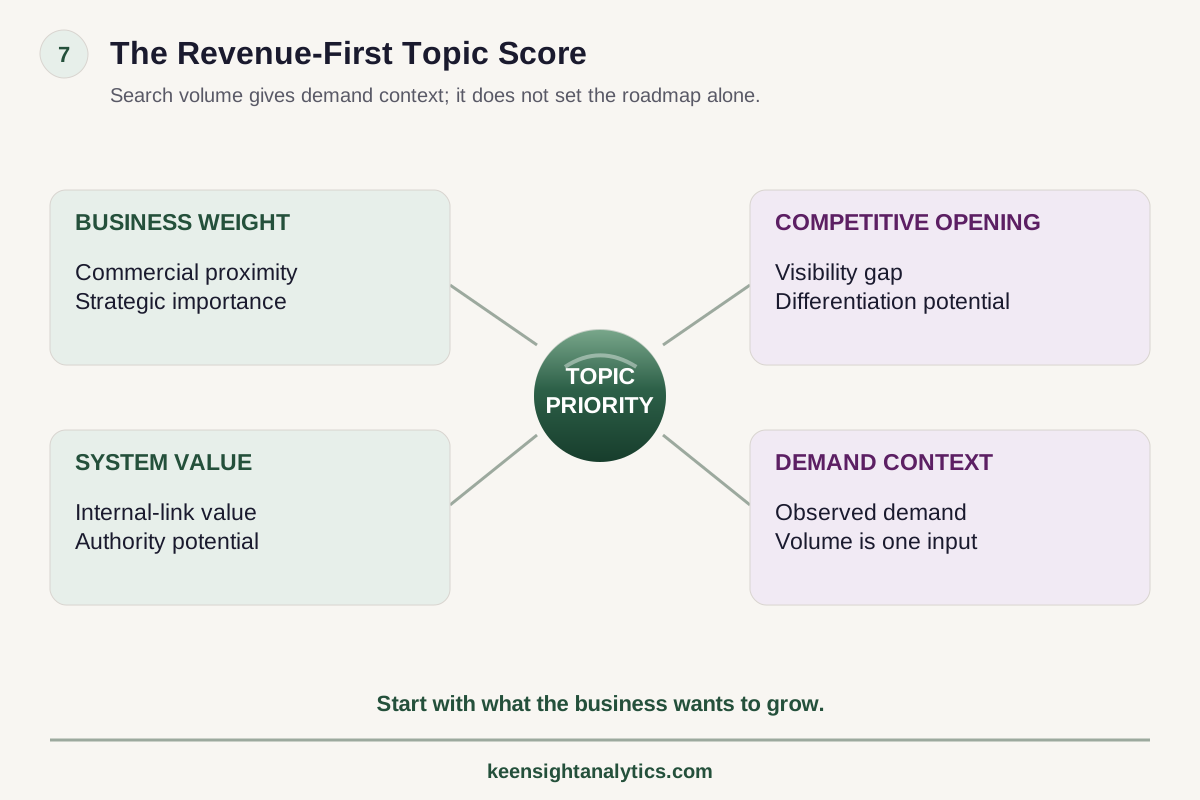
The framework
Revenue-first topic priorities
Search volume gives demand context; it does not set the roadmap alone.
Business weight
Commercial proximity and strategic importance.
Competitive opening
Visibility gap and differentiation potential.
System value
Internal-link value and authority potential.
Demand context
Observed demand; volume is one input.
Start with what the business wants to grow.
SEO next step
Apply the framework to a real commercial page set before adding more activity to the roadmap.High search volume is not a business model.
A topic can attract thousands of searches and contribute almost nothing to qualified discovery. Another can have modest measurable demand but sit directly inside a high-value buying decision. A content strategy built primarily from keyword volume often produces a large top-of-funnel library while the pages closest to revenue remain thin, disconnected, or invisible.
A revenue-first SEO content strategy reverses the order. It starts with the commercial system, identifies the search journeys that can influence it, then creates the smallest useful portfolio of pages needed to support those journeys.
1. Map what the business actually wants to grow
Start with services, products, categories, locations, industries, use cases, and customer segments. Identify which are strategically important and which have real delivery capacity.
For each one, document the commercial destination. Where should a buyer land when they are ready to evaluate the offer? If there is no strong service, product, category, or location page, creating more informational content can send authority and traffic into a weak conversion system.
This commercial-page map becomes the backbone of the editorial plan.
2. Define the decisions that happen before conversion
Buyers do not move through a neat awareness-consideration-decision funnel. They ask questions in different orders depending on what they already know.
Map the decisions and uncertainties that delay or enable the purchase:
- What is this category?
- Is this the right solution to the problem?
- How does it compare with an alternative?
- What does implementation require?
- What does it cost or how is it priced?
- Which risks or constraints matter?
- Does it work for my industry, location, scale, or technical environment?
- What evidence should I trust?
Those questions define useful content opportunities because they are connected to real commercial friction.
3. Distinguish commercial pages from supporting content
Not every query deserves a blog post. Sometimes the right answer is a stronger service page, product page, comparison page, location page, documentation page, pricing page, resource, or explainer.
Use blog content for analysis, frameworks, market interpretation, applied guidance, original viewpoints, and timely subjects that support the commercial architecture without duplicating it.
Use evergreen explainers when the job is to define a concept clearly. Use service pages when the job is to explain an offer. Use comparisons when the buyer needs tradeoffs. Use research when the market lacks evidence. Matching format to intent reduces cannibalization and makes internal linking more coherent.
4. Score topics by commercial proximity
Search volume can remain an input, but it should sit beside stronger business criteria.
A practical topic score can include:
- Commercial proximity: how directly does the topic connect to an active buying decision?
- Strategic importance: does the business want to grow this service, category, region, or segment?
- Visibility gap: is the company currently absent or weak where competitors are visible?
- Differentiation potential: can the company add useful information rather than paraphrasing consensus?
- Internal-link value: can the asset strengthen a meaningful commercial destination?
- Authority potential: could the asset reasonably earn references, citations, or recurring use?
- Demand: is there enough observed search or buyer interest to justify the work?
A low-volume topic can still rank highly if it is commercially close, strategically important, underserved, and uniquely answerable by the business.
5. Build topic clusters around decisions, not keyword variants
A weak cluster often consists of several articles targeting small wording variations: “SEO audit,” “SEO website audit,” “website SEO audit checklist,” and “how to audit SEO.” That creates portfolio clutter without necessarily adding information.
A stronger cluster assigns distinct jobs. One page may define what an audit is. Another may explain how to prioritize technical findings. Another may help a buyer distinguish a fixed technical project from managed search. Another may show a small-business audit framework. The pages overlap conceptually but serve different decisions.
Internal links should make those relationships obvious. Each supporting page should have a reason to point toward a commercial or deeper diagnostic destination.
6. Prioritize information competitors cannot easily reproduce
Content becomes strategically valuable when it contains information gain: original data, transparent methodologies, expert operating frameworks, real product documentation, calculators, maintained references, decision models, technical details, or a viewpoint grounded in actual delivery experience.
Generic “ten tips” content is easy to produce and therefore easy to replace. A useful decision framework can become a reference asset even if its raw search volume is lower.
Before approving a topic, ask: What will this page contain that is difficult to get from the first five existing results? If the answer is “the same information in our tone,” the topic may not deserve production yet.
7. Use search volume as context, not a command
Volume estimates are useful for understanding relative demand, seasonality, and topic scale. They are imperfect estimates, especially for long-tail, local, emerging, and B2B queries.
A revenue-first strategy uses volume to inform prioritization after the commercial role is clear. It does not choose a topic simply because a tool displays a large number.
This protects teams from chasing broad definitions that attract students, job seekers, peers, or low-fit audiences while ignoring narrow comparison or implementation questions asked by qualified buyers.
8. Build internal links as part of the brief
Internal linking should not be an afterthought added after publication. Every brief should identify where the page sits in the site architecture, which foundational pages it depends on, which commercial pages it supports, and which adjacent pages should link back.
Use descriptive anchors. Avoid forcing exact-match phrases mechanically. The goal is to help users move from problem understanding to decision support to a relevant commercial next step.
For example, a technical diagnosis article can link to a technical SEO explainer, a fixed Technical SEO Project, and a comparison with managed search—three different roles in the same decision journey.
9. Design the CTA around reader state
Not every reader is ready for a sales call. The CTA should match the uncertainty the article resolves.
An educational article may lead to a related explainer or a low-friction Free Visibility Preview. A reader actively diagnosing a complex market problem may be better suited to a one-time Search Intelligence Report. A reader who already understands the problem and needs execution may be ready for the relevant service.
Matching the CTA to reader state makes the content architecture more commercially coherent than attaching “Book a demo” to every page.
10. Measure content by portfolio role
Do not hold every page to the same KPI.
A commercial service page should be evaluated on visibility for high-intent demand and qualified conversions. An explainer may be valuable because it earns citations, supports internal links, and introduces a buyer to the category. A research asset may generate references and authority. A comparison page may assist late-stage decisions even at modest traffic volume.
Define the expected role before publication. Then measure topic-level visibility, landing-page performance, assisted conversion paths, internal-link flows, references, and competitive movement accordingly.
11. Connect visibility to revenue without inventing attribution
Revenue-first does not mean every article needs a perfectly attributed revenue number. Search journeys are often multi-touch, and privacy, consent, offline sales, and cross-device behavior limit attribution.
Use the best defensible evidence. That can include qualified form submissions, calls, demo requests, product revenue, assisted conversions, CRM source data, landing-page cohorts, or content paths that repeatedly precede conversion.
State the limitations. “This article influenced 18 opportunities” is different from “this article created $400,000 of revenue.” The reporting language should match the evidence.
12. Maintain content as an asset portfolio
A revenue-oriented strategy includes deletion, consolidation, and refresh decisions. If a page no longer has a distinct job, it should not remain simply because someone once published it.
Review whether pages still serve current demand, support active products, earn visibility, receive useful links, assist buyers, or strengthen the architecture. Consolidate overlapping assets. Refresh pages when the decision remains valid but the evidence or examples are stale. Retire pages tied to offers the business no longer sells.
A smaller, maintained portfolio can create more commercial value than a large archive that no one owns.
13. A practical revenue-first editorial workflow
- Map revenue priorities and canonical commercial destinations.
- Map buyer questions and decision friction around each destination.
- Audit current visibility and existing content before proposing new pages.
- Choose the right page type for each unmet need.
- Score opportunities by commercial proximity, strategic importance, gap, differentiation, internal-link value, authority potential, and demand.
- Define internal links, CTA path, and success criteria inside the brief.
- Publish only when the page adds a distinct role to the portfolio.
- Measure, refresh, consolidate, or retire based on the page’s assigned job.
14. What this changes about the editorial calendar
The result may be fewer blog posts. It may also mean more commercial-page work, comparisons, research, tools, local pages, documentation, and content refreshes.
That is not a failure of content marketing. It is a more complete view of search.
A company may discover that the next best “content” project is rewriting three service pages, building one comparison, consolidating six overlapping articles, and publishing one original study—not producing twelve new posts to satisfy a monthly quota.
Revenue-first content is a prioritization discipline
The point is not to eliminate informational content or ignore search volume. It is to put those inputs inside a commercial architecture.
Start with the business decision. Determine where search can influence it. Build the page that best resolves the buyer’s uncertainty. Connect it to the right commercial destination. Measure the role it was designed to play.
That creates a content system instead of a publishing calendar.
When this becomes recurring search work
Managed Search fits when several constraints have to move together.
Use managed KeenSight Search when technical foundations, commercial architecture, content, authority, and measurement require ongoing ownership. Use Search Intelligence first when the dominant constraint is still unclear.A simple revenue-first topic score
Score topics from 1–5 on commercial proximity, strategic importance, visibility gap, differentiation potential, internal-link value, and demand. A broad definition might score 2 + 2 + 1 + 1 + 2 + 5 = 13. A lower-volume vendor-comparison question might score 5 + 5 + 4 + 4 + 5 + 2 = 25.
The weights should match the business, but the exercise prevents search volume from silently becoming the strategy.
Separate content opportunity selection from content production
A revenue-first content strategy begins by deciding which market questions deserve investment. If category opportunity, competitive pressure or the commercial path is still unclear, use Search Intelligence before commissioning a large production backlog. A Free Visibility Preview can provide an initial outside-in signal when you first need to establish that a search visibility gap is worth investigating.
Once the roadmap, page roles and priorities are defined, Search Content Production is the finite execution path when capacity is the constraint. Use managed KeenSight Search when content priorities must continuously move with technical architecture, internal discovery, authority, competitors and measurement. The companion articles on when not to publish another post and page disposition help keep the roadmap from defaulting to net-new volume.
Decision checkpoint
Confirm whether the problem is a page decision, a diagnosis problem, or a recurring ownership problem.
Broad SEO symptoms often combine technical, content, architecture, authority, competitive, and measurement constraints.- 01Commercial roleCan you name the affected page set, buyer decision, or search segment rather than describing the problem only as “SEO”?
- 02Dominant constraintDo you have evidence for the primary failure layer and evidence that argues against the alternatives?
- 03Operating modelCan an internal team execute a prioritized plan, or do several constraints require recurring external ownership?
Revenue-First Topic Criteria
Commercial proximity
Prioritize questions and pages that influence real buying decisions, not merely large audiences.
Distinct page role
Choose service, product, comparison, explainer, research, resource, or blog formats according to the job.
Information gain
Favor original evidence, decision frameworks, technical detail, tools, and insights competitors cannot cheaply reproduce.
Measurable contribution
Define how the page should support visibility, commercial destinations, conversions, references, or competitive share.
SEO next steps
Move from broad search symptoms to the right level of ownership.
Compare other ways to get help
Build content around the search decisions that matter
KeenSight Search connects technical SEO, content, authority, and measurement when the constraints require recurring ownership. For a one-time diagnosis, start with Search Intelligence instead.
Keep Reading
Why Publishing More Can Be the Wrong Strategy
Diagnose whether new content is actually the next constraint to solve.
Read article →SEO Prioritization Across Failure Layers
Sequence content work against technical, authority, and competitive constraints.
Read explainer →Search Content Production
See where content production fits after strategy, page role, and prioritization are clear.
Explore service →Make it specific
See what the market looks like for your company.
The free visibility preview turns a broad search topic into a limited personalized baseline.