August 28, 2026 · 10 min read
How to Refresh Existing Content Without Destroying Rankings
A refresh should improve the page’s ability to do its existing job unless the evidence says the job itself needs to change.
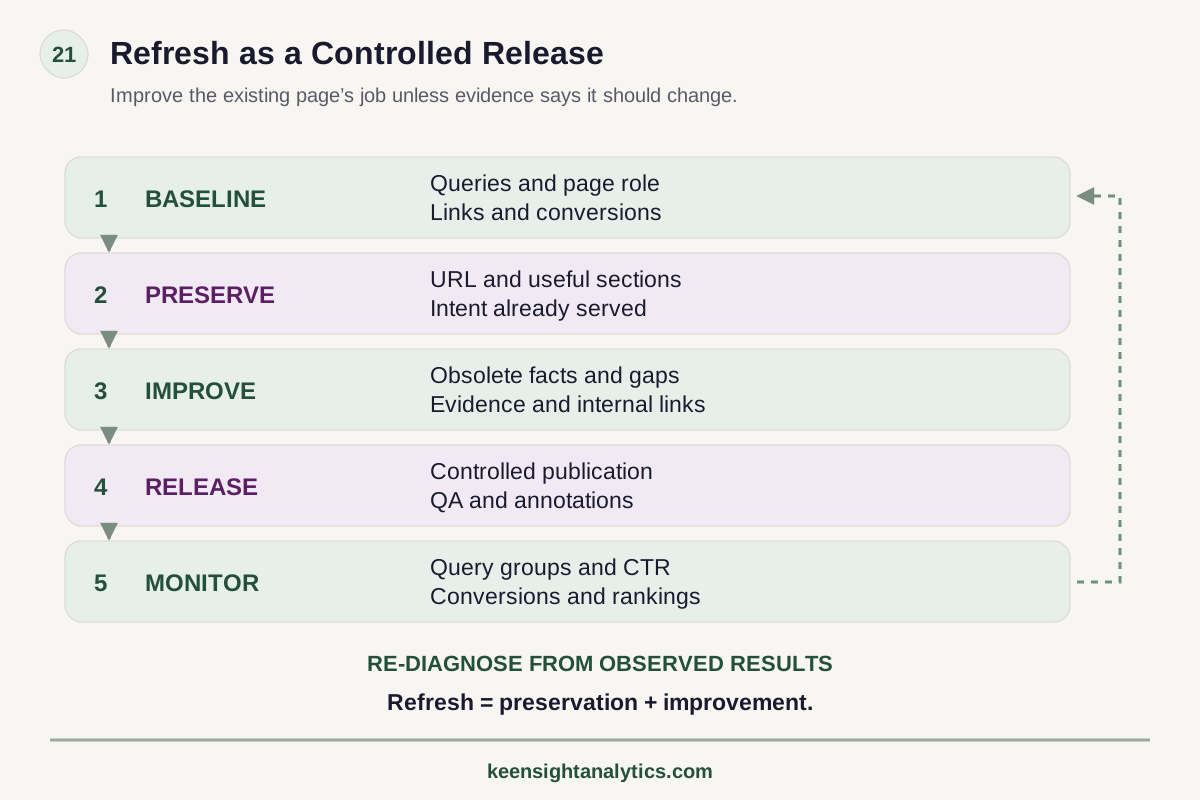
The framework
Refresh as a controlled release
Improve the page's existing job unless evidence says it should change.
Baseline
Queries, page role, links and conversions.
Preserve
URL, useful sections and intent already served.
Improve
Obsolete facts, gaps, evidence and internal links.
Release
Controlled publication, QA and annotation.
Monitor
Query groups, CTR, conversions and rankings.
Re-diagnose from observed results.
SEO next step
Apply the framework to a real commercial page set before adding more activity to the roadmap.Content refreshes are often treated as low-risk SEO work. They are not.
A page that already ranks has accumulated a history: query associations, links, internal references, user behavior, commercial role, and sometimes years of search equity. Rewriting it from scratch because the copy feels old can remove the exact information that made the page useful.
The safest refresh process begins by understanding what the page does today, then changing only what needs to change.
1. Diagnose why the page needs a refresh
Different problems require different interventions.
A page may be:
- factually outdated;
- losing visibility to stronger competitors;
- misaligned with current search intent;
- thin relative to the decision it serves;
- cannibalized by another page;
- commercially outdated because the offer changed;
- technically weakened by template or internal-link changes;
- performing well and simply due for factual maintenance.
Do not use the same “rewrite everything” solution for every case.
2. Capture the pre-change baseline
Before editing, record the current state.
Useful evidence includes:
- queries and impressions;
- clicks and landing-page traffic;
- conversions or assisted conversion paths;
- ranking and visibility by relevant query group;
- backlinks and important referring pages;
- internal links into and out of the page;
- indexation and canonical state;
- title, headings, structured data, and current URL;
- the dominant search-result intent around important queries.
Without a baseline, post-refresh evaluation becomes guesswork.
3. Identify what already works
Look for sections associated with important queries, snippets, links, or conversion behavior. This does not prove that one paragraph caused the result, but it highlights material you should not remove casually.
Preserve useful definitions, examples, tables, and explanations unless the information is wrong or the page’s intent needs to change.
4. Update obsolete facts first
Factual maintenance is usually the lowest-risk refresh.
Update statistics, product names, screenshots, legal or regulatory references, platform behavior, dates, pricing language, process descriptions, broken links, and discontinued features.
When old material is retained for historical context, label it clearly rather than allowing readers to mistake it for current guidance.
5. Re-evaluate search intent
Search results can change because the market changes.
Review what kinds of pages now rank for the target query. Is the result set more commercial, local, visual, comparative, transactional, or explanatory than it was previously?
If intent has changed materially, decide whether the existing page should evolve or whether a different page type should own the query. Do not force a blog post to become a service page when the architecture would be clearer with two distinct assets.
6. Fill missing decision information
Competitors may have improved because they answer questions the page does not.
Compare the content against the reader’s current decision: definitions, constraints, alternatives, implementation details, examples, risks, costs, methodology, evidence, and next steps.
Add material because it resolves a real gap, not to reach a target word count.
7. Improve evidence quality
Replace unsupported statements with sourced facts, transparent frameworks, original data, expert analysis, or clearly labeled examples.
Where the page touches health, legal, financial, or other consequential topics, make authorship, review, scope, and limitations especially clear.
8. Protect the URL unless there is a compelling reason to change it
Changing a successful URL adds migration risk with little upside in many cases.
Keep the existing URL when the page’s core intent remains the same. If the URL truly must change, use a direct permanent redirect, update internal links, update the sitemap and canonical, and monitor the transition.
9. Change titles and headings deliberately
Titles and headings can improve clarity, but aggressive rewrites can also shift the page away from queries it already serves.
Preserve the core topic when it remains valid. Add specificity or current framing without chasing every keyword variation.
10. Audit internal links during the refresh
A refresh is a good time to strengthen the page’s position in the site architecture.
Add links to relevant new commercial pages, explainers, research, or industry content. Remove links to retired material. Then identify strong related pages that should link back to the refreshed asset.
Internal links should reinforce the page’s actual role, not merely distribute anchor text.
11. Check whether consolidation is better than a refresh
If two or more pages now answer the same intent, refreshing all of them may preserve cannibalization.
Compare query overlap, backlinks, traffic, conversions, and content quality. Choose a canonical destination, move useful unique material into it, redirect redundant URLs where appropriate, and update internal links.
Consolidation should produce one stronger page, not simply delete inventory.
12. Preserve genuinely useful backlinks
If the page has external links, understand what those referring pages are citing.
A university may link to a table, a trade publication may reference a statistic, or a blog may cite a framework. Removing that material without a replacement can reduce the resource’s reference value.
Keep or improve the cited element where it remains accurate.
13. Treat the refresh as a controlled release
Document the publication date, what changed, and why. For important pages, keep a copy of the prior version.
QA titles, headings, links, canonicals, robots directives, structured data, status codes, layout, mobile rendering, forms, and analytics before release.
14. Monitor the page after publication
Track query mix, impressions, clicks, competitive visibility, conversions, indexation, and backlinks after the change.
A refresh can initially change query distribution. Evaluate the commercially important groups rather than reacting to every daily fluctuation.
If performance declines materially, compare the new page against the baseline and identify what changed. Do not immediately perform a second full rewrite.
15. Use a refresh decision matrix
- Accurate + performing: maintain lightly.
- Outdated + performing: preserve intent and update facts/evidence.
- Relevant + declining: diagnose competitive, content, technical, and SERP changes before rewriting.
- Overlapping: evaluate consolidation.
- No longer strategically useful: consider retirement or redirection based on links and intent.
- Wrong page type: create the correct destination and migrate carefully.
Refreshing is preservation plus improvement
The objective is not to make an old page look newly written. It is to preserve what still creates value, correct what has aged, and strengthen the page against the current search and buyer environment.
Capture the baseline. Understand the page’s job. Change deliberately. Measure the intervention.
When this becomes recurring search work
Managed Search fits when several constraints have to move together.
Use managed KeenSight Search when technical foundations, commercial architecture, content, authority, and measurement require ongoing ownership. Use Search Intelligence first when the dominant constraint is still unclear.Tier the refresh by risk
Low risk: factual updates, broken links, examples, citations, and small clarity edits. Medium risk: meaningful section restructuring, expanded query coverage, or title/H1 changes. High risk: changing primary intent, consolidating pages, altering the URL, removing large ranking sections, or shifting the commercial role.
Capture a change log and monitor high-risk refreshes as interventions rather than routine copy edits.
Match the refresh risk to diagnosis, production, or recurring ownership
A refresh should not be scoped the same way when the change is a title adjustment, a major rewrite, an intent shift, or a structural template change. If the page’s current value, intent fit, or failure mechanism is uncertain, use Search Intelligence before changing high-value URLs. If the refresh backlog is already defined and the bottleneck is execution capacity, use Search Content Production.
When the refresh depends on bounded canonical, rendering, redirect, or template remediation, a Fixed Technical SEO Project may be the right implementation shape. Choose managed KeenSight Search when refresh decisions must recur alongside technical, internal-linking, authority and competitive priorities. Pair this with the delete/consolidate/improve framework before deciding that every declining page should simply be rewritten.
Preserve earned authority before a high-value page is rewritten
Before a major refresh, inventory the sections other pages reference, the external links and citations the URL has earned, and the claims or data that make the page useful. If the page still has reference value, preserve or deliberately replace those elements rather than treating the refresh as a blank-slate rewrite. Use Search Content Production when the refresh backlog is already approved and the remaining work is finite editorial execution.
If the refreshed asset introduces new research, data, or genuinely reference-worthy material, Digital PR & Search Authority can support a relaunch and earned distribution; it should not be used to manufacture links to a routine rewrite. If a static page would create more utility as a calculator or assessment, consider Interactive Tools. The companion page-disposition framework helps protect authority when the right answer is consolidation rather than refresh.
Decision checkpoint
Confirm whether the problem is a page decision, a diagnosis problem, or a recurring ownership problem.
Broad SEO symptoms often combine technical, content, architecture, authority, competitive, and measurement constraints.- 01Commercial roleCan you name the affected page set, buyer decision, or search segment rather than describing the problem only as “SEO”?
- 02Dominant constraintDo you have evidence for the primary failure layer and evidence that argues against the alternatives?
- 03Operating modelCan an internal team execute a prioritized plan, or do several constraints require recurring external ownership?
A Safer Content Refresh
Baseline first
Capture queries, traffic, conversions, links, internal architecture, and intent before editing.
Preserve what works
Do not remove useful sections, URLs, or cited resources simply because they are old.
Diagnose overlap
Consolidation can be better than refreshing several pages that serve the same intent.
Measure the release
Annotate the change and monitor query mix, visibility, conversions, links, and indexation afterward.
SEO next steps
Move from broad search symptoms to the right level of ownership.
Compare other ways to get help
Refresh the pages that still have a job
KeenSight can help distinguish content decay from technical failure, competitive displacement, or portfolio overlap before major rewrites begin.
Keep Reading
Delete, Consolidate, or Improve?
Choose the right intervention for pages that are not performing.
Read article →Content Decay vs Competitive Displacement
Separate page deterioration from a market that simply became stronger.
Read explainer →Build Content Around Revenue
Maintain a portfolio based on commercial role rather than publishing volume.
Read article →Make it specific
See what the market looks like for your company.
The free visibility preview turns a broad search topic into a limited personalized baseline.