August 28, 2026 · 10 min read
When Should You Delete, Consolidate, or Improve an Underperforming Page?
Low traffic is not a deletion criterion. Decide based on the page’s job, search demand, overlap, links, commercial value, and whether another destination serves the intent better.
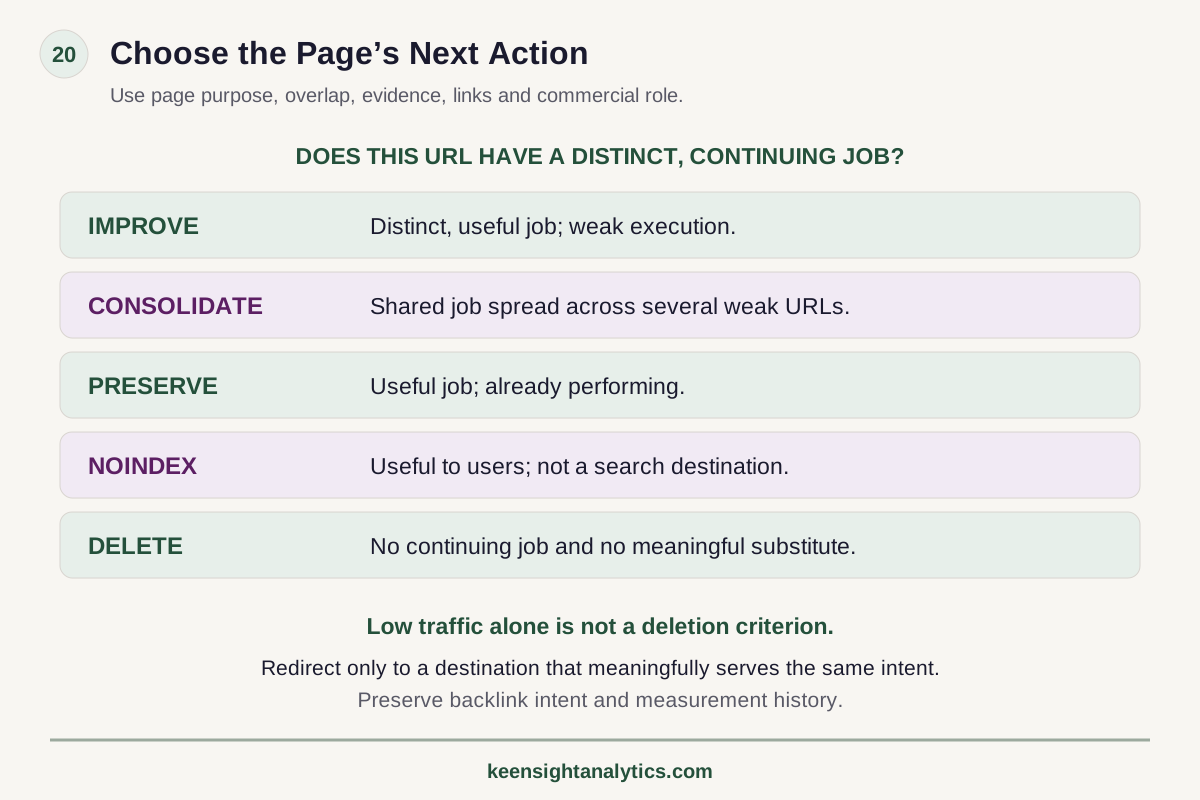
The framework
Choose the page's next action
Does this URL have a distinct, continuing job?
Improve
Distinct useful job, weak execution.
Consolidate
A shared job spread across several weak URLs.
Preserve
Useful and already performing.
Noindex
Useful to users, but not a search destination.
Delete
No continuing job and no meaningful substitute.
Low traffic alone is not a deletion criterion. Preserve backlink intent and measurement history.
SEO next step
Apply the framework to a real commercial page set before adding more activity to the roadmap.Content pruning becomes dangerous when teams use one rule: “delete anything below X visits.”
A page can receive little traffic and still be strategically important. It may support a high-value service, answer a niche buyer question, hold strong backlinks, act as a documentation reference, or convert a small but valuable audience. Another page can attract thousands of visits and still deserve retirement because it is outdated, irrelevant, or disconnected from the business.
The right question is not whether the page is “underperforming.” It is what job the page is supposed to do, whether that job still matters, and whether this URL is still the best place to do it.
1. Define the page’s intended job
Classify the page before judging it.
Common roles include:
- commercial service or product destination;
- location page;
- foundational explainer;
- comparison;
- supporting editorial content;
- research or linkable resource;
- documentation;
- campaign or temporary landing page;
- archive or historical reference.
Different roles require different performance expectations.
2. Do not start with traffic alone
Traffic should be one input, not the verdict.
Review:
- impressions and queries;
- conversions or assisted journeys;
- commercial importance;
- external backlinks;
- internal links;
- AI-search source or citation value where relevant;
- search intent;
- content quality and freshness;
- whether another page serves the same job.
3. Ask whether the page targets distinct demand
A low-volume page may deserve to remain if it serves a unique service, product, location, integration, use case, legal jurisdiction, technical question, or other narrow intent.
Low demand can still be commercially meaningful. This is especially common in B2B, specialist services, expensive products, and local markets.
4. Measure overlap with other pages
Compare query sets, titles, headings, content, internal links, and ranking URLs.
If several pages repeatedly appear for the same queries and answer the same user need, the portfolio may be fragmented.
But do not consolidate simply because two pages share keywords. A foundational explainer and a commercial service page can overlap semantically while serving different decisions.
5. Improve when the job is valid but execution is weak
Improvement is appropriate when:
- the page serves distinct and valuable intent;
- the topic remains strategically relevant;
- the page is thin, outdated, unclear, poorly structured, or weakly linked;
- competitors provide materially better decision information;
- technical defects suppress an otherwise useful page.
Capture a baseline before rewriting, then fix the actual gap.
6. Consolidate when several pages perform one job badly
Consolidation is appropriate when two or more URLs have substantial intent overlap and none needs to remain independently.
Choose the strongest destination based on relevance, links, history, URL quality, commercial role, and current performance. Move useful unique material into that page, then redirect redundant URLs directly to it.
Update internal links, canonicals, sitemap entries, and navigation so the site expresses one clear destination.
7. Preserve backlink intent during consolidation
Before redirecting a page with external links, inspect what other sites are citing.
If the old page contained a dataset, quote, chart, or framework, preserve or improve that material on the destination where possible. A redirect to a vaguely related homepage may discard the reason the link existed.
8. Delete when the page has no continuing job
Deletion is appropriate when the content is obsolete, has no meaningful backlinks or demand, does not support a current product or user need, and has no relevant successor.
Examples may include expired campaign pages, obsolete announcements, unsupported product pages with no replacement, generated thin pages, or content tied to a business line that no longer exists.
Use the correct status behavior rather than redirecting everything to the homepage.
9. Redirect only when intent maps meaningfully
A redirect should take users and search systems to a destination that meaningfully satisfies the original intent.
If an old product has a direct successor, a redirect may be useful. If a company closes one office but another nearby office genuinely serves the same market, a redirect may be appropriate after considering local context. If an obsolete article has no equivalent, a 404 or 410 can be cleaner than an irrelevant redirect.
10. Use noindex when the page should remain accessible but not search-visible
Some pages still serve users but are not intended as search destinations: internal utility pages, filtered views, certain archives, thin transactional states, or legacy content kept for reference.
In those cases, noindex may be more appropriate than deletion. Make the decision based on the page’s user role and technical architecture.
11. Treat expired products and inventory separately
Ecommerce and marketplace pages often have ongoing value after inventory changes.
If a product will return, keep the page. If it is permanently unavailable but still attracts demand or links, offer a clear unavailable state and relevant alternatives. If there is a true successor, consider redirecting. If the page has no continuing value, retire it cleanly.
12. Be careful with local and industry pages
Location and industry pages should not be pruned simply because traffic is low if they represent strategically important real markets and contain useful distinct information.
However, templated city or industry pages with no unique evidence often deserve consolidation or retirement rather than endless rewrites.
13. Preserve measurement history
Before large-scale pruning, record the current URL inventory, traffic, queries, links, conversions, internal links, and indexation.
After the change, track whether visibility and conversions consolidate into stronger pages or whether important demand disappeared.
Content pruning is an intervention and should be measurable.
14. Avoid “SEO pruning” as a substitute for diagnosis
Deleting pages does not automatically improve the rest of the site.
If organic growth is stalled because service pages are weak, competitors gained authority, the site has technical defects, or market demand shifted, pruning old blogs may do little.
Use pruning when portfolio quality and overlap are the actual constraints.
15. A practical decision tree
Does the page have a distinct, continuing job?
- If yes and it performs adequately: retain and maintain.
- If yes but it is weak or outdated: improve.
- If yes but another page performs the same job better: evaluate consolidation.
Does the page have no continuing standalone job?
- If another destination satisfies the same intent: consolidate and redirect.
- If it must remain available for users but not search: consider noindex.
- If no relevant successor exists and there is no continuing value: retire with an appropriate not-found/gone state.
Does the page have valuable backlinks or conversions?
- Preserve the cited or converting function before changing the URL.
16. Prioritize pruning by portfolio impact
Start with large sets of overlapping, generated, obsolete, or clearly low-value pages where the decision rule can be applied consistently.
Handle high-value service pages, linked resources, legal/financial content, major category pages, and strong historical performers individually.
The goal is not a smaller website
The goal is a clearer website where every indexable page has a distinct reason to exist.
Delete when the job is gone. Consolidate when several pages share one job. Improve when the job matters but the execution is weak. Retain when the page is already doing useful work.
When this becomes recurring search work
Managed Search fits when several constraints have to move together.
Use managed KeenSight Search when technical foundations, commercial architecture, content, authority, and measurement require ongoing ownership. Use Search Intelligence first when the dominant constraint is still unclear.Map the editorial decision to the URL outcome
Improve: keep the URL and strengthen the existing role. Consolidate: merge useful material into the strongest destination and redirect the redundant URL when there is a clear successor. Noindex: reserve for pages users still need but search should not treat as destinations. Retire: use 404/410 when content is gone and there is no honest replacement.
Before changing anything, capture inbound links, internal links, traffic, conversions, and canonical state; then monitor the destination.
Turn page disposition into an implementation decision, not a cleanup ritual
If the team cannot yet tell whether a weak page should be improved, consolidated, noindexed, redirected, or removed, use Search Intelligence when commercial intent, competitor coverage, backlinks, conversions, or overlap need deeper diagnosis. A Free Visibility Preview can provide a limited market signal, but it cannot decide URL disposition safely by itself.
Use Search Content Production when the approved action is a finite rewrite or consolidation backlog. Use a Fixed Technical SEO Project when the disposition program is primarily a bounded redirect, canonical, template, or indexation implementation. Choose managed KeenSight Search when pruning and improvement are recurring portfolio decisions. The companion refresh-risk framework helps determine how much preservation and monitoring each change requires.
Treat existing links and citations as assets in the disposition decision
Before deleting or consolidating a URL, identify the backlinks, citations, internal links, branded references, conversions, and unique intent coverage attached to it. A weak traffic trend does not mean those assets have no value. When consolidation is approved, Search Content Production can support a finite rewrite or merge while preserving the strongest useful material and redirect targets.
Digital PR & Search Authority is not a substitute for cleanup, but it becomes relevant when the surviving destination contains a stronger research or reference asset worth distributing. Choose managed KeenSight Search when page disposition is a recurring portfolio decision that has to stay coordinated with internal linking, authority, technical implementation, and measurement. Use the refresh-risk framework when the URL should remain but needs material improvement.
Decision checkpoint
Confirm whether the problem is a page decision, a diagnosis problem, or a recurring ownership problem.
Broad SEO symptoms often combine technical, content, architecture, authority, competitive, and measurement constraints.- 01Commercial roleCan you name the affected page set, buyer decision, or search segment rather than describing the problem only as “SEO”?
- 02Dominant constraintDo you have evidence for the primary failure layer and evidence that argues against the alternatives?
- 03Operating modelCan an internal team execute a prioritized plan, or do several constraints require recurring external ownership?
Choose the Intervention by Page Role
Improve
Use when the intent and business role are valid but content, evidence, architecture, or technical execution is weak.
Consolidate
Use when several pages serve substantially the same intent and one stronger destination should own the job.
Noindex
Use selectively when the page must remain accessible but is not intended to be a search destination.
Retire
Remove pages whose job is gone and that have no meaningful successor, links, demand, or user value.
SEO next steps
Move from broad search symptoms to the right level of ownership.
Compare other ways to get help
Diagnose the portfolio before deleting pages
Search Intelligence can separate content overlap and decay from technical, authority, competitive, and market-demand problems before a large pruning program begins.
Keep Reading
Refresh Content Without Destroying Rankings
Preserve useful search equity while improving pages whose role remains valid.
Read article →Why Publishing More Can Be Wrong
Fix portfolio quality and architecture before adding more content.
Read article →Canonicalization and Duplicate Content
Review the technical layer behind duplicate and consolidated pages.
Read explainer →Make it specific
See what the market looks like for your company.
The free visibility preview turns a broad search topic into a limited personalized baseline.