August 28, 2026 · 10 min read
How AI Search Changes SEO Content Strategy for B2B Companies
AI search compresses parts of the research journey, which makes shallow keyword content less useful. B2B companies need a stronger decision-information system across commercial pages, evidence, comparisons, documentation, and original analysis.
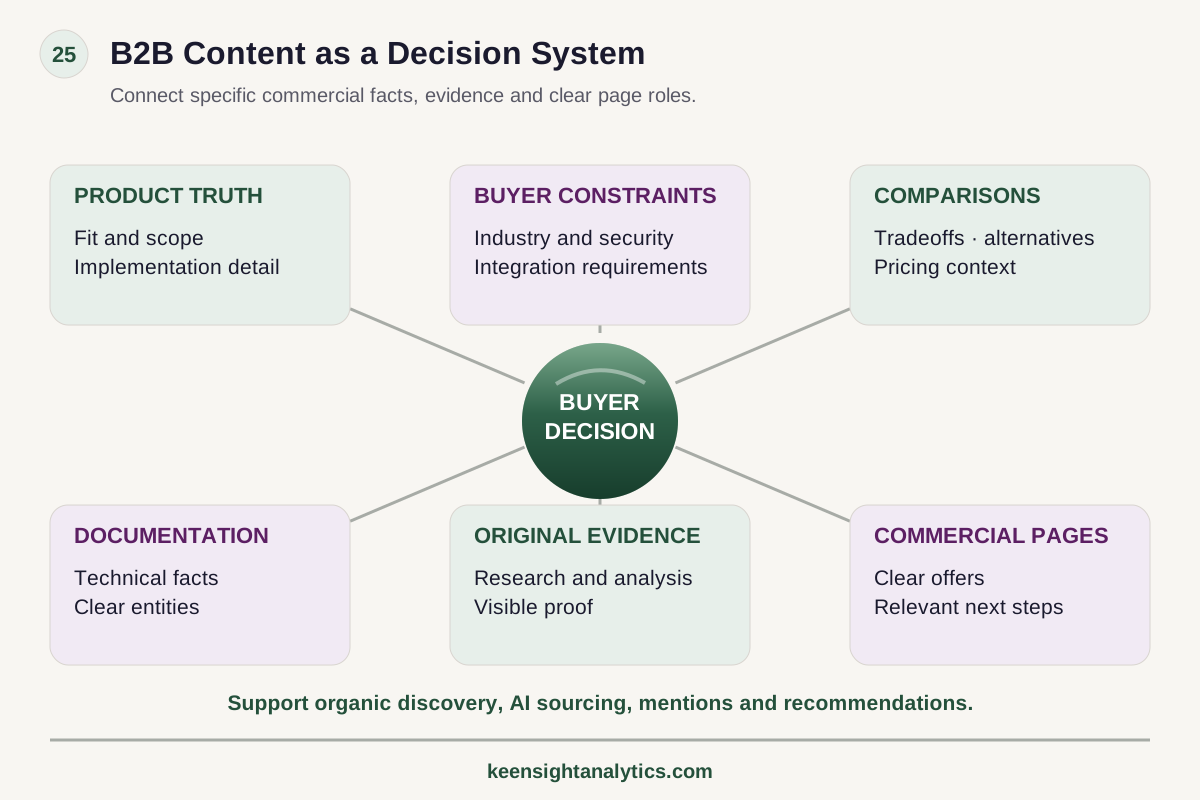
The framework
B2B content as a decision system
Connect commercial facts, evidence and clear page roles.
Product truth
Fit, scope and implementation detail.
Buyer constraints
Industry, security and integration requirements.
Comparisons
Tradeoffs, alternatives and pricing context.
Documentation
Technical facts and clear entities.
Original evidence
Research, analysis and visible proof.
Commercial pages
Clear offers and relevant next steps.
Support organic discovery, AI sourcing, mentions and recommendations.
B2B search next step
Map the buying decisions, commercial evidence, and source ecosystem before adding another content cadence.B2B content strategies built around “publish four blog posts a month” were already fragile. AI search makes the weakness easier to see.
A buyer can now ask a system to compare categories, summarize implementation tradeoffs, identify vendors with a particular integration, explain security considerations, or suggest options for a regulated environment. The buyer may receive a synthesized answer before visiting any website.
The response should not be to create “AI-optimized” articles at scale. It should be to improve the quality, specificity, and connectivity of the information your company makes available.
1. Start with the questions that require synthesis
AI interfaces are especially useful when a buyer asks a multi-constraint question.
Examples include:
- Which vendors support our existing stack?
- Which approach fits a regulated team?
- How does managed service compare with software-only execution?
- What are the implementation requirements?
- Which alternatives fit a smaller company?
- What evidence should procurement ask for?
These questions are difficult to serve with generic top-of-funnel articles because the buyer needs tradeoffs, constraints, and commercial facts.
2. Strengthen first-party commercial evidence
AI-search visibility is not primarily a blog problem.
Product, service, pricing, integration, security, methodology, industry, use-case, documentation, and comparison pages often contain the most important first-party evidence about what a company actually does.
Make those pages explicit about scope, customer fit, capabilities, limitations, delivery model, integrations, commercial structure, and next steps.
3. Replace vague positioning with retrievable facts
“Innovative end-to-end solution” is difficult for a buyer or retrieval system to compare.
Specific statements are more useful: supported integrations, implementation model, service boundaries, target customer size, geographic availability, security standards, data handling, pricing units, support model, and operational prerequisites.
Do not invent precision. Publish the facts the company can substantiate.
4. Build content around buyer constraints
Traditional keyword research often starts with topic volume. B2B AI-search strategy should also map the constraints buyers combine in real evaluation.
Those constraints may include:
- industry or regulatory environment;
- company size;
- technical stack;
- deployment model;
- security requirements;
- budget or pricing structure;
- implementation resources;
- geography;
- required integrations;
- internal ownership model.
Content becomes more useful when it explains how those constraints change the decision.
5. Use industry pages only where the context changes
An industry page should explain differences in workflow, terminology, compliance, buying process, evidence, integrations, or implementation.
Do not create dozens of “AI SEO for [industry]” pages with the same copy. AI retrieval does not create a strategic reason for thin vertical templates.
6. Build comparison content with real tradeoffs
Buyers ask AI systems comparative questions directly.
Create comparison pages that explain when each option fits, what tradeoffs exist, how implementation differs, what cost structures look like, and which constraints should drive the decision.
Transparent comparisons are more useful than pages that declare your company superior on every dimension.
7. Publish original information
Generic consensus content is easy to synthesize and easy to replace.
Original research, benchmarks, technical documentation, product data, methodology, tools, calculators, expert operating frameworks, and maintained reference resources create information competitors cannot reproduce cheaply.
Those assets can support organic rankings, external links, and AI-search source inclusion simultaneously.
8. Make definitions concise but keep the supporting depth
A page should make its central answer easy to identify. That does not mean every article should become a collection of two-sentence fragments.
Use a clear opening answer, then provide evidence, boundaries, examples, alternatives, and decision context. Extractability and depth can coexist.
9. Strengthen entity relationships
Make it clear how the organization, products, services, authors, integrations, locations, and methodologies relate to one another.
Use consistent naming, visible organization information, author biographies, internal links, and appropriate structured data. Structured data should reinforce visible facts rather than create a parallel version of the company.
10. Connect documentation to marketing architecture
Technical documentation often contains the strongest evidence about how a B2B product actually works.
Do not isolate docs from the commercial site. Link product pages to implementation and API documentation, and let docs link back to the relevant product context where useful.
Technical evaluators and economic buyers should be able to navigate the same information system at different levels of depth.
11. Build a commercial prompt set
To measure AI-search visibility, create prompts based on actual buyer decisions.
Include:
- category discovery;
- best/vendor recommendation queries;
- problem-led queries;
- comparison and alternative queries;
- integration requirements;
- industry constraints;
- implementation questions;
- buyer-size or budget constraints.
Keep a stable core set for trend measurement.
12. Measure sources, mentions, and recommendations separately
A brand can be used as a cited source without being recommended. It can be mentioned without a citation. It can be recommended based on third-party material rather than its own site.
Track these states separately:
- source inclusion;
- brand mention;
- recommendation;
- accuracy of description;
- which domains repeatedly shape the answer.
13. Study the source ecosystem
Where AI interfaces expose sources, classify them.
Do answers rely on vendor websites, review platforms, communities, analyst pages, documentation, trade publications, associations, original research, or another source type?
The pattern can reveal whether the visibility gap is mainly first-party information, third-party authority, documentation, entity clarity, or simply insufficient measurement.
14. Do not confuse crawler access with recommendation eligibility
Technical accessibility matters. Important content should be crawlable, render reliably, use coherent canonicals, and be connected through internal links.
But technical eligibility does not guarantee source inclusion or recommendation. Content quality, relevance, evidence, market authority, and query context still matter.
Do not sell a robots-file change as an AI-ranking strategy.
15. Avoid speculative “GEO factors”
AI-search systems are proprietary and change quickly. Be cautious with claims that a particular paragraph length, markup pattern, or phrase placement universally causes citation.
Prefer observable practices: clear answers, accessible pages, source-worthy evidence, accurate entities, strong commercial information, legitimate third-party references, and stable measurement.
16. Design CTAs for the research state
A buyer arriving from AI search may land deeper in the evaluation process than a traditional blog reader.
Give high-information pages useful next steps: product details, technical documentation, comparison pages, pricing, a low-friction visibility preview, a diagnostic report, or the relevant service.
Do not attach the same “book a demo” CTA to every educational page regardless of intent.
17. Measure organic and AI search together—but not as one metric
Track traditional search visibility, landing-page traffic, conversions, competitive share, and AI-search behavior in the same executive context.
Keep the metrics distinct so a gain in one surface does not hide a loss in another. The objective is broader commercial discoverability, not replacing Google with an AI dashboard.
18. Match the response to the failure layer
If AI systems cannot access important pages, fix technical access. If commercial pages are vague, strengthen first-party evidence. If third-party sources dominate the answer, build genuinely referenceable information and legitimate distribution. If visibility is unstable or anecdotal, improve measurement before adding content.
The diagnosis should determine the workstream.
B2B AI-search strategy is better information architecture
AI search changes the interface through which buyers can synthesize information. It does not remove the need for technical accessibility, commercial clarity, evidence, authority, documentation, and useful content.
The companies best prepared for AI search are the ones whose information systems already make hard buying questions easy to answer accurately.
When this becomes a B2B visibility program
Connect commercial SEO and AI-search evidence instead of running two content factories.
Use KeenSight Search for recurring ownership across commercial architecture, technical SEO, content, authority, and measurement. Add AI SEO when retrieval, source inclusion, recommendation visibility, and entity evidence are material parts of the buying journey.What this article owns—and what it does not
This article owns one question: how should B2B information be designed when buyers increasingly ask systems to synthesize constraints and compare options? Technical AI eligibility belongs in the source-readiness and AI-Overviews pieces. Source-ecosystem measurement belongs in the source-analysis article. Full SaaS site architecture belongs in the B2B SaaS article.
Keeping those boundaries explicit prevents the AI-search cluster from repeating the same guidance under different titles.
Turn B2B decision information into the right search operating model
AI search does not create a reason to manufacture a separate stream of “LLM content.” If the team still needs to determine which buyer questions, page roles, source gaps, competitive constraints, or evidence types matter most, use Search Intelligence for a one-time diagnosis before scaling production. The B2B SaaS buying-journey framework helps map category, problem, comparison, integration, use-case, and decision-stage roles, while the revenue-first content framework helps prioritize those roles by commercial value rather than publishing volume.
When the roadmap is already defined and the remaining constraint is finite production of commercial pages, comparisons, documentation-supporting content, refreshes, or original assets, use Search Content Production. When conventional SEO is already covered but AI retrieval, source inclusion, recommendation visibility, entity clarity, or citation opportunities need focused implementation, use AI SEO; the companion AI-source readiness analysis explains why technical eligibility alone is not enough.
Choose managed KeenSight Search when conventional search, AI-search visibility, technical architecture, content, authority, competition, and measurement must be reprioritized together as one recurring program. The operating principle stays the same across all four paths: publish substantiated decision information, connect it to the commercial and technical evidence buyers need, and measure AI sources, mentions, recommendations, and traditional search as related but distinct signals.
Decision checkpoint
Map the B2B buying decision before expanding the content program.
B2B visibility works best when site architecture, commercial evidence, technical validation, independent sources, and AI-search behavior support the same buyer journey.- 01Decision mapAre category discovery, use cases, integrations, comparisons, pricing, security, implementation, and proof represented by distinct page roles?
- 02EvidenceCan buyers and retrieval systems verify product fit, constraints, technical facts, and differentiation without relying on vague positioning?
- 03OwnershipIs the gap conventional search architecture, AI-search retrieval/evidence, or an integrated program that requires both?
What Changes for B2B Content
Decision depth
Build around multi-constraint buyer questions instead of only broad keyword topics.
Commercial evidence
Strengthen product, service, pricing, integration, security, and methodology pages—not only the blog.
Original information
Research, documentation, tools, and transparent frameworks create source-worthy information gain.
Separate measurement
Track AI sources, mentions, and recommendations alongside—but separately from—traditional search.
B2B search strategy
Connect commercial SEO and AI-search evidence around the same buying system.
Compare other ways to get help
See how your brand appears across commercial AI-search decisions
A Free Visibility Preview provides a low-friction evidence step. Search Intelligence is the deeper one-time diagnostic when the source, recommendation, and competitive gaps need explanation.
Keep Reading
B2B SaaS SEO From Discovery to Comparison
Connect category, product, integrations, documentation, and pipeline into one search architecture.
Read article →What Makes a Website an AI Search Source?
Improve retrieval readiness without relying on speculative ranking-factor lists.
Read article →Find the Sources Influencing AI Answers
Map the source ecosystem shaping commercial AI-search responses.
Read article →Make it specific
See what the market looks like for your company.
The free visibility preview turns a broad search topic into a limited personalized baseline.