August 28, 2026 · 12 min read
How to Find the Sources Influencing AI Answers in Your Market
AI visibility becomes more actionable when you stop tracking screenshots and start mapping the recurring source ecosystem behind commercial questions.
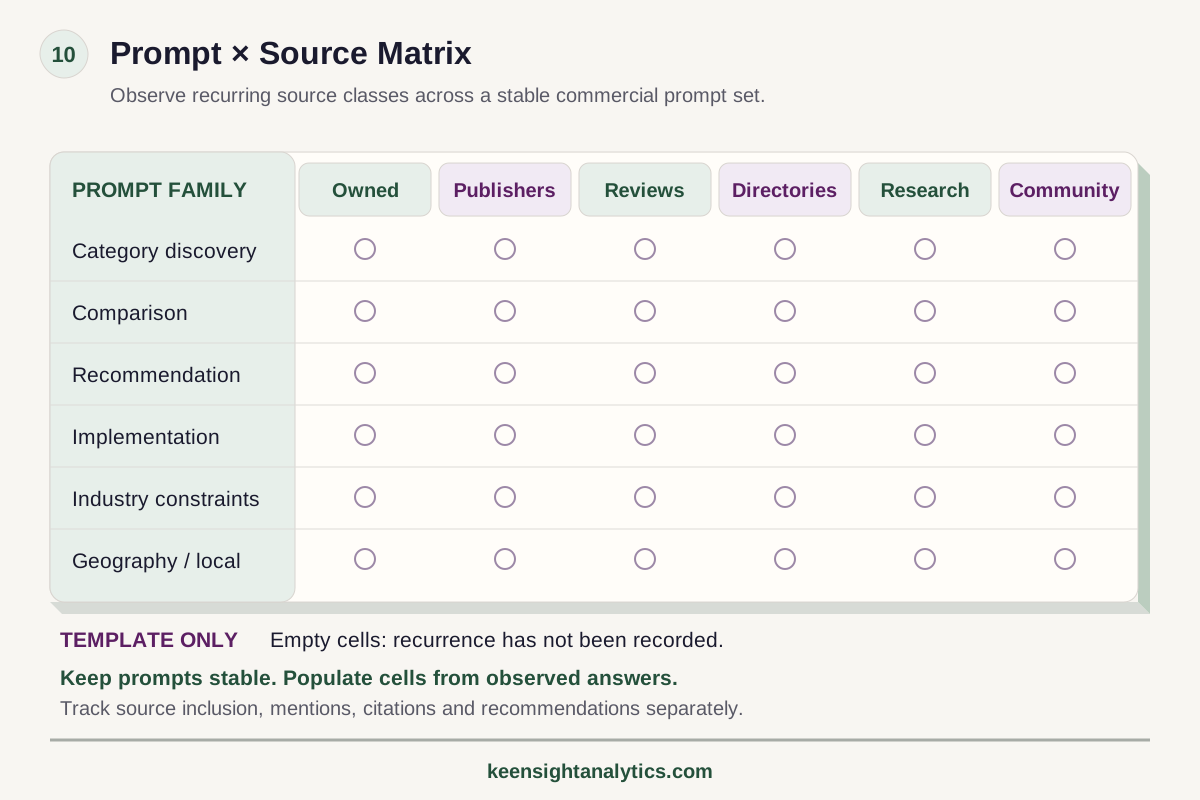
The framework
Prompt × source matrix
A template for observations; no source recurrence has been recorded.
Prompt families
Category discovery, comparison, recommendation, implementation, industry constraints and geography.
Source classes
Owned, publishers, reviews, directories, research and community.
Populate from evidence
For each prompt family, record which source classes appear in observed answers.
Keep outcomes separate
Track source inclusion, mentions, citations and recommendations separately.
Keep prompts stable. Empty cells do not mean a source is absent.
AI search next step
If this issue shows up in commercial AI-search prompts, compare the evidence first before changing the content plan.If an AI answer repeatedly mentions competitors, the obvious instinct is to track the brands. That is useful, but incomplete.
The more strategic question is: which sources keep appearing around the questions that matter, and what role do those sources play in shaping the answer?
A competitor may appear because its own product page is retrieved. It may appear because a directory, analyst, publication, association, review platform, community, or partner repeatedly discusses it. It may be cited for one factual claim while being recommended for an entirely different reason.
Source analysis turns AI-search monitoring from a visibility score into a form of competitive intelligence.
1. Start with a defined commercial prompt universe
Random prompts produce random conclusions. Build a prompt set around the buying decisions your market actually makes.
Useful prompt groups include:
- category discovery;
- problem diagnosis;
- vendor or provider comparisons;
- "best" or recommendation questions;
- implementation and integration questions;
- industry-specific constraints;
- company-size or budget constraints;
- geographic questions where location matters;
- risk, compliance, or suitability questions;
- alternative and replacement questions.
Maintain a stable core set for trend analysis. Keep exploratory prompts in a separate pool so a changing measurement set does not masquerade as a visibility change.
2. Capture more than the final answer
For each observation, record the platform, prompt, date, response, visible sources, brand mentions, recommendations, and relevant wording.
Where source links are exposed, capture the exact page, not just the domain. Page-level analysis often reveals the information format that is influencing the answer: a comparison article, a pricing page, a review profile, a government reference, product documentation, a service page, or original research.
Also record the distinction between:
- source inclusion — a page is used or linked;
- brand mention — a company is named;
- citation — a visible source supports part of the answer;
- recommendation — a brand is presented as a candidate or preferred option.
These are different states. Treating them as one metric hides the mechanism.
3. Classify source types
A useful source map groups pages by function. The categories will vary by industry, but common classes include:
- first-party vendor or provider pages;
- publisher and editorial sites;
- review and comparison platforms;
- directories and marketplaces;
- industry associations;
- government or regulatory sources;
- academic and research sources;
- technical documentation;
- forums and communities;
- partner ecosystems;
- local business profiles and location sources;
- original datasets and benchmark reports.
This classification matters because each source type implies a different strategy. You can improve your own service page directly. You cannot "optimize" a government site in the same way. A recurring industry publication may call for digital PR or expert contribution. A directory may require profile accuracy and category fit. A community source may reflect genuine practitioner consensus that cannot be manufactured credibly.
4. Look for recurrence, not one-off citations
One source appearance may be incidental. A domain or page type that repeatedly appears across commercially relevant prompts deserves more attention.
Calculate recurrence across the prompt set. Which domains show up most often? Which source classes dominate comparisons? Which pages appear in category-definition questions versus recommendation questions? Which sources are associated with your brand and which with competitors?
Repeated source presence can reveal the market's evidence infrastructure. In one category, independent reviews may dominate. In another, official documentation and analyst research may carry more weight. Local categories may lean on business profiles, reviews, directories, and local publishers.
5. Separate first-party evidence from third-party evidence
If a competitor appears because its own page is frequently used, the gap may be first-party information quality. Review that page's specificity, architecture, entity clarity, and ability to resolve the user's decision.
If the competitor appears primarily through independent sources, the gap may be broader authority or market evidence.
That difference matters operationally. Strengthening a service page is content and information-architecture work. Earning legitimate third-party references can require research, partnerships, digital PR, community participation, expert contributions, product adoption, customer reviews, or other real-world signals.
Do not collapse both into "build backlinks." The evidence problem is more specific than link count.
6. Analyze why a source is useful
The point is not to copy the pages that appear. The point is to understand what job they perform.
Ask:
- Does the page provide a concise factual answer?
- Does it compare options with clear criteria?
- Does it contain original data?
- Does it define a category precisely?
- Does it provide current technical documentation?
- Does it contain first-hand reviews or user evidence?
- Does it identify geographic or local facts?
- Does it explain limitations rather than making absolute claims?
- Is it simply the most relevant first-party source for a fact?
This converts source tracking into a content and authority diagnosis.
7. Build a source-to-claim map
A page can be cited without influencing the most important commercial claim in the answer.
Map which source supports which statement. For example, a vendor's documentation may support an integration claim, while an independent review platform supports ease-of-use sentiment and a regulatory source supports a compliance definition.
This is especially useful when a brand is recommended for a reason its own site barely explains. The recommendation may be downstream of independent evidence that has accumulated elsewhere.
Once you understand the claim-source relationship, the strategic question becomes clearer: should the organization strengthen first-party facts, create better evidence, correct inaccurate third-party information, or build relationships with the source ecosystems buyers already trust?
8. Measure source concentration
Some markets have a highly concentrated source ecosystem. A handful of publications, directories, or review platforms appear repeatedly. Others are fragmented.
Source concentration helps prioritize effort. If three independent sites dominate a large share of relevant prompts, understanding those sites may matter more than chasing dozens of one-off references.
But concentration also creates risk. A market overly dependent on one source can change quickly if that site's content, policies, or visibility changes. Track both dominant sources and emerging alternatives.
9. Track source changes over time
AI answers are dynamic. Models, retrieval systems, indexes, search interfaces, and the underlying web all change.
Therefore, the useful unit is not "this source appeared once." It is the trend:
- Which domains are gaining source share?
- Which page types are becoming more common?
- Are first-party sources becoming more or less visible?
- Are competitors gaining recommendation frequency because new evidence appeared?
- Did a source ecosystem change after a product launch, rebrand, acquisition, or new research publication?
Annotate major market events so changes in source behavior can be interpreted rather than merely graphed.
10. Use source analysis to improve internal content
Source research often exposes gaps in first-party content.
You may discover that independent sites explain your pricing model more clearly than your own website. Or that a competitor's documentation answers integration questions your commercial pages ignore. Or that industry publications repeatedly cite a statistic no vendor has bothered to contextualize.
Those observations can inform:
- service-page revisions;
- comparison content;
- FAQ and decision-support content;
- technical documentation;
- industry pages;
- original research;
- structured data where it accurately reflects visible facts;
- internal linking between evidence and commercial destinations.
11. Use source analysis to guide authority work
When the gap is external, the response should still be grounded in usefulness.
Possible interventions include producing original research that journalists and practitioners need, maintaining a useful tool, contributing expert commentary, improving partner documentation, correcting directory profiles, earning relevant reviews, participating in legitimate associations, or publishing reference material that other writers can cite confidently.
The wrong response is to treat every recurring source as a placement target. Some sources have editorial independence, eligibility rules, or evidence standards that cannot be bought or gamed credibly.
12. Compare source visibility with conventional search visibility
AI source analysis becomes more useful when joined with traditional SEO data.
For a given topic, compare:
- organic rankings and search share;
- pages ranking in classic results;
- domains appearing as AI sources;
- brand mentions and recommendations;
- landing-page clicks and conversions;
- backlink and referring-domain evidence;
- local visibility where geography matters.
A site may rank well organically but rarely appear in AI answers. Another may be frequently cited yet receive modest direct traffic. These are different discovery states and should not be forced into one score.
13. Avoid false precision
AI-source monitoring is observational. Even a disciplined prompt set cannot reveal proprietary retrieval logic completely.
Do not claim that a source appears because of one specific ranking factor unless the evidence supports it. Prefer language such as "this source recurs across 38% of the monitored comparison prompts" or "independent review pages are the dominant source class in this sample."
That keeps the analysis useful without pretending the system is fully observable.
14. A practical monthly source-analysis workflow
- Run the stable commercial prompt set.
- Capture visible sources, mentions, citations, and recommendations.
- Normalize domains and classify source types.
- Calculate recurrence by prompt group and source class.
- Map important sources to the claims they support.
- Compare current results with the prior period.
- Cross-reference conventional search visibility and competitive movement.
- Identify the dominant gap: first-party information, third-party evidence, technical eligibility, or measurement instability.
- Assign one or two interventions with clear ownership.
Source analysis turns AI visibility into a market map
The most useful output is not a leaderboard of who appeared most often. It is an evidence map showing which sources shape commercial questions, why those sources are useful, how competitors are supported, and where your organization lacks comparable information.
That map can guide content, technical work, documentation, digital PR, local visibility, partnerships, and measurement.
AI-search monitoring becomes strategically valuable when it explains the market—not merely the screenshot.
When this becomes an AI-search operating problem
Separate visibility evidence from implementation.
Use Search Intelligence when the source, citation, recommendation, or competitive gap still needs diagnosis. Use AI SEO when the failure layer is known and KeenSight needs to own implementation across content, entities, retrieval readiness, and supporting evidence.No AI-search engagement guarantees citations, recommendations, rankings, or placement in a specific answer.A source-observation record
For each monitored answer, record platform, date, exact prompt, brand-mention state, recommendation state, visible citation URLs, source domains, source type, and a short note on what fact the source appears to support. Keep the core prompt set stable.
This turns screenshots into a dataset that can be compared by prompt cluster, source type, and competitor.
Use the source map to decide whether the next step is diagnosis, implementation, or monitoring
A source map is valuable because it can change the engagement choice. If you only need to establish whether a meaningful AI-search gap exists, start with the Free Visibility Preview. If the source ecosystem is complex—or you still cannot tell whether the issue is first-party evidence, independent sources, entity clarity, competitive fit, or retrieval eligibility—use Search Intelligence for the deeper one-time diagnosis.
When the evidence already points to a known implementation constraint, AI SEO can own the remediation. When your internal or incumbent team will execute against the source findings, AI Visibility Monitoring can track whether mention, citation, recommendation, and source patterns actually change. The companion analyses on competitor recommendation gaps and AI-search source readiness help interpret what the source map means.
Decision checkpoint
Before changing the AI-search plan, verify which layer is actually failing.
A useful next step should follow the evidence. Use these checks to avoid turning a visibility observation into an unsupported implementation recommendation.AI-search visibility can be measured and improved as a system, but specific citations or recommendations cannot be guaranteed.- 01EvidenceDo you have a stable prompt set and repeated observations, rather than a single screenshot or anecdote?
- 02Failure layerCan you separate technical eligibility, source inclusion, entity clarity, independent evidence, and recommendation outcomes?
- 03OwnershipIs the need a one-time diagnosis, recurring measurement, or implementation work that KeenSight would own?
Build the Source Map
Track recurring domains
One citation is anecdotal. Repeated source presence across a stable prompt set reveals more durable patterns.
Classify source roles
Separate first-party pages, publishers, reviews, directories, documentation, communities, and institutional sources.
Map sources to claims
Identify which source supports the facts or recommendations that matter commercially.
Diagnose the gap
Use the source ecosystem to distinguish first-party information problems from external authority and evidence problems.
Choose the next layer
Move from AI-search observation to the right operating model.
Compare other ways to get help
Map the source ecosystem around your market
A Search Intelligence Report can go beyond brand mentions to show the competitors, source classes, and decision surfaces shaping your visibility.
Keep Reading
SEO for AI Overviews
See what Google's AI-search guidance changes—and what it does not.
Read article →Why Competitors Get Recommended
Diagnose the evidence gap behind repeated AI recommendations.
Read article →AI Search Citations
Review the difference between visible citations, sources, mentions, and recommendations.
Read explainer →Make it specific
See what the market looks like for your company.
The free visibility preview turns a broad search topic into a limited personalized baseline.