August 28, 2026 · 11 min read
SEO for B2B SaaS: From Category Discovery to Vendor Comparison
B2B SaaS buyers search across category education, use cases, integrations, security, implementation, pricing, comparisons, and internal justification. The SEO architecture has to support the whole evaluation process.
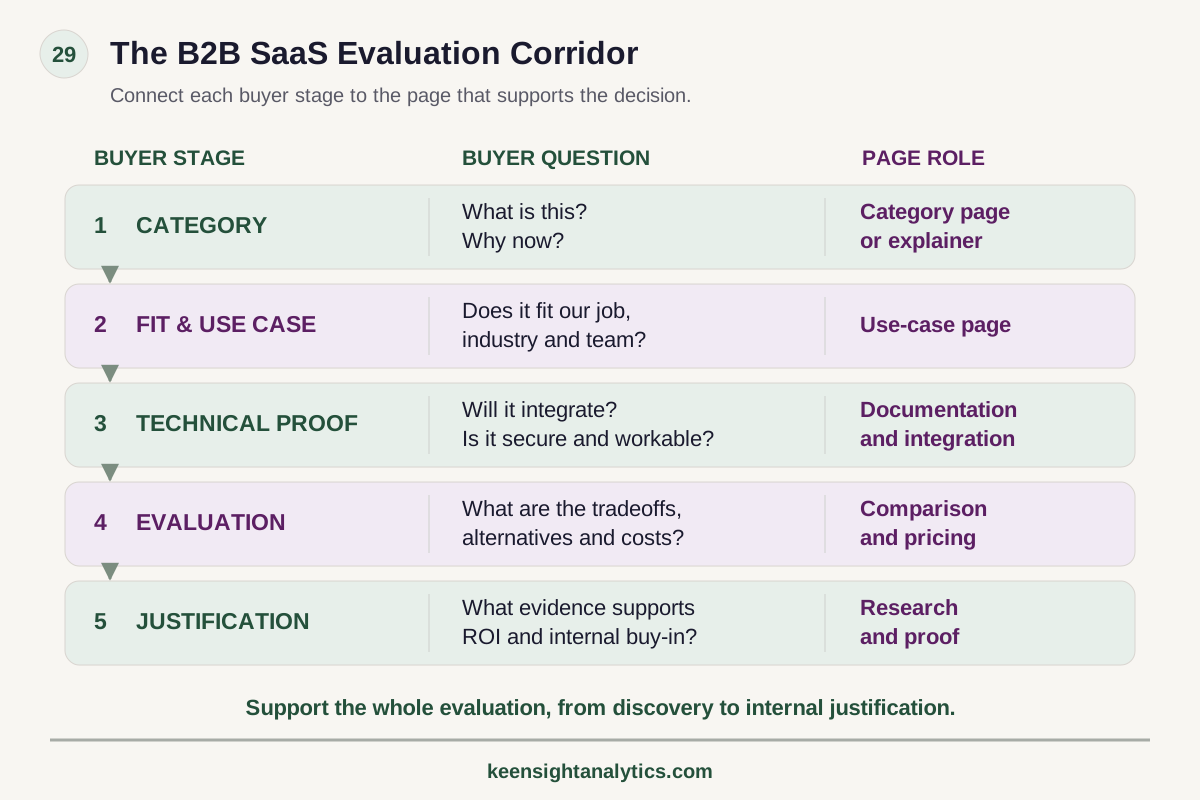
The framework
The B2B SaaS evaluation corridor
Connect buyer questions to supporting page roles.
Category
What is this, and why now? Category pages or explainers.
Fit and use case
Does it fit the job, industry and team? Use-case pages.
Technical proof
Will it integrate and is it secure? Documentation and integrations.
Evaluation
What are the tradeoffs and costs? Comparisons and pricing.
Justification
What supports ROI and internal buy-in? Research and proof.
Support the whole evaluation, from discovery to internal justification.
B2B search next step
Map the buying decisions, commercial evidence, and source ecosystem before adding another content cadence.B2B SaaS SEO is often overbuilt at the top of the funnel and underbuilt where buying decisions actually happen.
Teams publish definitions and trend articles because those topics show search volume. Meanwhile, product pages are vague, integration pages are thin, comparison pages avoid tradeoffs, technical documentation is isolated, and industry pages say little beyond “built for your business.”
A stronger SaaS search program starts with the buying system and gives each page type a distinct role.
1. Map the category the way buyers understand it
Define the product category, adjacent categories, alternatives, and the problem the software solves.
If the company operates in an emerging category, search demand may be split between the new term and older problem-based language. Build content for both discovery paths without forcing buyers to adopt internal product terminology before they understand the problem.
2. Make product and platform pages specific
Product pages should explain what the software actually does.
Include core capabilities, intended users, workflows, implementation model, integrations, security or governance context where relevant, limitations, packaging logic, and the next evaluation step.
Generic phrases such as “unlock efficiency with an innovative platform” provide little search or buyer value.
3. Use feature pages only when the feature has a distinct decision role
Not every feature deserves a search page.
Create a feature page when buyers search for the capability, the feature has enough depth to explain independently, or it materially influences evaluation. Otherwise, keep the feature inside the broader product architecture.
This prevents hundreds of thin feature pages that fragment authority.
4. Build use-case pages around jobs, not persona labels
A use-case page should explain the workflow or outcome the software supports.
Show the starting problem, process, relevant product capabilities, implementation considerations, dependencies, and what the software does not replace.
“For marketing teams” is not a use case by itself. “Automate multi-step lead enrichment before CRM routing” is much more specific.
5. Create industry pages only where the operating context changes
Industry pages are useful when regulation, workflow, terminology, integrations, buying criteria, or implementation constraints differ materially by vertical.
A financial-services page may need governance and data-control detail. A healthcare page may need workflow and privacy context. An ecommerce page may need catalog or merchandising integration examples.
Do not publish twenty vertical pages with the same architecture and a different industry noun.
6. Treat integrations as real product documentation
Integration pages can capture high-intent demand because technical evaluators often search by platform combination.
A useful integration page should explain what connects, supported objects or workflows, implementation approach, prerequisites, limitations, authentication or permission considerations, and where deeper documentation lives.
A logo plus two marketing sentences is not enough.
7. Make technical documentation crawlable and connected
Developer documentation, API references, setup guides, migration docs, release notes, and troubleshooting content can become major search assets.
Ensure documentation is accessible, indexable where appropriate, internally linked, canonicalized correctly, and connected to the commercial product architecture.
Technical evaluators and economic buyers may enter through different pages, but the site should allow them to converge on a shared evaluation path.
8. Build comparison pages that acknowledge tradeoffs
Comparison content performs best when it helps a buyer decide—not when it pretends the company wins every dimension.
Compare use cases, deployment model, pricing structure, integrations, workflow complexity, governance, implementation effort, support model, and customer fit where the information can be supported.
Differentiate “alternative to” pages from “X vs Y” pages and avoid making claims about competitors that cannot be verified.
9. Answer pricing and packaging questions directly
Even when exact prices are not public, buyers often need to understand how pricing works.
Explain relevant units, plan logic, implementation costs, usage factors, contract structure, or what information is needed for a quote where appropriate.
Hiding all pricing logic can create a search gap that comparison sites and competitors fill instead.
10. Build editorial content around evaluation friction
Useful SaaS editorial topics include implementation decisions, migration risks, build-vs-buy frameworks, category comparisons, integration planning, governance, ROI methodology, adoption barriers, benchmarks, and operating lessons.
Generic “ten trends” posts rarely create lasting differentiation because they are easy to reproduce.
Prioritize content that helps a buyer resolve a decision tied to the product.
11. Create original evidence
SaaS companies often have access to useful aggregate patterns, product telemetry, customer research, benchmark data, or domain expertise that can become referenceable research when privacy, methodology, and sample limitations are handled correctly.
Original studies, calculators, templates, and technical benchmarks can strengthen both backlinks and AI-search source visibility.
12. Build a coherent internal-link graph
Foundational explainers should link to the relevant product and use-case pages. Integrations should link into product capabilities and docs. Comparisons should link to the features that matter. Industry pages should connect to the services, use cases, and evidence relevant to that vertical.
Blog articles should support the commercial system rather than become a separate traffic silo.
13. Measure by buying-stage query groups
Segment the search market into category discovery, problem diagnosis, use case, integration, implementation, comparison, pricing, competitor, and branded evaluation.
Track visibility share and landing-page performance for each group. A company can gain top-of-funnel traffic while losing the comparison and integration queries closest to pipeline.
14. Connect SEO to pipeline carefully
Measure demo requests, trials, signups, qualified opportunities, assisted journeys, and revenue where attribution supports the claim.
Do not assign all downstream revenue to the first blog visit. Use CRM and analytics evidence conservatively and distinguish sourced pipeline from influenced pipeline.
15. Identify the real search competitors
SaaS search competitors can include direct vendors, open-source projects, publishers, review platforms, analyst sites, communities, marketplaces, and documentation domains.
Build cohorts by query segment. The domain taking “best software” visibility may differ from the one winning technical implementation searches.
16. Prepare commercial content for AI-search synthesis
AI systems allow buyers to ask complex vendor questions directly: which tools support an integration, which vendors fit a regulated environment, what alternatives exist, or how products differ.
Strengthen first-party evidence: explicit product scope, integrations, security, pricing logic, customer fit, documentation, comparison detail, and implementation context.
Monitor sources, mentions, and recommendations across a stable commercial prompt set. Do not promise AI citations or recommendations.
17. Use the right next step for the constraint
If the site’s product and technical architecture is broken, content alone will not solve the problem. If the category is well built but competitors dominate independent references, authority may be the constraint. If teams disagree about which layer matters, a one-time diagnostic may be more valuable than committing immediately to recurring execution.
Match the engagement model to the actual failure layer.
B2B SaaS SEO is a decision-information architecture
The best SaaS search system supports the full evaluation: category, problem, use case, product, integration, implementation, comparison, pricing, security, proof, and technical validation.
When those assets work together, search becomes part of the buying journey rather than a separate content channel.
When this becomes a B2B visibility program
Connect commercial SEO and AI-search evidence instead of running two content factories.
Use KeenSight Search for recurring ownership across commercial architecture, technical SEO, content, authority, and measurement. Add AI SEO when retrieval, source inclusion, recommendation visibility, and entity evidence are material parts of the buying journey.A SaaS search architecture by page role
Category pages establish the market frame. Product/feature pages explain capability. Use-case and industry pages explain fit. Integration pages document interoperability. Comparison pages expose tradeoffs. Pricing and security pages reduce evaluation friction. Documentation supports technical validation. Editorial and research provide analysis and evidence.
Use category and buying-journey evidence to choose the SaaS operating model
For B2B SaaS, Local SEO is generally not the default unless offices, regional availability, or location-specific demand are actually part of the buying journey. Use Search Intelligence when the team needs a one-time diagnosis of category demand, search competitors, page roles, comparison intent, integration demand, or where the buying journey loses visibility.
Use Search Benchmarking when leadership wants a stable recurring view of category and competitor movement while the internal growth team executes. Choose managed KeenSight Search when technical SEO, category architecture, problem/use-case content, comparison pages, authority, AI-search visibility, and measurement need continuous prioritization. The companion revenue-first content framework helps keep top-of-funnel reach connected to qualified commercial paths.
Decision checkpoint
Map the B2B buying decision before expanding the content program.
B2B visibility works best when site architecture, commercial evidence, technical validation, independent sources, and AI-search behavior support the same buyer journey.- 01Decision mapAre category discovery, use cases, integrations, comparisons, pricing, security, implementation, and proof represented by distinct page roles?
- 02EvidenceCan buyers and retrieval systems verify product fit, constraints, technical facts, and differentiation without relying on vague positioning?
- 03OwnershipIs the gap conventional search architecture, AI-search retrieval/evidence, or an integrated program that requires both?
The B2B SaaS Search Architecture
Commercial specificity
Make products, features, integrations, pricing logic, and use cases explicit enough to evaluate.
Technical discovery
Connect crawlable documentation and implementation content to the commercial product system.
Decision content
Use comparisons, frameworks, benchmarks, and original evidence to resolve buyer uncertainty.
Pipeline measurement
Track visibility by buying stage and connect search to qualified pipeline conservatively.
B2B search strategy
Connect commercial SEO and AI-search evidence around the same buying system.
Compare other ways to get help
Benchmark where your SaaS search journey breaks
Search Intelligence can show whether category, commercial pages, technical architecture, authority, or competitive displacement is the dominant constraint before execution is selected.
Keep Reading
How AI Search Changes B2B Content Strategy
Build decision-support content for synthesized buyer questions.
Read article →Build Content Around Revenue
Prioritize content by commercial role rather than search volume.
Read article →Find Search Competitors Taking Visibility
Identify the domains winning each stage of the SaaS evaluation journey.
Read article →Make it specific
See what the market looks like for your company.
The free visibility preview turns a broad search topic into a limited personalized baseline.