August 28, 2026 · 12 min read
What Makes a Website More Likely to Be Used as an AI Search Source?
There is no public checklist that guarantees citation. The durable work is making important pages accessible, interpretable, specific, useful, and supported by evidence.
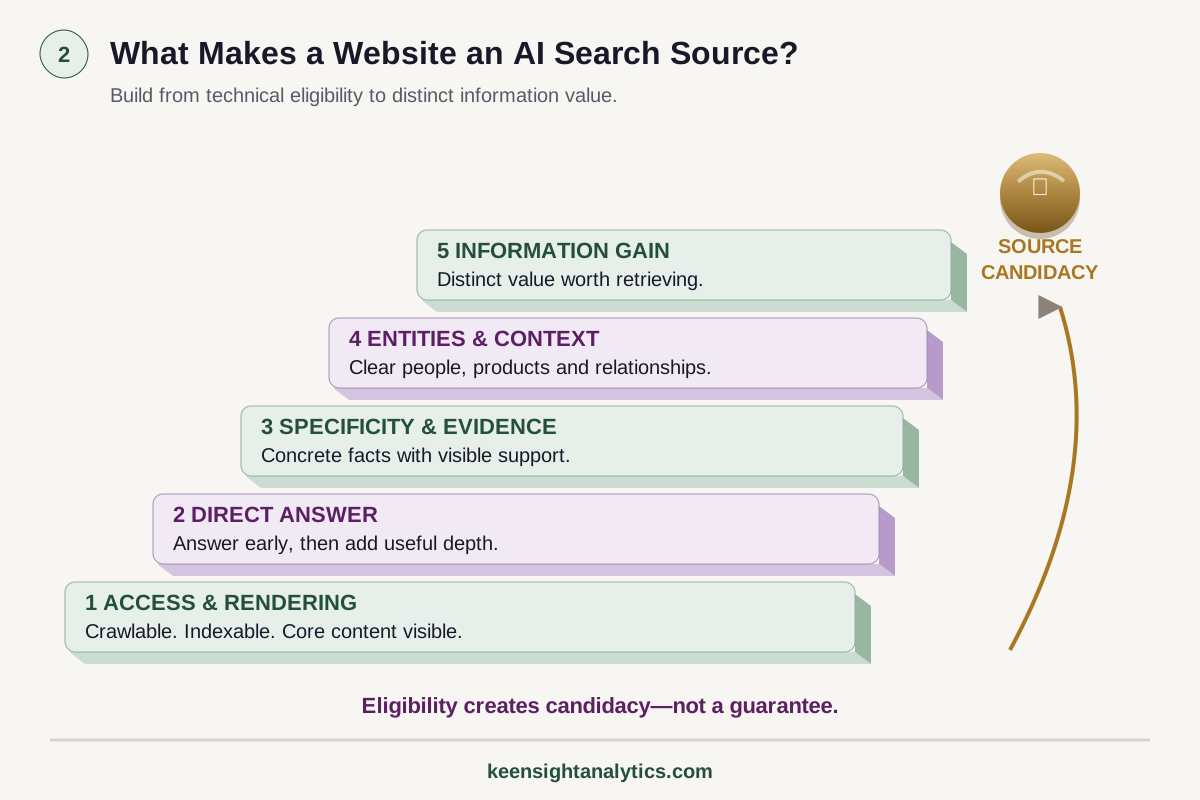
The framework
What makes a website an AI search source?
Review technical eligibility and information usefulness.
Access and rendering
Crawlable, indexable, with core content visible.
Direct answer
Answer early, then add useful depth.
Specificity and evidence
Concrete facts with visible support.
Entities and context
Clear people, products and relationships.
Information gain
Distinct value worth retrieving.
Eligibility creates candidacy, not a guarantee.
AI search next step
If this issue shows up in commercial AI-search prompts, compare the evidence first before changing the content plan.There is no universal set of “AI search ranking factors” that guarantees a page will become a source in ChatGPT, Google’s generative search experiences, or another answer engine. Different systems use different indexes, crawlers, retrieval methods, ranking systems, model behavior, and presentation rules. Even within one platform, source selection can vary by query.
That means the useful optimization target is not a secret formula. It is retrieval readiness: can the page be discovered, accessed, interpreted, matched to the user’s question, trusted enough to use as evidence, and connected to a clear entity and topic context?
As of August 2026, the public guidance from major search platforms reinforces that principle. OpenAI says public websites can appear in ChatGPT search and advises publishers not to block OAI-SearchBot if they want content to be discovered and included in summaries and snippets. Google’s current guidance for generative AI features continues to emphasize established SEO practices and explicitly says there is no special visibility benefit from an llms.txt file for Google Search.
Those statements do not reveal a ranking formula. They do clarify that technical access and useful web content still matter.
1. Retrieval starts with access
A page that cannot be fetched is a weak candidate for any retrieval system that depends on crawling or web access. Review robots directives, HTTP status codes, authentication requirements, canonicalization, noindex directives, rendering behavior, and whether important content exists in a form the crawler can actually receive.
OpenAI’s publisher guidance is explicit about OAI-SearchBot access for ChatGPT search. Google’s technical requirements similarly define crawler access, successful responses, and indexable content as basic eligibility conditions for Google Search.
Eligibility is only the first gate. A technically accessible page can still be ignored because it is duplicative, irrelevant, vague, low-value, or less useful than competing sources. But if access is broken, content optimization is premature.
2. Important information should survive rendering
Modern sites can be highly interactive without being hostile to search, but search-critical information should not depend on a fragile client-side state. Compare raw HTML, rendered HTML, and the user-visible page. Verify that titles, canonical tags, robots directives, primary copy, internal links, product or service information, and structured data remain consistent.
Google documents that it renders JavaScript during crawling, but that does not make rendering architecture irrelevant. Failures, status-code problems, API dependencies, hydration mismatches, or script-only navigation can still produce unpredictable output. The objective is not “avoid JavaScript.” It is predictable access to the information that needs to be discovered.
The same principle helps outside traditional search. A stable, server-accessible information layer is generally more resilient than an experience whose meaning appears only after several client-side interactions.
3. Answer the actual question early
Source usefulness depends on whether a page contains material that resolves the user’s question. A page that delays its answer through a long introduction, repeats a keyword without explaining the concept, or buries the relevant fact inside generic marketing language is difficult for both humans and retrieval systems.
Strong source pages usually establish the central answer early, then add the context required to use that answer correctly. That context can include definitions, mechanisms, examples, tradeoffs, exceptions, calculations, implementation steps, source evidence, and limits.
This does not mean every article should be short or reduced to bullet points. Deep pages can be highly retrievable when their information hierarchy is clear. Concise opening answers and substantial supporting depth are compatible.
4. Specificity creates extractable evidence
Compare two statements:
“We provide comprehensive SEO solutions tailored to your business.”
and:
“Our fixed Technical SEO Projects cover crawlability, rendering, indexation, canonicalization, internal-link architecture, structured data, migration defects, and prioritized implementation guidance; they are designed for finite technical remediation rather than recurring execution.”
The second statement gives a buyer—and a retrieval system—far more usable information. It defines scope, mechanism, boundaries, and fit.
Specificity matters across product pages, service pages, documentation, pricing pages, author profiles, location pages, research, and editorial content. Include the details a knowledgeable buyer would need to distinguish one option from another.
5. Information gain matters more than paraphrasing consensus
If ten pages repeat the same generic explanation, another paraphrase contributes little. A stronger source adds something the market did not already have in the same form: original data, a useful framework, a technical explanation, a transparent methodology, an expert interpretation, a comparison model, a maintained reference, a calculator, a primary document, or a well-scoped answer to a difficult question.
Google’s 2026 documentation update on optimizing for generative AI features specifically highlighted the value of non-commodity content while reinforcing that ordinary SEO best practices remain relevant. The strategic lesson is broader than one platform: produce information worth retrieving.
For commercial sites, information gain can come from explaining the actual operating model. Scope, constraints, implementation sequencing, ownership, measurement, pricing logic, and decision criteria are often more differentiated than another high-level article about “five benefits of SEO.”
6. Claims need evidence and boundaries
Pages become more useful when readers can tell what a claim is based on. Cite primary sources. Explain methodology. Identify whether a number is measured, estimated, illustrative, or externally sourced. State when a recommendation applies and where it may not.
This is particularly important in regulated, technical, medical, legal, financial, and fast-changing subjects. Unsupported certainty reduces usefulness. A page that accurately says “the available evidence supports X under these conditions” is stronger than one that converts uncertainty into marketing confidence.
Evidence also improves maintainability. When the platform changes, an editor can identify which statements need review instead of rewriting the entire article from memory.
7. Clear entities reduce ambiguity
A retrieval system should be able to understand what organization produced the content, what products or services it offers, which experts authored or reviewed the material, where the company operates, and how those entities relate.
Use consistent organization naming. Maintain accurate location information. Connect experts to the subjects they actually cover. Keep product and service naming stable. Use structured data to reinforce visible relationships when appropriate. Link to authoritative external profiles where they help disambiguate the entity.
Structured data is useful when it describes reality. It is not a mechanism for declaring authority that the visible site and external evidence do not support. For more detail, see KeenSight’s entity SEO and structured data explainers.
8. Internal architecture supplies context
A source page should not be an orphan. Internal links help users and crawlers understand how a page relates to the broader topic and commercial architecture.
A strong information system might connect a definition to a deeper explainer, a methodology page, a service page, a comparison, a research asset, and a practical resource. Those links create context without forcing every page to repeat every concept.
Use descriptive anchor text and crawlable links. Build clear canonical destinations for major subjects. Avoid creating five near-duplicate pages that all compete to explain the same concept. Retrieval readiness improves when the site itself knows which page owns which job.
9. Third-party references can strengthen the evidence environment
AI-generated answers do not rely only on first-party vendor pages. Depending on the question and platform, visible sources may include publishers, directories, communities, associations, documentation, primary research, government pages, reviews, and other independent sources.
That makes off-site evidence part of AI-search strategy—but not in the crude sense of accumulating mentions. The goal is to have accurate, relevant, independently useful information about the company and subject available where the market naturally looks.
For one business that may mean complete professional directories and strong review coverage. For another it may mean original research cited by industry publications. For a software company it may mean better technical documentation and ecosystem references. The correct source strategy follows the market.
10. Freshness should follow the subject, not a calendar trick
Some subjects change quickly. Platform documentation, pricing, laws, regulations, product capabilities, benchmarks, and market statistics may need frequent review. Foundational concepts can remain useful for years if they are accurate.
Do not update a date merely to look fresh. Instead, maintain the facts that affect the answer. Show publication and update information where it helps the reader assess currency. Retire or consolidate pages that can no longer be maintained responsibly.
For AI-search content in particular, platform behavior can change quickly. Separate durable principles from platform-specific notes so future updates are easier.
11. Do not confuse structured formatting with quality
FAQ blocks, lists, tables, definitions, schema, and summary sections can make information easier to navigate. They are useful editorial tools. They are not magic AI-search formats.
A shallow page broken into perfect headings is still shallow. A weak claim inside JSON-LD is still weak. A generic article converted into fifty questions is still generic. Structure should expose useful information, not substitute for it.
12. Measure source inclusion as an outcome, not a promise
After improving a page or source ecosystem, measure whether conditions changed. Use a stable commercial prompt set. Record source domains, first-party citation frequency, brand mentions, recommendations, and changes in the language used to describe the company.
Do not attribute every movement to the latest edit. Generated search is volatile, and platforms change independently. Look for sustained patterns across prompts and time.
Pair AI-search measurement with traditional organic visibility, landing-page performance, conversion behavior, and competitive share. A page can become a useful AI source while producing little direct referral traffic. Another page may generate organic revenue without ever appearing as a visible AI citation. Both can still be valuable.
A practical retrieval-readiness checklist
- Important pages return the correct status and are not unintentionally blocked.
- Canonical, robots, and rendering behavior are stable.
- The central question is answered clearly and early.
- The page includes specific information a buyer can use.
- Claims are sourced, scoped, and maintainable.
- Organization, product, service, author, and location entities are clear.
- Internal links establish topic and commercial context.
- The page contributes original or unusually useful information.
- Relevant third-party evidence exists where the market naturally evaluates the subject.
- Source inclusion is measured across a repeatable prompt set rather than inferred from one answer.
The durable goal is useful, accessible evidence
AI search has created a new reason to care about how easily information can be retrieved and synthesized, but the strongest response is not to invent a parallel web for language models. Build a better public information system: technically accessible, clearly structured, specific, evidence-backed, connected, and genuinely useful.
That is not a guarantee of citation. It is a stronger foundation for search visibility across changing interfaces.
When this becomes an AI-search operating problem
Separate visibility evidence from implementation.
Use Search Intelligence when the source, citation, recommendation, or competitive gap still needs diagnosis. Use AI SEO when the failure layer is known and KeenSight needs to own implementation across content, entities, retrieval readiness, and supporting evidence.No AI-search engagement guarantees citations, recommendations, rankings, or placement in a specific answer.Eligibility is not selection
Audit two questions separately. Can the page participate? Check crawlability, indexability, rendering, canonicalization, and visible information. Why would a system use it? Check whether the page answers a distinct question, contains verifiable facts, provides enough context to stand alone, and is supported by credible evidence.
A technically perfect page can still be a weak source. A strong source can still be excluded by an access defect. Diagnose the layer before changing the editorial plan.
Connect source readiness to the commercial decision
Source readiness should not become a checklist detached from the market. A limited Visibility Preview can establish whether the brand is appearing at all. If technically eligible pages remain absent and the reason is unclear, Search Intelligence can compare source inclusion, competitor evidence, entity clarity, and recommendation behavior before the team changes content or authority strategy.
If the diagnosis shows a repeatable source-readiness or evidence gap that KeenSight should implement, move into AI SEO. If another team owns remediation, use AI Visibility Monitoring to remeasure the same prompt and source set. The adjacent analyses on SEO for AI Overviews and source influence in AI answers help separate durable SEO fundamentals from the wider source ecosystem.
Decision checkpoint
Before changing the AI-search plan, verify which layer is actually failing.
A useful next step should follow the evidence. Use these checks to avoid turning a visibility observation into an unsupported implementation recommendation.AI-search visibility can be measured and improved as a system, but specific citations or recommendations cannot be guaranteed.- 01EvidenceDo you have a stable prompt set and repeated observations, rather than a single screenshot or anecdote?
- 02Failure layerCan you separate technical eligibility, source inclusion, entity clarity, independent evidence, and recommendation outcomes?
- 03OwnershipIs the need a one-time diagnosis, recurring measurement, or implementation work that KeenSight would own?
The Retrieval-Readiness Stack
Access
Crawlers can fetch the page, important content survives rendering, and technical directives are coherent.
Answerability
The page resolves a real question with specific, extractable information instead of generic marketing copy.
Evidence
Claims are supported, scoped, current, and useful enough to reference independently.
Context
Entities, internal links, page roles, and third-party references make the information easier to interpret.
Choose the next layer
Move from AI-search observation to the right operating model.
Compare other ways to get help
Check your AI-search retrieval readiness
Use the Free Visibility Preview for an initial evidence check, then move to deeper Search Intelligence only if the market gap needs diagnosis.
Keep Reading
Why Competitors Get Recommended by AI Search
Diagnose the evidence gaps behind competitive recommendation visibility.
Read article →How AI Search Retrieval Works
Understand retrieval, generation, and the limits of what can be observed from outside a platform.
Read explainer →AI Search Source Selection
A focused explanation of source inclusion, evidence, and measurement.
Read explainer →Make it specific
See what the market looks like for your company.
The free visibility preview turns a broad search topic into a limited personalized baseline.