August 28, 2026 · 13 min read
SEO for AI Overviews: What Should Actually Change in Your Strategy?
Google's generative search features change the interface, but not the need for crawlable pages, useful answers, clear entities, strong evidence, and disciplined measurement.
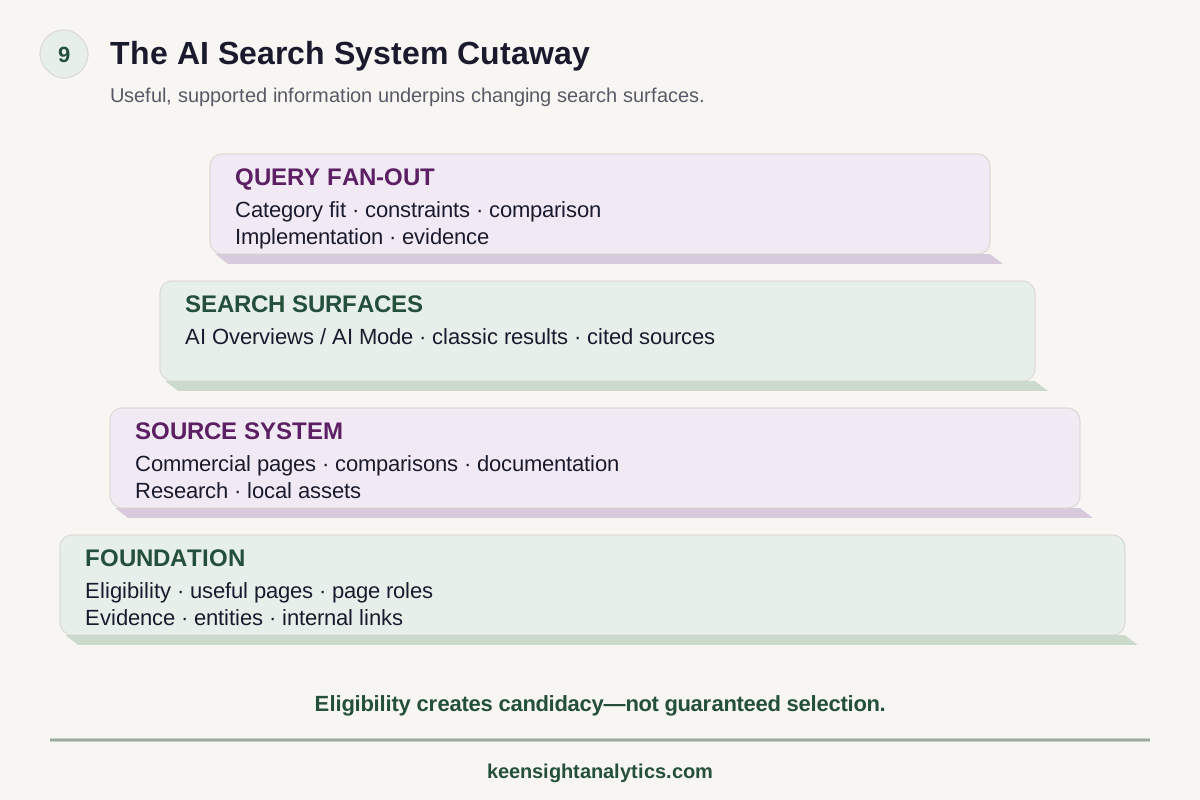
The framework
The AI search system
Useful, supported information underpins changing search surfaces.
Query fan-out
Category fit, constraints, comparison, implementation and evidence.
Search surfaces
AI Overviews, AI Mode, classic results and cited sources.
Source system
Commercial pages, comparisons, documentation, research and local assets.
Foundation
Eligibility, useful pages, page roles, evidence, entities and internal links.
Eligibility creates candidacy, not guaranteed selection.
AI search next step
If this issue shows up in commercial AI-search prompts, compare the evidence first before changing the content plan.AI Overviews and AI Mode have created a predictable reaction in SEO: teams want a new checklist.
That instinct is understandable, but it can lead to the wrong work. Google's current guidance is unusually explicit: there are no separate technical requirements, special schema types, or AI-specific machine-readable files required to appear in AI Overviews or AI Mode. A page still needs to be indexed, eligible to appear in Search with a snippet, and useful enough to be selected as supporting material.
The strategic change is therefore not "replace SEO with GEO." The change is to become more rigorous about retrieval, information quality, page relationships, evidence, and measurement across a broader search interface.
1. Start with eligibility, not AI formatting tricks
Before debating answer length, headings, or markup, confirm that the page can participate in Search at all.
For Google AI features, the technical floor remains familiar: the page should be crawlable, return a meaningful success status, be indexable, expose important content in a form Google can process, and be eligible to show a snippet. Internal links should make the page discoverable, and canonicalization should make the intended URL clear.
That matters because many supposed "AI visibility" problems are ordinary search-access problems wearing a new label. A service page blocked by a noindex directive is not an AI optimization problem. A product comparison reachable only through client-side interactions may be a rendering and internal-link problem. A duplicated category set with unstable canonicals may be a canonicalization problem.
Technical eligibility does not guarantee selection. It simply keeps the page in the candidate set.
2. Understand what query fan-out changes
Google says AI Overviews and AI Mode may use query fan-out: the system can issue multiple related searches across subtopics and data sources while constructing a response.
That has an important content implication. A page does not need to target only the exact wording of the user's original question. It may become relevant because it answers one of the subquestions necessary to produce a useful response.
For example, a user asking "what is the best CRM for a 50-person regulated financial-services team?" creates several possible evidence needs: CRM category fit, team-size fit, compliance or security capabilities, implementation model, integration requirements, pricing structure, and independent comparisons. Different pages may support different parts of that answer.
A content strategy built only around one keyword per page can miss this. The stronger approach is to map the decision system: what facts, comparisons, constraints, and definitions are needed to answer the broader commercial question accurately?
3. Give each page a clear informational job
AI search increases the cost of vague page roles.
If a service page tries to be a definition, comparison, location page, pricing explainer, and thought-leadership article at once, it may not answer any one part of the decision particularly well. Conversely, a site with dozens of overlapping articles can make it harder to identify which page should carry the strongest answer.
Use clear page roles:
- Service or product pages explain the offer, fit, scope, methodology, constraints, and next step.
- Explainers define mechanisms, concepts, or technical ideas.
- Comparisons make tradeoffs explicit.
- Industry pages explain how the problem changes inside a specific operating environment.
- Research and resources supply evidence that is difficult to reproduce.
- Blog analysis interprets changes, frameworks, market behavior, and applied decisions.
When those roles are internally linked, the site becomes easier for both buyers and retrieval systems to interpret.
4. Write answers that survive extraction
A strong source page should make its central information identifiable without forcing the reader to reconstruct the argument from a wall of copy.
That does not mean every page should become a collection of 40-word answer blocks. It means the information hierarchy should be disciplined. State the answer. Then support it with definitions, mechanisms, evidence, exceptions, examples, and decision boundaries.
Consider a page answering "when should a company use a fixed technical SEO project instead of managed SEO?" A weak page says one option is flexible and the other is comprehensive. A useful page defines the conditions: whether the failure layer is finite, whether implementation ownership exists internally, whether measurement and competitive adaptation need to continue, and whether several constraints interact.
That specificity helps a human buyer. It also produces source material that retains meaning when a portion is retrieved or summarized.
5. Add evidence, not decorative authority signals
Generic assertions are easy to generate and easy to replace. AI-search visibility gives organizations another reason to publish information that is specific, verifiable, and genuinely useful.
Useful evidence can include:
- primary documentation;
- transparent methodologies;
- original datasets or benchmarks;
- expert analysis with clear scope and limitations;
- maintained reference tables;
- technical specifications;
- calculators and tools;
- first-party facts about products, services, locations, and operating models;
- independent third-party references that corroborate the entity or claim.
Adding an author box or schema to a page whose claims remain vague does not create meaningful evidence. Structured data should reinforce visible information, not substitute for it.
6. Strengthen entity clarity across the site
Organizations often describe themselves inconsistently. The homepage uses one category, service pages use another, directory listings use an old name, location pages omit the parent company, and authors have no clear relationship to the organization.
Entity work begins with visible coherence. Make it clear who the organization is, which services or products it provides, where it operates, who authors specialist content, which locations are real, and how related pages connect.
Structured data can reinforce these relationships when it accurately reflects visible content. Local businesses should also maintain current Business Profile information where relevant, and ecommerce organizations should keep product and merchant data accurate.
The goal is not to "feed the AI an entity graph." The goal is to remove unnecessary ambiguity from the public information about the business.
7. Treat commercial pages as AI-search assets
Many AI-search strategies overfocus on blogs. That misses some of the strongest first-party evidence on a site.
Service, product, integration, location, industry, pricing, methodology, and comparison pages often contain the facts a retrieval system needs when answering commercial questions. If those pages are thin, no amount of adjacent thought leadership fully fixes the gap.
Review whether commercial pages answer:
- Who is this for?
- What problem does it solve?
- What is included and excluded?
- How does the engagement or product work?
- What alternatives should a buyer consider?
- What constraints change the recommendation?
- What evidence supports the claims?
- What should the buyer do next?
That is conversion work, SEO work, and AI-retrieval readiness at the same time.
8. Use multimodal and local assets when the query warrants them
Google's current AI-search guidance also emphasizes the role of images, video, shopping data, and local business information where applicable.
That does not mean every article needs a video. It means the information format should match the user task. Product discovery may depend on accurate product feeds and high-quality images. Local recommendations depend on real location entities and current business information. A technical how-to may benefit from a diagram or demonstration.
Search is increasingly multimodal, so an all-text content strategy can leave useful evidence unrepresented.
9. Do not create a separate AI-content factory
A common failure mode is to create hundreds of narrowly phrased pages for possible conversational prompts.
This can produce thin, repetitive inventory, internal competition, and maintenance debt. Google's guidance on generative AI content still emphasizes accuracy, quality, relevance, and avoiding scaled low-value production.
Instead of creating a page for every prompt variant, build durable assets around stable decisions and information needs. A strong comparison framework can answer many prompt variations. A well-maintained service page can support many buyer constraints. Original research can be relevant across dozens of synthesized questions.
10. Measure AI visibility separately from organic clicks
AI-search performance should not collapse into one metric.
Track at least four states where practical:
- Source inclusion: is your page or domain used as supporting material?
- Brand mention: is the organization named?
- Citation or link: is a visible source link associated with the answer?
- Recommendation: is the brand presented as a candidate or preferred option?
Then connect those observations to ordinary search data: impressions, clicks, landing-page behavior, conversions, and competitive visibility.
Google began rolling out dedicated generative-AI performance reporting in Search Console in 2026. Where available, use that first-party data alongside stable prompt-set monitoring rather than replacing one with the other.
11. Build a prompt set around commercial decisions
AI-search monitoring becomes noisy when teams collect random screenshots.
Build a controlled prompt universe using the same discipline as a keyword universe. Include category prompts, comparisons, problem-led prompts, buyer constraints, implementation questions, industry variations, and location constraints where relevant.
Keep a stable core set for trend measurement. Add exploratory prompts separately so changes in the measurement set do not get confused with changes in visibility.
Record platform, date, prompt, brand appearances, source domains, visible citations, recommendation context, and important answer changes. The objective is a repeatable observation system, not an anecdote archive.
12. Diagnose the failure layer before changing the content plan
If AI visibility is weak, do not assume the answer is more articles.
The dominant constraint may be:
- technical: important pages are not reliably eligible or accessible;
- commercial content: the business does not explain its offer with enough specificity;
- entity clarity: the organization, service, or location relationships are inconsistent;
- authority: the market contains little independent evidence or reference-worthy material;
- competition: other brands have built materially better source ecosystems;
- measurement: the prompt set is too small or unstable to support a conclusion.
Each constraint requires a different intervention.
13. What should actually change in the SEO roadmap?
For most organizations, AI Overviews should change prioritization more than fundamentals.
- Verify that priority pages are technically eligible for Search.
- Map the commercial questions likely to require synthesis.
- Assign clear page roles across services, products, explainers, comparisons, industries, and research.
- Improve first-party specificity and independent evidence.
- Strengthen internal links and entity relationships.
- Build stable AI-search monitoring alongside traditional SEO measurement.
- Use observed source patterns and competitive gaps to prioritize the next intervention.
That is less dramatic than inventing a new optimization discipline. It is also more defensible.
AI Overviews reward better information systems, not magic markup
Google's own guidance continues to place AI features inside the broader Search system. The opportunity is not a hidden tag. It is to make the business easier to discover, understand, verify, and use as evidence.
That means better technical foundations, better commercial pages, better information gain, clearer entities, stronger source ecosystems, and better measurement.
In other words: SEO still matters. The interface has become more demanding.
Primary references
Current platform guidance used for this article includes Google's AI features and your website, guide to optimizing for generative AI features, and 2026 Search Console generative-AI reporting announcement.
When this becomes an AI-search operating problem
Separate visibility evidence from implementation.
Use Search Intelligence when the source, citation, recommendation, or competitive gap still needs diagnosis. Use AI SEO when the failure layer is known and KeenSight needs to own implementation across content, entities, retrieval readiness, and supporting evidence.No AI-search engagement guarantees citations, recommendations, rankings, or placement in a specific answer.Freshness standard for AI-search guidance
Editorial freshness note: treat platform-specific sections as time-sensitive. Recheck primary Google documentation when Search Console reporting, AI Mode behavior, snippet eligibility, or crawler guidance changes materially. Keep durable SEO principles separate from interface-specific observations so the article can be refreshed without rewriting the entire strategy.
Turn AI-Overview observations into a bounded operating decision
Do not treat an AI Overview appearance or disappearance as an automatic implementation trigger. Start with a Free Visibility Preview when you need a limited current-market signal. Use Search Intelligence when the question is why a competitor, source, or page is gaining visibility and the dominant constraint has not been established.
Once the failure layer is known, AI SEO can own focused implementation across retrieval readiness, commercial evidence, entities, content, and source authority. If implementation already sits with another team, AI Visibility Monitoring is the measurement-only path. For deeper context, pair this article with the AI-search source-readiness framework and the source-observation methodology.
Decision checkpoint
Before changing the AI-search plan, verify which layer is actually failing.
A useful next step should follow the evidence. Use these checks to avoid turning a visibility observation into an unsupported implementation recommendation.AI-search visibility can be measured and improved as a system, but specific citations or recommendations cannot be guaranteed.- 01EvidenceDo you have a stable prompt set and repeated observations, rather than a single screenshot or anecdote?
- 02Failure layerCan you separate technical eligibility, source inclusion, entity clarity, independent evidence, and recommendation outcomes?
- 03OwnershipIs the need a one-time diagnosis, recurring measurement, or implementation work that KeenSight would own?
What Actually Changes
Broader retrieval questions
Map the subquestions, constraints, comparisons, and evidence needed to answer complex buyer decisions.
Stronger source material
Make commercial pages, research, documentation, and explainers specific enough to support accurate synthesis.
More explicit measurement
Separate source inclusion, mentions, citations, recommendations, clicks, and conversions instead of using one AI visibility score.
Same technical floor
Crawlability, indexation, internal links, canonicalization, visible content, and Search eligibility still come first.
Choose the next layer
Move from AI-search observation to the right operating model.
Compare other ways to get help
See where your AI-search visibility is actually breaking down
Start with evidence before choosing an implementation path. KeenSight can benchmark visibility and identify whether the dominant constraint is technical, content, authority, competition, or measurement.
Keep Reading
What Makes a Website an AI Search Source?
Go deeper on retrieval readiness, evidence, and source usefulness.
Read article →Find the Sources Influencing AI Answers
Turn visible citations and recurring domains into a market-level source map.
Read article →AI Search Source Selection
Review the mechanisms and evidence layers behind source-selection analysis.
Read explainer →Make it specific
See what the market looks like for your company.
The free visibility preview turns a broad search topic into a limited personalized baseline.