August 28, 2026 · 11 min read
Why Your Competitors Get Recommended by AI Search—and You Don’t
The useful question is not which prompt trick they found. It is which evidence, sources, entities, and commercial signals make them easier to retrieve and recommend.
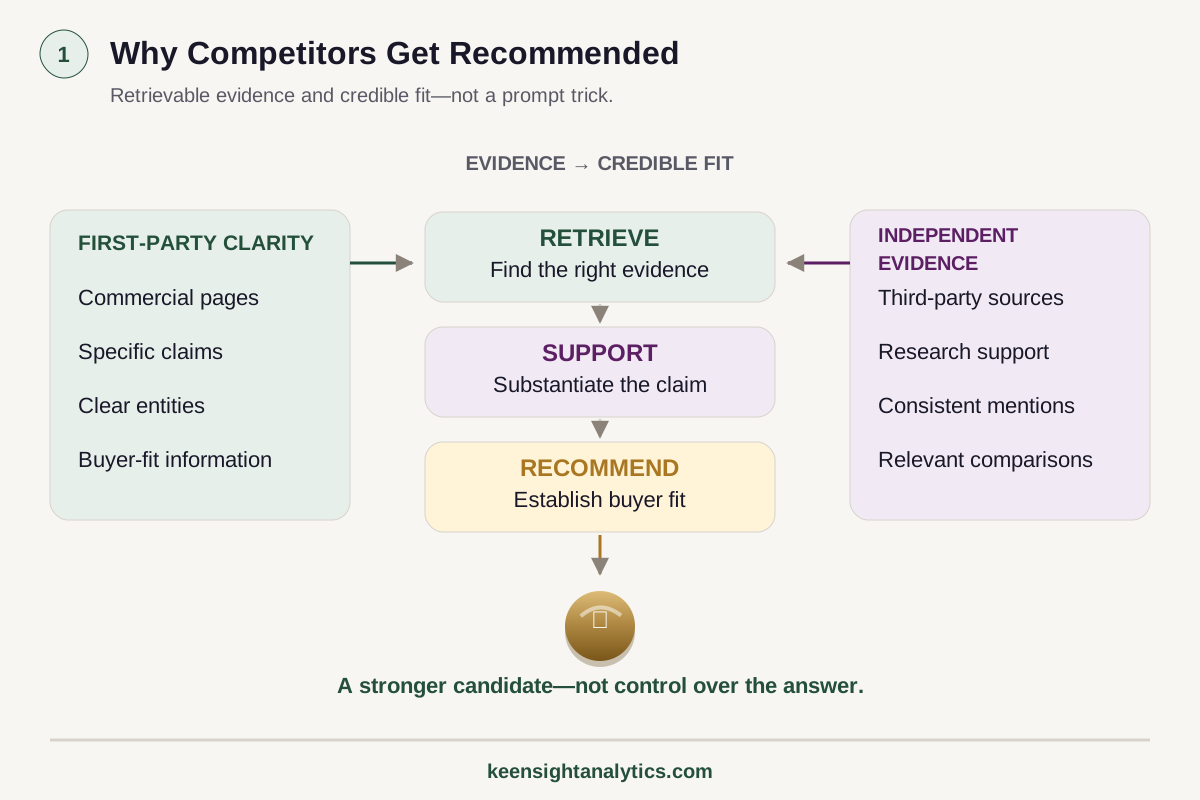
The framework
Why competitors get recommended
Compare first-party clarity with independent evidence.
First-party clarity
Commercial pages, specific claims, clear entities and buyer-fit information.
Independent evidence
Third-party sources, research, consistent mentions and relevant comparisons.
Retrieve
Find the right evidence.
Support
Substantiate the claim.
Recommend
Establish buyer fit.
A stronger candidate—not control over the answer.
AI search next step
If this issue shows up in commercial AI-search prompts, compare the evidence first before changing the content plan.When a competitor repeatedly appears in AI-generated recommendations and your company does not, it is tempting to search for a hidden optimization trick. Add more schema. Rewrite pages into question-and-answer blocks. Publish an llms.txt file. Mention the category more often. None of those actions, by themselves, answer the commercial question.
The more useful question is: what evidence about the competitor is available, understandable, and repeatedly relevant that is missing, weaker, or harder to interpret about your business?
AI search systems differ by product, model, retrieval method, index, and query. Their exact selection logic is not fully observable, and no legitimate SEO program can guarantee a recommendation. What you can observe is the output environment: which brands appear, which sources are shown, what reasons are given, how often the pattern repeats, and whether the same evidence gaps exist across your website and the wider web.
1. Separate mentions, citations, and recommendations
Start by refusing to collapse every appearance into one metric. A brand can be mentioned because the system knows it exists. A page can be cited because the system uses it as evidence. A company can be recommended because the answer presents it as a candidate for the user’s decision. Those states overlap, but they are not interchangeable.
A useful AI-search measurement model records at least four things for each prompt: whether the brand appears, whether its own domain appears as a visible source, whether third-party sources support the brand, and whether the answer places the brand in a recommendation or shortlist. That distinction prevents teams from celebrating a citation that never affects commercial consideration—or panicking because a brand was not cited even though it was still recommended.
KeenSight’s AI search citations explainer and recommendation visibility explainer treat these as separate measurement problems for the same reason.
2. Build a prompt universe around buyer decisions
One screenshot is an anecdote. Ten variations of the same prompt are still a weak market model. The first serious step is a controlled prompt universe based on how buyers actually evaluate the category.
Include category prompts such as “best payroll software for a 200-person company,” problem prompts such as “how should a regional HVAC company improve local search visibility,” comparison prompts, implementation questions, geographic questions where location matters, and prompts that include buyer constraints such as company size, industry, budget, integrations, regulatory environment, or service area.
Then group those prompts by intent. A competitor may dominate broad category recommendations while disappearing from technical implementation questions. Another may be cited constantly as a source without being recommended as a vendor. Segmenting the prompt set reveals where the actual commercial gap sits.
Keep a stable core set over time. Exploratory prompts are useful for learning, but a changing prompt list makes trend measurement unreliable. The goal is not to manufacture a favorable score. It is to build a repeatable market sample.
3. Compare the first-party evidence
Next compare the pages belonging to companies that appear with the pages belonging to companies that do not. Do not begin with word count. Begin with decision usefulness.
Strong first-party commercial evidence tends to answer concrete questions: What exactly is the service or product? Who is it for? What is included? What is excluded? How is it delivered? Which use cases fit? Which locations are served? What integrations or constraints matter? What does the pricing model look like? What evidence supports the company’s claims? What should a buyer do next?
A page that says a company provides “innovative, customized solutions” may sound polished to a brand team while supplying almost no comparative information to a buyer or retrieval system. Specific scope, methodology, product data, service areas, credentials, technical documentation, limitations, and transparent decision criteria create a much richer evidence surface.
This is why AI visibility is often a commercial-page problem before it is a blog problem. A thousand educational articles cannot compensate for a service page that never clearly explains the service.
4. Check whether the site is technically eligible to be retrieved
Content quality does not matter if important pages are unavailable to the systems that need to discover them. Review robots rules, status codes, canonical tags, indexability, rendering, internal links, sitemap inclusion, and whether the public HTML contains the information the page claims to provide.
For ChatGPT search specifically, OpenAI says public websites can appear in search and advises publishers not to block OAI-SearchBot if they want their content to be discoverable and included in summaries and snippets. See OpenAI’s publisher and developer guidance. Google similarly continues to frame technical accessibility, crawlable links, helpful content, and understandable page structure as core Search requirements in its Search Essentials.
Those facts do not mean “allow the crawler and get recommended.” They mean access is a prerequisite. Eligibility and selection are different stages.
5. Compare the third-party evidence environment
Companies are not described only by their own websites. Review platforms, trade associations, professional directories, publishers, partners, community discussions, technical documentation, government sources, original research, and industry resources can all shape the public evidence surrounding a brand.
Map which third-party domains recur around your prompt universe. Then ask why they are useful. Are they comprehensive directories? Do they publish structured comparisons? Do they have firsthand reviews? Are they authoritative primary sources? Do they contain original data? Are they simply more specific than vendor pages?
The wrong response is mechanical outreach to “get listed anywhere competitors are listed.” The right response depends on the source type. A missing association profile is an entity-completeness problem. A lack of independent reviews is a reputation problem. A market that cites original studies may point toward research or data. A market dominated by detailed technical documentation may expose a documentation gap.
6. Strengthen entity clarity
Search systems need to distinguish the company from similarly named entities and understand relationships among the company, products, services, people, offices, locations, and external profiles. Entity clarity starts with consistent visible information—not schema markup alone.
Use stable organization naming. Maintain accurate service and product descriptions. Make location relationships explicit. Keep author and expert profiles current. Link to legitimate external profiles where useful. Apply structured data when it accurately describes visible content and real relationships.
Schema can help make information machine-readable, but it does not turn vague or unsupported content into strong evidence. Think of structured data as a description layer, not a credibility generator.
7. Identify the dominant failure layer
Once you have first-party, technical, third-party, and prompt-level evidence, classify the dominant constraint.
- Access failure: important pages are blocked, poorly rendered, inconsistently canonicalized, or difficult to discover.
- Commercial evidence failure: the company is accessible but its pages do not explain enough for a buyer to distinguish it.
- Entity failure: products, services, locations, experts, or organization relationships are inconsistent or ambiguous.
- Independent evidence failure: competitors have stronger reviews, references, research, documentation, or third-party validation.
- Competitive-fit failure: the competitor is simply a better match for the prompt constraints.
- Measurement failure: the apparent gap comes from an unstable prompt set, one-off screenshots, or inconsistent sampling.
The response should match the failure. Technical problems need technical remediation. Thin commercial pages need stronger decision content. Weak independent evidence may require digital PR, research, partnerships, documentation, or reputation work. Measurement noise needs a better measurement system.
8. Do not optimize for a single generated answer
Generated answers can vary. Prompt wording changes. Platforms update retrieval and ranking systems. Source availability changes. A durable strategy cannot depend on forcing one exact output.
Measure repeated patterns across a controlled set and focus on evidence that improves the business’s discoverability beyond AI search as well: technically sound pages, strong commercial explanations, accurate entities, useful research, good documentation, legitimate reputation signals, and content that helps buyers make decisions.
That also protects the SEO program from chasing every new acronym. If an action would make the company clearer, more useful, more verifiable, and easier to discover even if a specific AI interface disappeared tomorrow, it is probably strategically defensible.
9. Turn the gap into an operating plan
A practical remediation plan should list each observed visibility gap, the evidence supporting it, the affected prompt or query segment, the likely failure layer, the proposed action, the owner, and the measurement that will confirm whether conditions changed.
For example, if competitors are repeatedly recommended for a regulated use case and your site barely explains compliance scope, the action may be a stronger use-case or methodology page. If competitors are repeatedly supported by reputable industry directories and your company has incomplete profiles, the action is entity and profile cleanup. If your pages never appear as sources and OAI-SearchBot is blocked, fix access before commissioning new content.
Not every diagnosis requires an ongoing managed program. A finite technical defect may fit a Technical SEO Project. A deeper one-time competitive or visibility question may fit a Search Intelligence Report. A company that already has execution resources but needs independent tracking may need measurement rather than implementation.
The objective is candidacy, not control
No company can control whether an AI system recommends it for a specific prompt. The operational objective is more disciplined: become a clearly understood, technically accessible, well-supported candidate when the user asks a question your company should reasonably be considered for.
That shifts AI SEO away from prompt tricks and toward evidence engineering: stronger commercial pages, clearer entities, better technical access, more useful information, legitimate independent validation, and repeatable measurement. Those improvements remain valuable even when the interface changes.
When this becomes an AI-search operating problem
Separate visibility evidence from implementation.
Use Search Intelligence when the source, citation, recommendation, or competitive gap still needs diagnosis. Use AI SEO when the failure layer is known and KeenSight needs to own implementation across content, entities, retrieval readiness, and supporting evidence.No AI-search engagement guarantees citations, recommendations, rankings, or placement in a specific answer.A worked recommendation-gap example
Suppose a company tests 20 commercial prompts across two AI-search systems. It appears in only 3 answers, while two competitors appear in 14 and 11. The winning answers repeatedly cite competitor integration documentation, pricing pages, comparisons, and independent review sources.
The useful conclusion is not “write more AI content.” The evidence says the brand has a weaker source surface for the facts buyers ask systems to synthesize. Map those gaps by prompt cluster, strengthen the missing first-party and independent evidence, then remeasure the same stable prompt set.
Use the recommendation gap to choose the next step
A recommendation gap becomes commercially useful only when it changes the next decision. If you have not yet established whether the brand appears across a stable set of buyer questions, begin with the Free Visibility Preview. If the gap persists but the cause is uncertain, Search Intelligence can separate source, competitor, entity, citation, and recommendation evidence before implementation begins.
When the failure layer is already clear and conventional SEO is covered, AI SEO is the focused implementation path. When an internal team or incumbent agency will execute the work, AI Visibility Monitoring keeps the measurement layer independent. For the supporting evidence model, read what makes a website usable as an AI-search source and how to map the sources influencing AI answers.
Decision checkpoint
Before changing the AI-search plan, verify which layer is actually failing.
A useful next step should follow the evidence. Use these checks to avoid turning a visibility observation into an unsupported implementation recommendation.AI-search visibility can be measured and improved as a system, but specific citations or recommendations cannot be guaranteed.- 01EvidenceDo you have a stable prompt set and repeated observations, rather than a single screenshot or anecdote?
- 02Failure layerCan you separate technical eligibility, source inclusion, entity clarity, independent evidence, and recommendation outcomes?
- 03OwnershipIs the need a one-time diagnosis, recurring measurement, or implementation work that KeenSight would own?
What to Measure
Recommendation visibility
Track whether the brand is actually presented as a candidate, not merely mentioned somewhere in the response.
Source inclusion
Record first-party and third-party sources separately so you can see which evidence environment supports the answer.
Failure layer
Classify gaps as technical access, commercial evidence, entity clarity, independent validation, competition, or measurement.
Trend stability
Use a stable prompt universe and repeated sampling instead of treating a single screenshot as market evidence.
Choose the next layer
Move from AI-search observation to the right operating model.
Compare other ways to get help
See where your search visibility is breaking
Start with a low-friction visibility preview. If the gap needs deeper diagnosis, move into one-time Search Intelligence rather than guessing at the fix.
Keep Reading
What Makes a Website an AI Search Source?
A deeper look at technical eligibility, extractability, evidence, entities, and source usefulness.
Read article →How AI Search Source Selection Works
Understand the retrieval and source-selection concepts behind generated search answers.
Read explainer →AI Search Recommendation Visibility
Separate recommendation outcomes from mentions and citations in your measurement model.
Read explainer →Make it specific
See what the market looks like for your company.
The free visibility preview turns a broad search topic into a limited personalized baseline.