August 28, 2026 · 10 min read
SEO for Wealth Management Firms: Building Trust Across Organic and AI Search
Prospective clients are not only searching for financial information. They are evaluating fit, expertise, geography, service model, and trust. The SEO system has to support that decision without oversimplifying consequential financial topics.
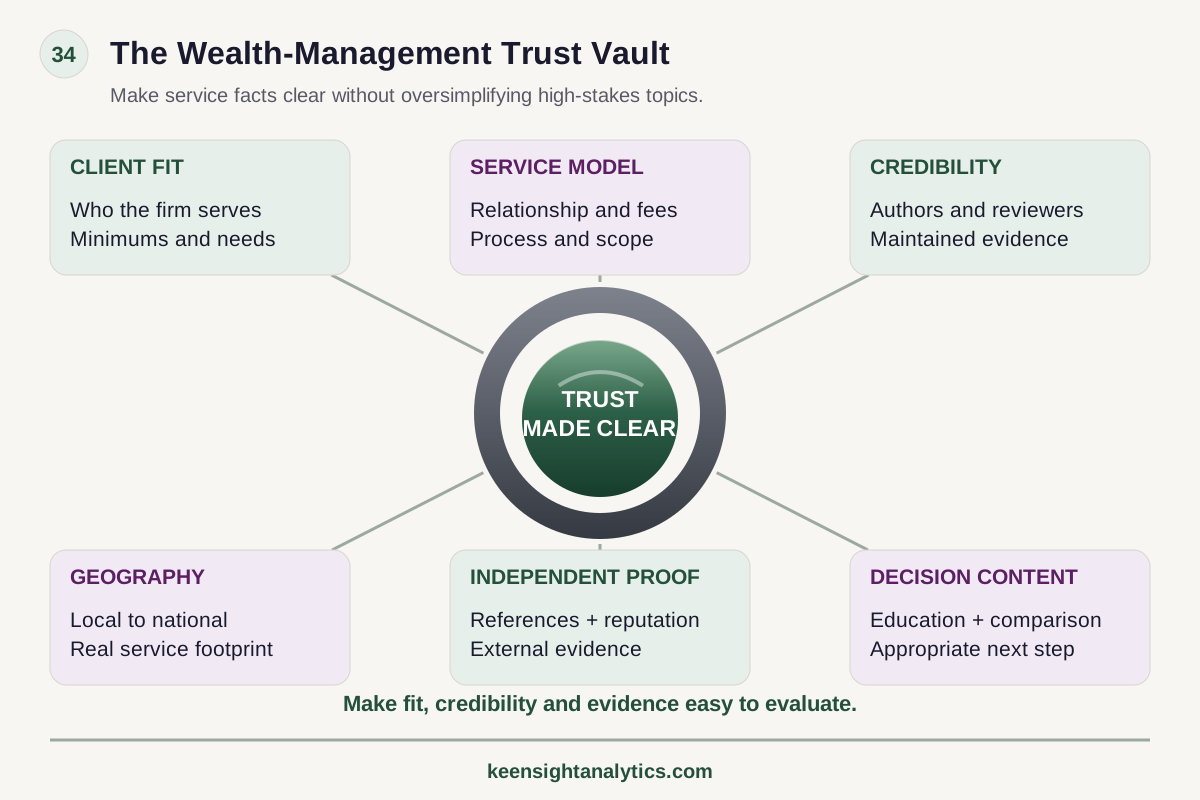
The framework
Wealth-management trust framework
Make service facts clear without oversimplifying high-stakes topics.
Client fit
Who the firm serves, minimums and needs.
Service model
Relationship, fees, process and scope.
Credibility
Authors, reviewers and maintained evidence.
Geography
Local to national, with a real service footprint.
Independent proof
References, reputation and external evidence.
Decision content
Education, comparison and an appropriate next step.
Make fit, credibility and evidence easy to evaluate.
SEO next step
Apply the framework to a real commercial page set before adding more activity to the roadmap.Wealth-management search is a trust problem before it is a keyword problem.
A prospective client may search for a financial advisor, retirement planning, tax-aware investing, business-owner planning, estate coordination, concentrated-stock questions, or help after a liquidity event. But the underlying decision is larger: Is this firm relevant to my situation, credible enough to trust, and clear about how the relationship works?
SEO for wealth managers and RIAs should make those answers easy to discover without turning nuanced financial decisions into simplistic marketing claims.
1. Define the client segments the firm actually serves
Start with real client fit, not keyword volume.
The firm may focus on retirees, executives, physicians, business owners, families with complex estates, employees with equity compensation, institutions, or clients above a particular complexity threshold. Those distinctions should influence the architecture because they change the questions buyers ask.
A generic “wealth management for everyone” site often produces generic search content.
2. Make service pages specific
Service pages should explain the actual planning or investment relationship: what the firm does, who it is designed for, how engagements work, what issues are commonly addressed, and what falls outside the scope.
Relevant service areas may include financial planning, investment management, retirement planning, tax-aware planning, estate coordination, business-owner planning, charitable planning, equity-compensation guidance, or family-office-style services where genuinely offered.
Specificity helps both search systems and prospective clients understand fit.
3. Separate educational information from individualized advice
Educational content can answer broad planning and evaluation questions, but it should not imply that a general article is personalized financial, legal, or tax advice.
Use appropriate disclaimers and review processes. Where a topic depends on current tax rules, regulations, contribution limits, or other changing facts, keep sources and update dates visible.
The goal is clarity and usefulness, not certainty beyond what the source supports.
4. Build author and reviewer credibility into the content system
Financial content should identify who wrote or reviewed it when possible.
Maintain professional biographies with credentials, roles, areas of focus, regulatory or professional affiliations where appropriate, and links to authored content. Keep claims accurate and current.
Authorship alone does not guarantee rankings, but it helps readers evaluate the information source.
5. Use client-fit pages carefully
Pages for “wealth management for business owners” or “financial planning for physicians” can be useful when the firm genuinely has a distinct service model, expertise, workflow, or decision framework for that audience.
They become thin doorway pages when every audience receives the same generic copy with a profession swapped in.
Only create vertical pages where operating context meaningfully changes the problem.
6. Decide whether the market is local, regional, or national
Some firms depend heavily on local discovery. Others serve a national specialist audience. Many do both.
For local strategies, maintain real office pages, consistent business information, relevant local profiles, and local reputation signals. For national specialist strategies, invest more deeply in topic expertise, original analysis, third-party references, and content aligned to the niche.
The geography should follow the actual service model.
7. Build a useful “why us” evidence layer
Prospective clients often want to understand how the firm differs from alternatives.
Useful evidence may include:
- clear service model;
- fee structure or pricing logic where appropriate and accurate;
- custodial or platform relationships when relevant;
- professional credentials;
- planning process;
- client-fit criteria;
- investment philosophy;
- third-party references or recognition that can be substantiated.
Avoid unsupported superlatives and performance implications the evidence cannot justify.
8. Use educational content to answer real decision questions
The editorial portfolio should support the buying journey, not chase broad finance traffic indiscriminately.
Topics might include how to evaluate an advisor, what questions to ask about fees, how planning and investment management differ, what happens during a liquidity event, how equity compensation affects planning complexity, or how to prepare for a first planning meeting.
Broad definitions can be useful, but they should not dominate the strategy if they attract audiences with little relationship to the firm’s proposition.
9. Create original evidence where the firm has a right to publish it
Benchmarking, anonymized aggregate research, transparent planning frameworks, checklists, and decision tools can create information gain when privacy, compliance, and methodology are handled appropriately.
Do not fabricate performance case studies or client outcomes. Original research should stand on a documented method.
10. Strengthen internal architecture
Connect educational content to the relevant service, audience, and methodology pages. Link service pages to deeper explainers and evaluation resources.
A prospective client should be able to move from “what is this?” to “is this relevant to me?” to “how does this firm work?” without beginning a new search after every page.
11. Measure the search market by client segment
Track visibility around the services and client types the firm actually wants to grow.
A large increase in traffic to generic finance definitions may be less valuable than a modest gain in visibility for high-fit retirement, business-owner, or equity-compensation searches.
Use query segments, competitive visibility, landing-page performance, and qualified inquiries together.
12. Identify the real search competitors
Search competitors may include national financial publishers, robo-advisors, directories, broker-dealers, local RIAs, accounting firms, and specialist advisory firms.
Build competitor cohorts by query segment. A publisher may dominate informational intent while a local advisory firm dominates commercial “near me” results.
13. Add AI-search visibility as a separate measurement layer
Prospective clients can ask AI systems questions such as which types of advisors may fit a particular situation, how RIAs differ, what to evaluate, or which firms operate in a market.
Track source inclusion, brand mentions, and recommendation behavior across a representative prompt set. Review whether the firm’s services, client fit, professionals, locations, and third-party references are represented accurately.
Do not treat one recommendation screenshot as proof of durable visibility or promise future recommendation placement.
14. Build an independent evidence footprint
Strong first-party pages are necessary but not sufficient for market trust.
Professional directories, associations, media references, expert commentary, community involvement, partner ecosystems, and other legitimate third-party references can strengthen how the firm is discovered and evaluated.
The objective is real-world credibility, not manufactured mentions.
15. Maintain high-stakes content
Assign update schedules to pages affected by tax law, regulation, market conventions, firm policies, pricing, or product changes.
Archive or update content that has become misleading. Keep dates visible where recency changes interpretation.
Wealth-management SEO should make trust legible
The best strategy does not attempt to turn every financial query into traffic. It makes the firm’s real proposition, expertise, client fit, geography, methods, and evidence easy to find and evaluate.
That creates a stronger foundation for organic search, local discovery, AI-search visibility, and qualified client inquiry without crossing the line into promises the firm should not make.
When this becomes recurring search work
Managed Search fits when several constraints have to move together.
Use managed KeenSight Search when technical foundations, commercial architecture, content, authority, and measurement require ongoing ownership. Use Search Intelligence first when the dominant constraint is still unclear.Treat financial SEO as high-stakes publishing
Assign a review process for service descriptions, performance-related language, testimonials, credentials, tax or investment education, and any statement that could be interpreted as individualized advice. Content should state scope and limitations clearly and be refreshed when laws, firm offerings, or professional guidance change.
SEO should improve discoverability of accurate information, not pressure the firm into broader claims than its compliance process can support.
Treat regulated communications as a constraint on the search program—not an afterthought
For wealth-management firms, Local SEO is relevant only when geography and real office markets materially affect client acquisition. Use Search Intelligence when the firm first needs to understand category demand, competitor positioning, service-intent coverage, or the source of a visibility gap. Use Search Benchmarking when leadership needs a recurring market frame while an internal or incumbent team executes.
Choose managed KeenSight Search when technical SEO, high-trust content, entity clarity, authority, competition, and measurement require recurring ownership. Publication still belongs inside the firm’s applicable compliance process: the SEC investment-adviser marketing rule applies to advisers registered or required to be registered with the SEC, while FINRA Rule 2210 governs member communications with the public. The applicable regime depends on the firm; KeenSight’s SEO process does not substitute for securities-law or compliance review.
Decision checkpoint
Confirm whether the problem is a page decision, a diagnosis problem, or a recurring ownership problem.
Broad SEO symptoms often combine technical, content, architecture, authority, competitive, and measurement constraints.- 01Commercial roleCan you name the affected page set, buyer decision, or search segment rather than describing the problem only as “SEO”?
- 02Dominant constraintDo you have evidence for the primary failure layer and evidence that argues against the alternatives?
- 03Operating modelCan an internal team execute a prioritized plan, or do several constraints require recurring external ownership?
The Wealth Management Search Framework
Client-fit clarity
Build pages around the people, services, and complexity the firm genuinely serves.
Responsible education
Separate general information from personalized advice and keep high-stakes facts reviewed and current.
Independent evidence
Strengthen discovery with legitimate third-party references rather than unsupported self-description.
Segmented measurement
Measure visibility and qualified inquiry by target client segment and service line.
SEO next steps
Move from broad search symptoms to the right level of ownership.
Compare other ways to get help
Benchmark the search markets your advisory firm actually cares about
KeenSight Search Intelligence can measure organic, local, competitive, and AI-search visibility without turning measurement into a claim about investment or search outcomes.
Keep Reading
Why Competitors Get Recommended by AI Search
Diagnose the evidence gap behind recommendation visibility.
Read article →Build Content Around Revenue
Prioritize content around the client decisions that matter commercially.
Read article →Topical Authority vs Content Volume
Build credible expertise through coherent evidence rather than publication volume.
Read article →Make it specific
See what the market looks like for your company.
The free visibility preview turns a broad search topic into a limited personalized baseline.