August 28, 2026 · 11 min read
The SEO Metrics Executives Actually Need to See
Executive reporting should reduce SEO into market position, commercial impact, risk, and decisions—not reproduce the specialist dashboard.
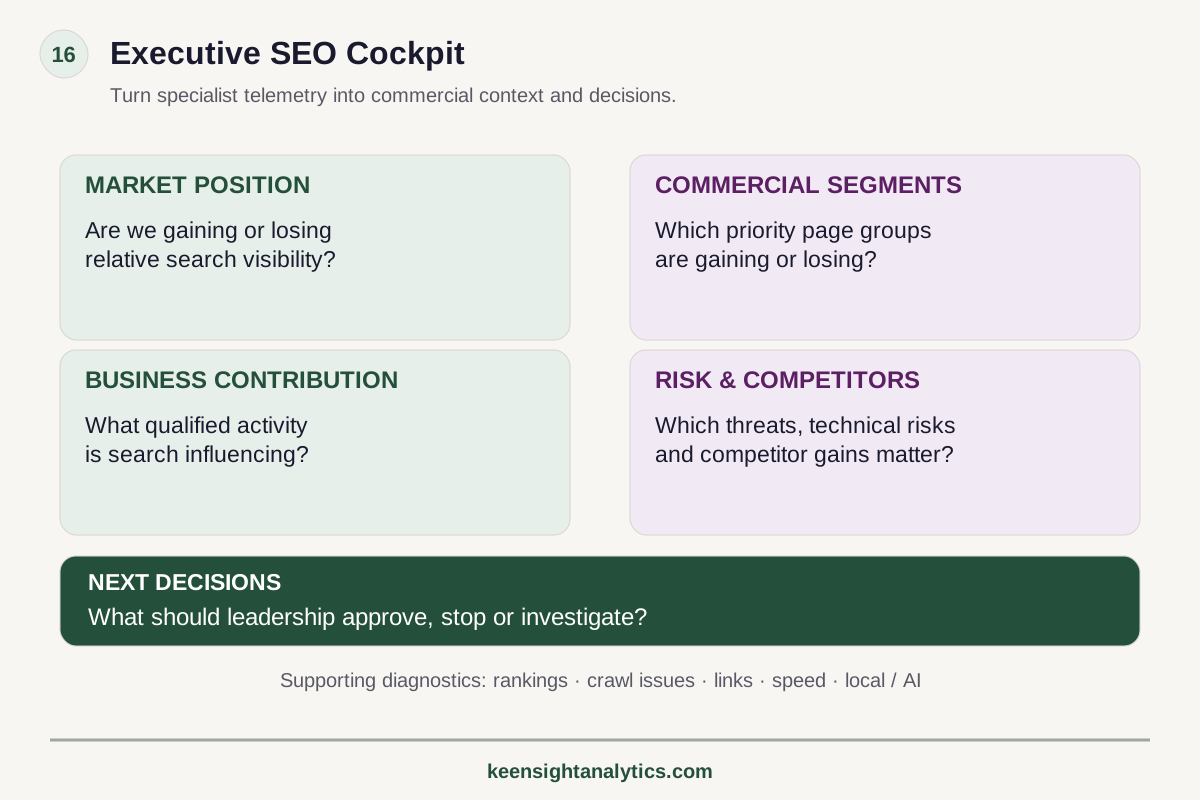
The framework
Executive SEO cockpit
Turn specialist telemetry into commercial context and decisions.
Market position
Are we gaining or losing relative search visibility?
Commercial segments
Which priority page groups are gaining or losing?
Business contribution
What qualified activity is search influencing?
Risk and competitors
Which threats, technical risks and competitor gains matter?
Next decisions
What should leadership approve, stop or investigate?
Keep rankings, crawl issues, links, speed and local/AI diagnostics underneath.
Measurement next step
Use a stable baseline and competitive frame before turning a reporting change into an implementation recommendation.SEO reporting often fails executives by giving them too much data and too little management information.
A 40-slide deck can contain rankings, clicks, impressions, crawl errors, page speed, backlinks, conversions, AI mentions, local grids, and content production while still failing to answer the questions leadership actually needs:
- Are we gaining or losing search-market position?
- Where is the change happening?
- Is search contributing qualified business activity?
- What could materially hurt or improve performance next?
- What decision does leadership need to make?
The executive scorecard should be built around those questions.
1. Start with competitive search visibility
Site traffic alone cannot tell leadership whether the business is gaining share.
Organic visits can increase because overall demand grew. They can decline because seasonality changed while competitive position stayed stable. A meaningful executive view therefore includes a competitive visibility measure across a defined query universe.
This can be reported as search share of voice, weighted visibility, or another transparent competitive index. The specific formula matters less than maintaining a stable methodology and segmenting it around the markets the business cares about.
Show current share, period-over-period change, and the competitors responsible for the largest gains or losses.
2. Break visibility into commercial segments
Sitewide averages can hide strategic failure.
A company can gain overall search visibility while losing its highest-margin service. A multi-location brand can improve nationally while three priority markets deteriorate. An ecommerce site can grow informational traffic while category pages lose purchase-intent demand.
Executive reporting should therefore segment by the organization's real growth structure:
- service line;
- product or category;
- industry;
- region or location;
- funnel or intent stage;
- brand vs nonbrand;
- strategic initiative.
Leadership should be able to see where search is gaining and losing, not merely whether the aggregate line is green.
3. Show the commercial landing pages that matter
An executive does not need a list of 1,000 URLs. They do need to know whether the pages responsible for revenue discovery are strengthening or weakening.
Create page groups for core services, product categories, locations, comparison pages, or other commercial destinations. Report their impressions, clicks, qualified conversions, and competitive visibility as a group.
This creates a bridge between SEO metrics and the site's commercial architecture.
4. Report qualified conversion contribution with attribution caveats
Search reporting becomes commercially useful when it connects visibility to business outcomes, but attribution should not be overstated.
Use the best defensible downstream metrics available:
- qualified leads;
- calls;
- demo or trial requests;
- ecommerce revenue;
- pipeline contribution;
- new customers;
- assisted conversions;
- location actions.
State whether the number represents last-click attribution, first-touch, assisted influence, CRM source, or another methodology. A precise number with weak attribution can be more misleading than a bounded range with clear assumptions.
5. Keep impressions and clicks, but explain what they mean
Search Console impressions and clicks remain useful first-party metrics. Google defines impressions and position according to specific result behaviors, and its own documentation recommends focusing on trends in impressions and clicks rather than position alone.
Executives should see those metrics when they explain a real change:
- impressions rising while clicks are flat may indicate broader visibility, changing SERP composition, or weaker click-through;
- clicks falling with stable impressions may warrant title, result-layout, intent, or SERP-feature analysis;
- both impressions and clicks falling in a priority segment may indicate lost visibility or falling demand.
Do not show raw totals without interpretation.
6. Use rankings as diagnostics, not the headline KPI
Rankings help explain competitive movement. They should not be the executive outcome.
Average position combines many queries, devices, geographies, and result layouts. A page can move from position 8 to 5 on an irrelevant term while a high-value query falls from 2 to 6.
Show ranking changes only when they explain a material commercial or competitive shift. Prefer segment-level visibility and win/loss summaries over pages of keyword arrows.
7. Surface competitor movement
Leadership needs to know not only what happened internally but who captured the lost opportunity.
A useful competitor section shows:
- the domains gaining the most weighted visibility;
- which topic or commercial segments they gained in;
- which page types are driving the gain;
- whether the competitor is a direct business rival, marketplace, publisher, directory, or other search competitor;
- what changed enough to warrant a response.
This turns competitive reporting into a decision input rather than a vanity comparison.
8. Include technical risk as exposure, not issue count
"We have 347 technical SEO issues" is rarely useful to an executive.
Translate technical findings into business exposure:
- priority pages at risk of deindexation;
- migration defects affecting a major revenue section;
- rendering failures across a product template;
- sitewide canonical errors;
- local-location data inconsistencies;
- analytics defects preventing reliable measurement.
Report severity, affected scope, owner, and expected resolution—not crawler warning volume.
9. Add local visibility when geography drives revenue
For local and multi-location organizations, national organic metrics can miss the real competitive market.
Executive local reporting may include:
- geographic coverage across priority query groups;
- market-level share;
- Google Business Profile actions;
- review health and operational issues;
- location-page conversion performance;
- markets with material competitive loss.
A single "average local rank" is not enough when visibility changes block by block.
10. Add AI-search visibility where it is commercially relevant
AI search should be reported as a distinct discovery surface, not blended invisibly into traditional rankings.
Depending on the business and available data, report:
- source inclusion;
- brand mentions;
- citations;
- recommendations;
- competitor frequency;
- recurring source domains;
- first-party platform reporting where available.
Use a stable commercial prompt set and avoid overreacting to one response.
11. Show demand context
Executives need to know whether changes reflect site performance or market demand.
Add context for seasonality, category demand, branded-search changes, major industry events, or SERP changes. A 15% traffic decline can mean something very different if category demand fell 25% and market share increased.
Search performance should be interpreted relative to the opportunity environment.
12. Report what changed, why, and confidence
Every material movement should have an interpretation.
Use language such as:
- Observed: nonbrand visibility for Service A fell 9% quarter over quarter.
- Likely drivers: two competitors gained category pages while our service page lost internal links after the navigation release.
- Confidence: medium; demand remained stable, but several SERP features also changed.
- Decision: restore internal links and perform a competitive content review before commissioning net-new articles.
This makes uncertainty explicit rather than presenting every SEO explanation as fact.
13. End the scorecard with decisions
Executives do not need reporting for its own sake.
The final section should list actions requiring management attention:
- continue current investment;
- reallocate resources;
- approve a technical remediation;
- investigate a competitive loss;
- change market priorities;
- stop low-value production;
- approve a redesign safeguard;
- improve measurement before making a larger decision.
If the report does not help someone decide, it probably contains too much telemetry and not enough analysis.
14. A one-page executive SEO scorecard
A concise quarterly or monthly view can contain:
- Market position: weighted search share and change.
- Commercial segments: strongest gains and losses.
- Business contribution: qualified conversions or best downstream measure.
- Competitors: material win/loss movement.
- Discovery surfaces: local and AI visibility where relevant.
- Risk: technical or measurement issues with material exposure.
- Next decisions: three to five management actions.
The specialist team can maintain deeper dashboards underneath this layer. Leadership should receive the abstraction appropriate to the decision.
Executive reporting is an operating system
The purpose of SEO measurement is not to prove that the SEO team was busy.
It is to tell the business where it is gaining or losing discoverability, whether that visibility produces useful commercial activity, what competitors are changing, which risks matter, and what management should do next.
Primary reference
Google's definitions for Search Console impressions, clicks, and average position are documented in What are impressions, position, and clicks?. The methodology is important when translating Search Console metrics into executive reporting.
When this becomes a measurement program
Choose the cadence based on the decision—not the dashboard.
Search Benchmarking fits recurring executive comparison. Monitoring fits continuous measurement when an internal team or incumbent executes changes. Search Intelligence fits a deeper one-time diagnosis when leadership needs to understand why visibility changed before choosing implementation.A one-page executive SEO scorecard
Keep the executive layer compact: 1) commercial search visibility share, 2) qualified organic conversions or pipeline where defensible, 3) priority page-group movement, 4) competitive wins/losses, 5) major technical or indexation risk, and 6) the next decision requiring leadership attention.
Keyword, crawl, and page-level detail belongs underneath the scorecard, not on its first screen.
Choose the measurement product by the executive decision, not the dashboard
An executive scorecard should tell leadership whether the search market is improving, deteriorating or changing in a way that requires a decision. Use the Free Visibility Preview when you only need an initial market signal. Use Search Intelligence when an executive question requires one-time causal analysis rather than another recurring chart.
Choose Search Benchmarking for a stable recurring competitive frame that leadership can review over months and quarters. Choose Monitoring when the need is ongoing observation while an internal team or incumbent executes. The executive review cadence article shows how the same evidence should be packaged differently for weekly operations, monthly management and quarterly leadership decisions.
Decision checkpoint
Make sure the metric is tied to a decision before building another dashboard.
Measurement should establish a stable denominator, competitive frame, and cadence. It should not silently become implementation advice.- 01DefinitionAre the query set, competitor cohort, geography, weighting, page groups, and conversion definitions stable enough to compare over time?
- 02DecisionWhat action will leadership take if the metric moves materially up, down, or sideways?
- 03OwnershipDoes KeenSight only measure, or is there a separate requirement for diagnosis or managed implementation?
The Executive SEO Scorecard
Competitive visibility
Show whether the business is gaining or losing weighted search-market position across strategic segments.
Commercial contribution
Connect priority landing-page groups to qualified conversions using explicit attribution assumptions.
Risk + competitors
Surface material technical exposure and the competitors responsible for meaningful share movement.
Decisions
End with the actions leadership needs to approve, stop, investigate, or reprioritize.
Search measurement
Choose the measurement product by the decision and cadence.
Compare other ways to get help
Give leadership a search-market view, not another ranking report
Search Benchmarking separates measurement from implementation and gives teams an independent view of competitive visibility when an incumbent team owns execution.
Keep Reading
Why Ranking Reports Can Mislead
Understand the measurement traps hidden inside keyword-level reporting.
Read article →Measure Search Market Share
Build the competitive denominator behind the executive visibility metric.
Read article →Executive Search Market Reporting
Review the evergreen framework for decision-oriented search reporting.
Read explainer →Make it specific
See what the market looks like for your company.
The free visibility preview turns a broad search topic into a limited personalized baseline.