August 28, 2026 · 11 min read
What Does a Good SEO Baseline Look Like Before a Redesign or Growth Program?
Capture the current search system before you change it: visibility, page groups, competitors, indexation, conversions, links, local coverage, AI-search exposure, and measurement configuration.
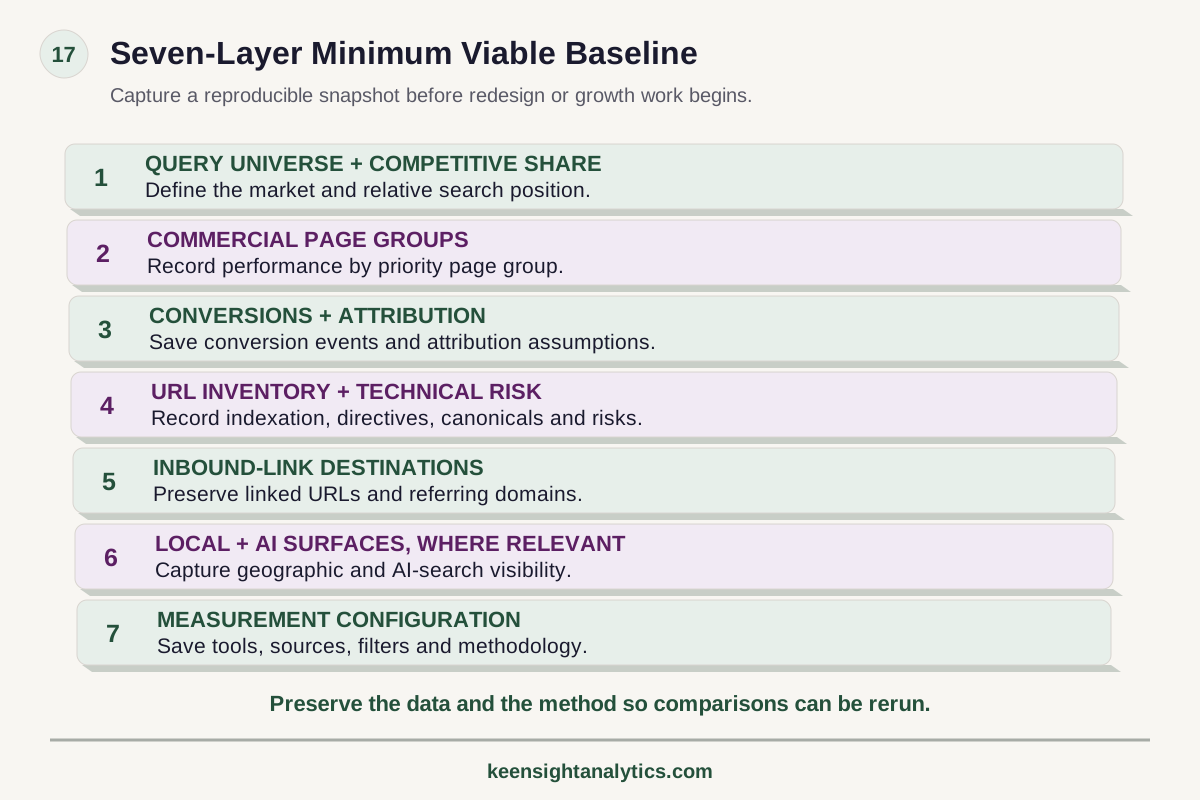
The framework
Seven-layer minimum viable baseline
Capture a reproducible snapshot before redesign or growth begins.
Query universe and competitive share
Define the market and relative search position.
Commercial page groups
Record performance by priority group.
Conversions and attribution
Save conversion events and attribution assumptions.
URL inventory and technical risk
Record indexation, directives, canonicals and risks.
Inbound-link destinations
Preserve linked URLs and referring domains.
Local and AI surfaces
Capture geographic and AI-search visibility where relevant.
Measurement configuration
Save tools, sources, filters and methodology.
Preserve the data and method so comparisons can be rerun.
Measurement next step
Use a stable baseline and competitive frame before turning a reporting change into an implementation recommendation.Before a major redesign or SEO investment, teams usually know they should record traffic.
Traffic alone is not enough.
Six months after launch, the important question will not simply be "did organic sessions increase?" It will be: what changed relative to the opportunity we had before, which page groups moved, which competitors gained or lost, and can we separate site effects from demand and measurement changes?
A good baseline preserves enough of the pre-change state to answer that question.
1. Define the decision the baseline needs to support
Different changes require different baselines.
A redesign needs strong URL, content, technical, and conversion snapshots. A new managed SEO program needs competitive visibility, page-group performance, technical constraints, authority, and commercial search demand. A local expansion needs geographic grids and location-level competitors. An AI-search initiative needs a stable prompt set and source observations.
Do not collect data merely because it exists. Collect the evidence required to evaluate the upcoming intervention.
2. Freeze an indexable URL inventory
Capture the URLs the site intends to make available for search before the change.
For each important URL, record:
- page type;
- HTTP status;
- indexation directive;
- canonical;
- sitemap inclusion;
- title and primary heading;
- major internal-link relationships;
- organic traffic or impressions;
- conversion role.
This inventory becomes invaluable after a migration because it shows which old search destinations existed and what job each one performed.
3. Create page groups
Sitewide totals hide too much.
Group pages by commercial and architectural role: services, products, categories, locations, industries, comparisons, blogs, resources, documentation, utilities, and any important programmatic templates.
Then capture performance for each group. A redesign may improve the blog while damaging service pages. A growth program may increase informational impressions while category visibility remains unchanged.
Page-group baselines make those distinctions measurable.
4. Capture the query universe, not only current ranking keywords
A baseline should describe the search market the business wants to compete in, including places where it currently has weak visibility.
Build a representative query universe grouped by:
- service or category;
- commercial intent;
- brand vs nonbrand;
- funnel or decision stage;
- location;
- industry;
- strategic importance.
This avoids a common baseline mistake: recording only the keywords the site already ranks for and therefore ignoring the opportunity gap the program is supposed to address.
5. Measure competitive search share
Capture who owns visibility across the query universe before the program begins.
Record the competitive cohort, weighted visibility by segment, top winning domains, and the page types responsible for those wins.
This gives future reporting a denominator. Traffic may grow while market share falls. Rankings may improve while competitors expand faster. A competitive baseline lets leadership distinguish absolute growth from relative progress.
6. Preserve Search Console performance data
Capture clicks, impressions, CTR, and position trends by query, page, country, device, and search appearance where useful.
Export data for priority pages and page groups before the change. Search Console retains historical data for a limited window, and future aggregation or property changes can make reconstruction difficult.
Document how filters were applied so later comparisons reproduce the baseline rather than approximate it.
7. Capture conversion and attribution configuration
Search performance cannot be interpreted commercially if the measurement system changes invisibly.
Record:
- analytics platform and property;
- consent configuration;
- conversion events;
- form and call tracking;
- ecommerce events;
- CRM source fields;
- attribution model;
- cross-domain settings;
- known data gaps.
If a redesign also changes analytics, the organization needs to know whether a reported performance shift came from search behavior or instrumentation.
8. Snapshot technical health by template
Do not reduce technical baseline data to one health score.
Capture meaningful technical states for major page groups:
- crawlability;
- indexation directives;
- canonicalization;
- status-code patterns;
- redirect chains;
- rendered content;
- internal-link depth;
- structured data;
- Core Web Vitals or other performance data where relevant;
- XML sitemap behavior.
This allows a post-change audit to identify what actually improved or regressed.
9. Capture backlink and referring-domain context
A migration can break inbound equity when old URLs disappear or redirect incorrectly.
Record high-value linked URLs, important referring domains, and assets that have earned meaningful references. During a redesign, those pages deserve careful URL mapping.
For a growth program, the baseline also shows whether authority is concentrated in editorial content while commercial pages remain weakly connected.
10. Capture local visibility geographically
For local or multi-location businesses, record visibility across the actual market—not from one device in one office.
Use representative geographic points and stable query groups to establish:
- local-pack coverage;
- organic visibility;
- market-specific competitors;
- strong and weak geographic zones;
- location-page performance;
- Google Business Profile state.
This makes future local SEO improvements measurable as market coverage rather than anecdotal rank checks.
11. Capture AI-search visibility where relevant
If AI discovery is commercially important, build a stable prompt baseline before work begins.
Record platform, prompt, date, brand mentions, recommendations, visible sources, citations, and competitor appearances. Keep the core prompt set stable enough to compare over time.
This is not a substitute for organic search data. It is an additional discovery surface with its own measurement method.
12. Record the existing content architecture
Before a redesign or content program, document the relationships among service, industry, location, resource, and blog pages.
Capture important navigation paths, breadcrumbs, contextual internal links, and hub relationships. A new design can preserve URLs but accidentally dismantle the internal graph that helped users and crawlers discover priority pages.
13. Capture SERP composition
The search results themselves are part of the baseline.
For strategic query segments, note whether results contain:
- local packs;
- shopping results;
- AI Overviews;
- videos;
- forums;
- featured snippets;
- large publishers or marketplaces;
- other result features that materially affect clicks.
A future decline in clicks may reflect a changed result page rather than a simple ranking loss.
14. Annotate known business and market conditions
Baseline data needs context.
Record major promotions, seasonality, product launches, acquisitions, brand campaigns, pricing changes, market disruptions, and offline events that influence search demand or conversion.
This makes later analysis less likely to attribute every movement to SEO.
15. Store the baseline in a reproducible format
A baseline is only useful if it survives staff changes and can be rerun.
Document:
- date range;
- query set version;
- competitor cohort;
- visibility formula;
- page-group rules;
- data sources;
- filters;
- attribution assumptions;
- known limitations.
Store raw exports alongside the summary. The executive benchmark should be understandable, while the underlying evidence remains available for investigation.
16. A strong baseline produces a change ledger
Once the program begins, annotate meaningful interventions against the baseline:
- redesign launch;
- URL migration;
- technical fixes;
- new commercial pages;
- content consolidation;
- major link or PR activity;
- Google Business Profile changes;
- measurement changes.
This does not create perfect causality, but it greatly improves diagnosis.
17. The minimum viable executive baseline
If time is limited, preserve these seven layers:
- query universe and competitive share;
- priority commercial page-group performance;
- conversion contribution and attribution method;
- indexable URL inventory and major technical risks;
- high-value inbound-link destinations;
- local and AI-search baselines where relevant;
- analytics and measurement configuration.
Measurement before implementation protects the decision
A good baseline does not guarantee that a redesign or SEO program will succeed. It guarantees something almost as important: the organization will be able to evaluate what changed with substantially less guesswork.
Without a baseline, post-launch analysis becomes reconstruction. With one, it becomes comparison.
When this becomes a measurement program
Choose the cadence based on the decision—not the dashboard.
Search Benchmarking fits recurring executive comparison. Monitoring fits continuous measurement when an internal team or incumbent executes changes. Search Intelligence fits a deeper one-time diagnosis when leadership needs to understand why visibility changed before choosing implementation.Baseline capture template
Before a major change, freeze: priority URLs and page roles; query and landing-page performance; indexed/canonical states; internal links to critical pages; backlinks to priority URLs; conversion and analytics configuration; current competitor visibility; local grid coverage where relevant; and AI-search observations if they are part of the program.
Date the snapshot and store the methodology. A baseline is useful only when the post-change comparison uses the same definitions.
Use the baseline to preserve attribution before the program changes
A baseline is a control surface, not a decorative pre-project report. If you only need a limited current-market signal, start with the Free Visibility Preview. If the baseline must explain existing weaknesses or unresolved competitor gaps before a redesign or growth program, use Search Intelligence for the deeper one-time diagnosis.
Use Search Benchmarking when the pre-change query set, competitor cohort and market frame should remain stable after launch so leadership can compare like with like. Use Monitoring when another team will execute the redesign or growth work and KeenSight should independently observe the resulting changes. For post-change causality, pair the baseline with the traffic-decline diagnostic.
Decision checkpoint
Make sure the metric is tied to a decision before building another dashboard.
Measurement should establish a stable denominator, competitive frame, and cadence. It should not silently become implementation advice.- 01DefinitionAre the query set, competitor cohort, geography, weighting, page groups, and conversion definitions stable enough to compare over time?
- 02DecisionWhat action will leadership take if the metric moves materially up, down, or sideways?
- 03OwnershipDoes KeenSight only measure, or is there a separate requirement for diagnosis or managed implementation?
Baseline the Search System
Market position
Capture a defined query universe, competitor cohort, and weighted visibility before the intervention.
Commercial pages
Freeze page-group clicks, impressions, conversions, internal links, and indexation state.
Technical + measurement
Record template behavior, URL inventory, analytics configuration, and known data limitations.
Local + AI surfaces
Add geographic search coverage and stable AI prompt observations when those surfaces matter commercially.
Search measurement
Choose the measurement product by the decision and cadence.
Compare other ways to get help
Establish the baseline before the site changes
Search Benchmarking creates an independent measurement layer that can survive redesigns, incumbent changes, and shifting implementation teams.
Keep Reading
Rebuild a Website Without Losing SEO
Use the baseline to protect URLs, content, links, and measurement through a migration.
Read article →Independent SEO Performance Measurement
Separate measurement ownership from implementation when another team executes.
Read explainer →Make it specific
See what the market looks like for your company.
The free visibility preview turns a broad search topic into a limited personalized baseline.