August 28, 2026 · 11 min read
How to Determine Whether a Traffic Decline Is an SEO Problem or a Market Problem
Organic traffic can fall because the site lost visibility, the market searched less, the SERP captured more clicks, analytics changed, or competitors displaced you. The response depends on the cause.
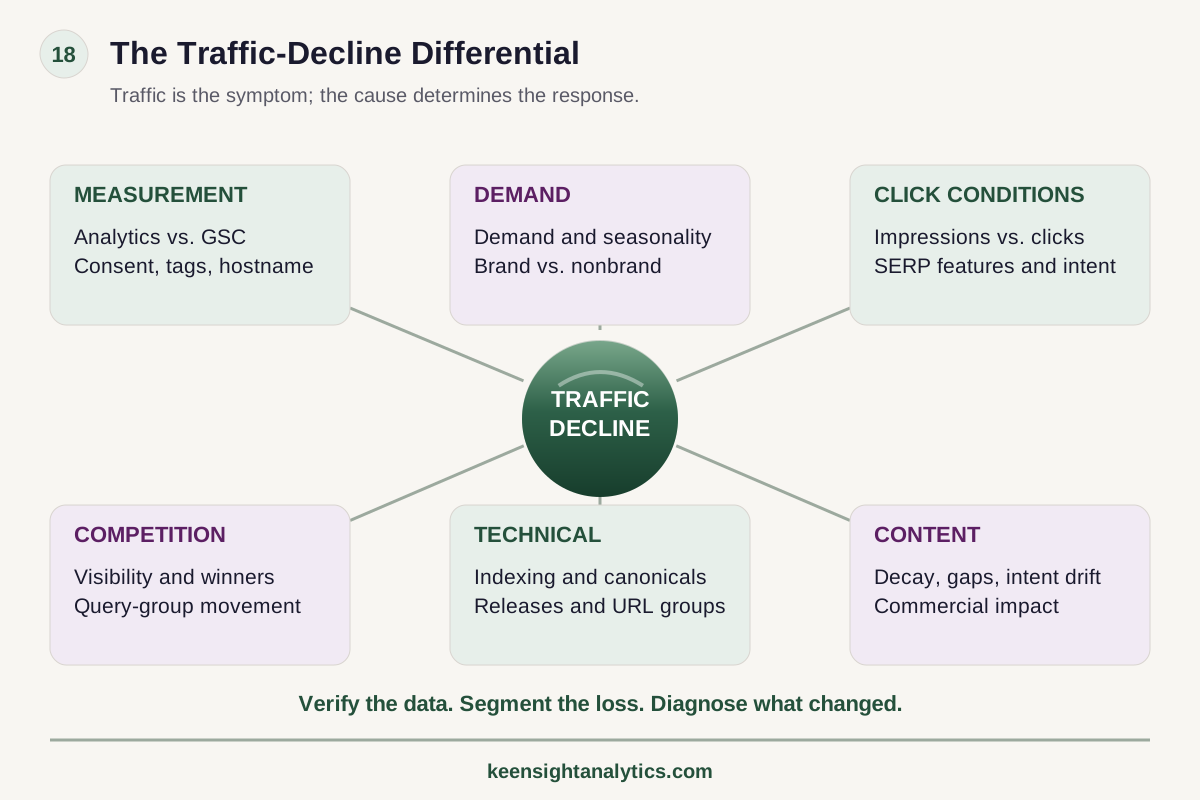
The framework
Traffic-decline differential
Traffic is the symptom; the cause determines the response.
Measurement
Compare analytics and Search Console; check consent, tags and hostname.
Demand
Review demand, seasonality and brand versus nonbrand.
Click conditions
Compare impressions and clicks, SERP features and intent.
Competition
Review visibility, winners and query-group movement.
Technical
Check indexing, canonicals, releases and URL groups.
Content
Check decay, gaps, intent drift and commercial impact.
Verify the data. Segment the loss. Diagnose what changed.
Measurement next step
Use a stable baseline and competitive frame before turning a reporting change into an implementation recommendation.Organic traffic is an outcome of several systems interacting at once.
Search demand changes. Rankings change. Search-result layouts change. Competitors improve. Brand interest rises and falls. Analytics breaks. Websites migrate. Seasonality repeats. AI-generated search features can change how users interact with results.
That is why "organic sessions are down 20%" is a symptom, not a diagnosis.
Before commissioning new content, buying links, or rewriting the site, determine which part of the system actually changed.
1. Verify the measurement first
Start by checking whether the decline exists in the underlying data.
Review:
- analytics implementation;
- consent changes;
- tag-manager releases;
- cross-domain tracking;
- bot filtering;
- channel grouping;
- URL or hostname changes;
- conversion-event changes;
- Search Console clicks and impressions.
If analytics sessions fell but Search Console clicks remained stable, the first investigation may be measurement rather than search visibility.
2. Segment the decline before explaining it
Sitewide organic traffic hides the mechanism.
Split the decline by:
- brand vs nonbrand;
- page type;
- service or product line;
- location;
- device;
- country or market;
- informational vs commercial intent;
- new vs returning pages;
- date pattern.
A 20% sitewide decline caused almost entirely by old informational articles is a different business problem from a 10% decline concentrated in core service pages.
3. Compare impressions and clicks
Search Console can help separate visibility from click behavior.
Common patterns include:
- Impressions down, clicks down: possible demand loss, ranking loss, deindexation, or reduced query coverage.
- Impressions stable, clicks down: possible CTR decline, SERP feature changes, weaker result presentation, or changed intent.
- Impressions up, clicks flat: broader visibility may be occurring in lower-click or lower-position contexts.
- Clicks stable, analytics sessions down: likely measurement or landing-page instrumentation issue.
These are hypotheses, not automatic conclusions, but they narrow the investigation.
4. Check market demand
A category can shrink even when your rankings do not.
Review query-level impressions, keyword-demand trends, seasonality, category data, and known market events. Compare year over year where seasonality is strong.
Ask:
- Are fewer people searching for the category?
- Did demand shift to different terminology?
- Did a product category decline?
- Did offline economic conditions affect demand?
- Did seasonality start earlier or later?
If total market demand fell 30% while your traffic fell 15%, the business may actually have gained relative search position.
5. Separate branded demand from SEO execution
Brand search is influenced by advertising, PR, reputation, customer growth, offline presence, and market awareness.
If branded organic clicks fall because fewer people search for the company name, that is not automatically an SEO failure. Conversely, a large brand campaign can make organic traffic look strong even while nonbrand competitive visibility deteriorates.
Report brand and nonbrand demand separately where the data supports it.
6. Measure competitive share
This is where market-share measurement becomes critical.
Track a stable query universe and ask whether your weighted visibility changed relative to competitors.
Four broad states are possible:
- Traffic down, share stable: likely demand or click-environment pressure.
- Traffic down, share up: market may be shrinking faster than your visibility.
- Traffic down, share down: competitive displacement or technical/content loss becomes more likely.
- Traffic up, share down: market growth may be masking competitive weakness.
Traffic without competitive context can tell the wrong story.
7. Identify who gained the lost visibility
If share declined, identify the domains that captured it.
Then analyze the winning page types:
- new service or category pages;
- stronger comparisons;
- original research;
- marketplaces;
- directories;
- local competitors;
- forums;
- video or other formats;
- AI-generated or SERP features reducing traditional click opportunity.
"Competitors gained" becomes actionable only when you know where and how.
8. Review ranking and URL changes by segment
If impressions and competitive share fell, inspect ranking movement on important query groups.
Also check whether the same URL still ranks. URL rotation can indicate cannibalization, content consolidation, changed canonicalization, or a mismatch between page role and query intent.
A site can appear to hold average position while the wrong page starts ranking and converting poorly.
9. Check for technical changes
Overlay the decline with the site's release timeline.
Look for:
- redesigns or migrations;
- URL changes;
- robots or noindex changes;
- canonical updates;
- navigation changes;
- JavaScript framework releases;
- site-speed incidents;
- server instability;
- sitemap changes;
- content-management updates.
Technical losses often have page-group patterns that align with a template or deployment.
10. Check indexation and canonical state
For affected landing pages, confirm whether they remain indexable and canonical.
A traffic decline caused by deindexation requires a very different response from one caused by a competitor improving its content.
Sample high-value lost pages and compare declared canonicals, Google-selected canonicals where available, status codes, rendered content, and internal-link paths.
11. Review content decay and intent drift
A page can lose visibility because the answer is no longer competitive.
Look for outdated statistics, old product information, stale legal or regulatory context, weak examples, changed buyer questions, or SERPs that now favor a different page type.
Do not refresh content solely because its traffic declined. First establish whether the page's underlying intent and commercial role are still valid.
12. Examine SERP composition
Classic organic position does not fully describe click opportunity.
Compare the result page over time. New local packs, shopping modules, AI Overviews, videos, forums, featured snippets, ads, or other features can change where users click.
If ranking remains similar but clicks fall across the market, the search interface may have changed the available click share.
13. Check conversion quality separately from traffic
Not every traffic loss has equal commercial impact.
A site may lose broad informational traffic while qualified leads remain stable. Or sessions may decline modestly while high-intent conversions collapse.
Track affected landing-page groups through qualified business outcomes. This helps leadership distinguish a reporting concern from a revenue problem.
14. Build a cause matrix
Summarize the evidence across possible causes:
- measurement issue;
- market-demand decline;
- brand-demand decline;
- competitive displacement;
- technical defect;
- indexation/canonical issue;
- content decay or intent shift;
- SERP click-environment change.
For each, record supporting evidence, contradictory evidence, and confidence.
This prevents one plausible explanation from becoming accepted fact too early.
15. Match the response to the diagnosis
Different causes require different actions.
- A technical defect may require finite remediation.
- Competitive displacement may require stronger commercial pages, content, authority, or managed search.
- A demand decline may require market strategy, positioning, or channel diversification—not an SEO fix.
- A measurement problem requires analytics repair.
- A SERP click shift may require content-format changes or a revised KPI model.
- Uncertain causality may justify deeper Search Intelligence before implementation.
16. A 60-minute first-pass investigation
- Verify analytics and Search Console agreement.
- Segment traffic by page type, brand/nonbrand, and commercial importance.
- Compare impressions, clicks, and query demand.
- Check competitive search share.
- Identify the domains and page types gaining visibility.
- Overlay technical releases and indexation changes.
- Review SERP composition for the largest lost segments.
- State the top two or three hypotheses with confidence levels.
This will not solve every decline, but it often prevents an expensive wrong turn.
Traffic is the symptom. Competitive position is the diagnosis layer.
SEO should not be blamed for every organic traffic decline, and market conditions should not be used to excuse genuine competitive losses.
The responsible approach is to separate demand, visibility, click behavior, technical state, competitors, and measurement—then act on the layer the evidence supports.
When this becomes a measurement program
Choose the cadence based on the decision—not the dashboard.
Search Benchmarking fits recurring executive comparison. Monitoring fits continuous measurement when an internal team or incumbent executes changes. Search Intelligence fits a deeper one-time diagnosis when leadership needs to understand why visibility changed before choosing implementation.Use a cause matrix
Classify the decline across five causes: demand (the market searched less), SERP (click opportunity changed), measurement (analytics or consent changed), technical/site (eligibility or routing changed), and competition (other domains gained share).
Require at least one supporting observation before prescribing remediation.
Diagnose the decline before choosing measurement or implementation
A traffic decline does not prove an SEO execution failure. First separate total demand, SERP click behavior, analytics faults, technical loss and competitive displacement. A Free Visibility Preview can provide a limited external market signal, while Search Intelligence is the one-time diagnostic path when leadership needs to understand why the decline happened.
Use Search Benchmarking when the business needs a durable comparison against demand and competitor movement over time. Use Monitoring when another team owns remediation and KeenSight should track whether the affected search and AI-search signals recover, continue declining or shift elsewhere. The competitor-discovery framework helps test whether apparent demand loss is actually displacement.
Decision checkpoint
Make sure the metric is tied to a decision before building another dashboard.
Measurement should establish a stable denominator, competitive frame, and cadence. It should not silently become implementation advice.- 01DefinitionAre the query set, competitor cohort, geography, weighting, page groups, and conversion definitions stable enough to compare over time?
- 02DecisionWhat action will leadership take if the metric moves materially up, down, or sideways?
- 03OwnershipDoes KeenSight only measure, or is there a separate requirement for diagnosis or managed implementation?
Separate the Possible Causes
Demand
Determine whether the market, seasonality, or branded interest changed before assuming the site lost search performance.
Competitive share
Measure whether other domains captured more of the same search opportunity.
Technical + indexation
Overlay migrations, directives, canonicals, rendering, and navigation changes with the decline.
Click environment
Account for SERP features and result-layout changes when rankings remain stable but clicks fall.
Search measurement
Choose the measurement product by the decision and cadence.
Compare other ways to get help
Diagnose the decline before funding the fix
Search Intelligence is designed for cases where the symptom is clear but the dominant failure layer is not.
Keep Reading
Measure SEO Market Share
Build the competitive denominator that separates demand decline from share loss.
Read article →Find the Competitors Taking Visibility
Identify which domains and assets captured the lost search opportunity.
Read article →Content Decay vs Competitive Displacement
Distinguish an aging page from a market that simply moved ahead.
Read explainer →Make it specific
See what the market looks like for your company.
The free visibility preview turns a broad search topic into a limited personalized baseline.