August 28, 2026 · 11 min read
How to Tell Whether Your SEO Problem Is Technical, Content, Authority, or Competition
The wrong diagnosis produces expensive activity. Separate the dominant failure layer before deciding whether to fix infrastructure, improve pages, build evidence, or respond to competitive displacement.
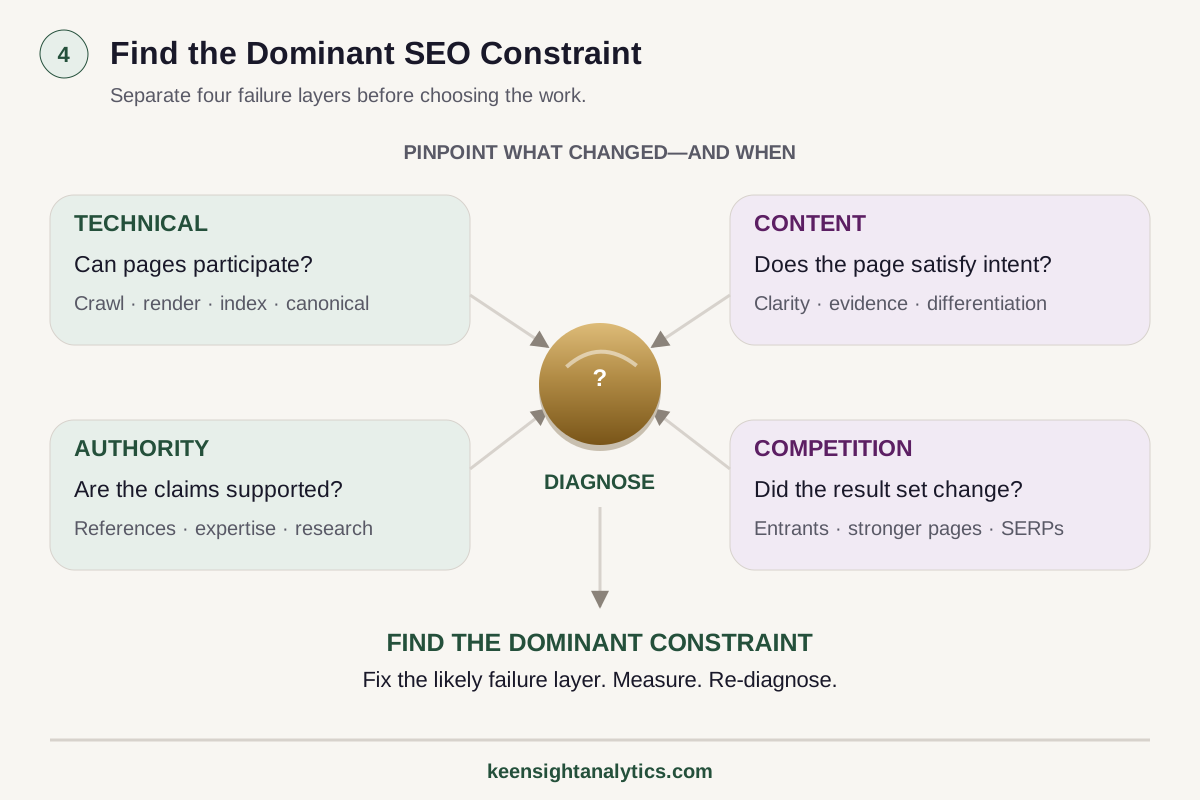
The framework
Find the dominant SEO constraint
Pinpoint what changed—and when.
Technical
Can pages participate? Check crawl, rendering, indexation and canonicals.
Content
Does the page satisfy intent? Check clarity, evidence and differentiation.
Authority
Are the claims supported? Check references, expertise and research.
Competition
Did the result set change? Check entrants, stronger pages and SERPs.
Fix the likely failure layer. Measure. Re-diagnose.
SEO next step
Apply the framework to a real commercial page set before adding more activity to the roadmap.SEO programs often jump from symptom to tactic. Traffic falls, so the team publishes more content. Rankings weaken, so someone buys links. A redesign underperforms, so titles are rewritten. Competitors gain share, so the keyword list expands.
The problem is that the same symptom can come from very different causes. A service page can lose visibility because it is no longer indexable, because the page no longer satisfies intent, because competitors have stronger evidence and authority, or because the market itself changed.
A useful diagnosis separates four layers: technical access, content and intent, authority and evidence, and competition. They can overlap, but one layer often constrains the others more than the rest.
1. Define the symptom precisely
“SEO is down” is not a diagnosis. Identify what changed.
- Did indexed pages disappear?
- Did rankings decline for one topic or across the entire site?
- Did impressions fall while positions stayed similar?
- Did clicks fall because result-page features changed?
- Did organic traffic decline only on informational pages?
- Did leads fall while visibility remained stable?
- Did one competitor gain sharply in the same segments?
Segment by page type, topic, location, device, and commercial intent. Sitewide averages hide the failure layer. A collapse in blog traffic and a collapse in core service pages are different business events even if total organic sessions fall by the same percentage.
2. Technical problems limit eligibility or distribution
A technical SEO problem exists when important information cannot be discovered, rendered, indexed, canonicalized, or internally distributed reliably.
Common evidence includes accidental noindex directives, robots blocking, incorrect canonicals, redirect failures, migration gaps, soft 404s, template-level status-code problems, JavaScript rendering discrepancies, crawl traps, duplicate URL families, broken internal navigation, and architecture that buries revenue-critical pages.
Technical failures often have a footprint. One bad canonical can affect a page. One bad template can affect thousands. That is why page-group analysis matters.
Use the crawling and indexing, canonicalization, and JavaScript rendering explainers to investigate the mechanism before assigning severity.
3. Signs that technical SEO is probably the dominant constraint
Technical remediation should move to the front of the queue when important pages are missing from the index, the wrong URLs are ranking, a migration created systematic losses, crawl access changed, rendering strips meaningful content, or internal architecture prevents critical pages from receiving discovery and context.
A strong clue is broad impact across pages that share the same technical implementation. If every location page declines after a template deployment while unrelated content stays stable, the template deserves investigation before the editorial calendar.
Another clue is mismatch between page quality and search eligibility. A strong page cannot perform if search systems consistently receive the wrong status, canonical, content state, or navigation path.
4. Content problems occur when the page is accessible but inadequate
Content problems are not synonymous with “low word count.” The real question is whether the page does its job for the query and buyer decision.
Look for mismatched intent, missing decision information, outdated claims, weak examples, shallow commercial detail, unclear differentiation, over-broad targeting, cannibalization, or several pages competing to answer the same need.
A product page that ranks for a category comparison query but contains only specifications may need decision-support content. A service page that never explains scope, process, fit, or constraints may be technically perfect and still weak. A once-successful guide may decay because the market, product, regulation, or competitor standard changed.
Content diagnosis should compare the page with the current result set and buyer need—not with a generic SEO checklist.
5. Signs that content is probably the dominant constraint
Content becomes the leading suspect when pages remain indexed and technically healthy but lose relevance or competitive depth in specific query groups. You may see declining rankings without indexation loss, search terms shifting away from the page’s intended subject, strong impressions but weak clicks because the title or proposition no longer matches intent, or competitors winning with substantially more useful page types.
Another sign is portfolio duplication. If three pages target nearly the same service and none is clearly authoritative, consolidation may create more value than adding a fourth.
Use the content decay versus competitive displacement framework to separate deterioration of your own asset from improvement in the market around it.
6. Authority problems are evidence problems
“Authority” is often reduced to a domain score from a third-party tool. That is too crude for diagnosis.
The practical question is whether the market has enough reasons to trust, reference, and choose your information compared with alternatives. Relevant links can be part of that evidence, but so can original research, expert authorship, strong product documentation, legitimate reviews, professional associations, citations, brand recognition, credible partnerships, and repeated third-party references.
A technically sound, genuinely useful page can still struggle in a competitive category if stronger sites have accumulated substantially more relevant validation. The response should not automatically be “buy more backlinks.” It should be to understand what kinds of evidence the market rewards and which of those your organization can legitimately earn.
7. Signs that authority is probably the dominant constraint
Authority is a stronger hypothesis when your important pages are technically healthy, satisfy intent well, and still lose consistently to competitors with stronger relevant references or recognized expertise. It is also plausible when new pages index but rarely break into competitive result sets despite strong on-page quality.
Look at the source ecosystem. Who cites the competitors? Which industry directories, associations, publications, research assets, partner ecosystems, or communities reinforce them? Are the links genuinely relevant, or is the apparent gap mostly a tool metric?
The evidence should shape the response. A company missing from core industry directories has a different problem from a company competing against a publisher with years of original research.
8. Competition can change while your site stays the same
Sometimes nothing “broke.” The market improved around you.
A competitor may launch better category pages, acquire another brand, expand local locations, publish original data, improve internal architecture, consolidate duplicate content, earn substantial press, or simply align more closely with a changing search intent.
Search-result composition can also change. Local packs, shopping modules, video, AI-generated summaries, forums, or other result features may occupy more of the page and alter click behavior. Your ranking can remain nominally stable while your share of attention falls.
Competitive diagnosis therefore asks not only “what happened to us?” but “what changed in the result set and who captured the lost share?”
9. Signs that competitive displacement is the dominant constraint
Competitive displacement is likely when your own technical state and content remain stable while one or more competitors gain across the same segments. Search share moves away from you even if absolute ranking changes appear modest. The winning pages may reveal a new content format, stronger commercial architecture, better local coverage, or more useful evidence.
This is where search benchmarking and competitive win/loss reporting become more useful than isolated rank checks.
10. Mixed failures are common
The four layers are not independent. A technically weak site can suppress strong content. Thin content can make canonical clustering harder to interpret. Weak internal architecture can reduce both crawl discovery and topical context. A competitive shift can expose content decay that was already developing.
The goal is not to force every problem into one box. It is to identify the dominant constraint and the dependencies around it.
For example, a site may need a finite canonical and rendering fix before any content evaluation is meaningful. Another may need commercial-page consolidation first, followed by authority work once the canonical assets are strong enough to deserve promotion.
11. Use an evidence matrix instead of instinct
For each suspected layer, record supporting and contradicting evidence.
Technical hypothesis: Are affected pages missing from the index? Did directives or templates change? Are status codes or canonicals wrong? If not, technical SEO may not be the main cause.
Content hypothesis: Is the page still indexed? Did query intent shift? Do winning pages answer materially more useful questions? Does the page have a distinct job?
Authority hypothesis: Are comparable pages from more-referenced competitors consistently winning? Is the reference gap relevant to the subject, or merely a generalized domain metric?
Competition hypothesis: Did others gain the same visibility you lost? Did the result format change? Did a new entrant or page type capture the market?
A hypothesis that cannot survive contradictory evidence should not drive the budget.
12. Match the engagement model to the failure pattern
Diagnosis also determines how the work should be owned.
A finite technical problem can fit a fixed Technical SEO Project. A deeper one-time question spanning competitors, visibility layers, and prioritization may call for a Search Intelligence Report. If an internal team or incumbent agency can execute but leadership lacks objective measurement, monitoring should remain measurement—not an implied implementation retainer.
Recurring managed search makes more sense when technical, content, authority, local, conversion, and measurement constraints interact continuously and someone needs to own the system across functions.
13. Re-diagnose after the first constraint is removed
SEO diagnosis is iterative. Once a major technical defect is fixed, the next bottleneck may become visible. Once duplicate content is consolidated, authority may concentrate enough to reveal an intent problem. Once strong service pages launch, the real competitive gap may shift to independent evidence.
Do not assume the original diagnosis remains the only diagnosis forever. Measure the result of each intervention and update the model.
The best SEO recommendation is often “not that yet”
SEO strategy becomes more valuable when it prevents premature work. Not more content yet. Not links yet. Not a redesign yet. Not an ongoing retainer yet.
The right sequence starts with the dominant failure layer, removes the constraint with the highest commercial impact and confidence, measures what changed, and only then moves to the next problem. That is slower than a checklist for the first hour and much faster over a year.
When this becomes recurring search work
Managed Search fits when several constraints have to move together.
Use managed KeenSight Search when technical foundations, commercial architecture, content, authority, and measurement require ongoing ownership. Use Search Intelligence first when the dominant constraint is still unclear.Test the diagnosis instead of naming a layer
For each suspected failure layer, document both supporting and contradictory evidence. A technical hypothesis is stronger when affected pages share a template defect and weaker when equally affected pages remain fully eligible while competitors gain. A content hypothesis is stronger when the page role is thin or mismatched and weaker when stronger pages on the same domain lose the same query set.
Ask: what observation would prove this diagnosis wrong? That turns the framework into a testable decision process.
Turn the failure-layer diagnosis into the right operating model
When several explanations remain plausible, Search Intelligence is the one-time diagnostic path: establish what evidence supports or falsifies each failure layer before assigning implementation. A Free Visibility Preview can provide a limited market signal, but it should not be mistaken for the diagnosis itself.
If the mechanism resolves to a bounded technical defect, move into a Fixed Technical SEO Project. If the constraint is a clearly defined content backlog, use Search Content Production. Choose managed KeenSight Search when technical, content, authority, competition and measurement must be reprioritized together over time. For a lighter first-pass framework, use the small-business visibility audit.
Decision checkpoint
Confirm whether the problem is a page decision, a diagnosis problem, or a recurring ownership problem.
Broad SEO symptoms often combine technical, content, architecture, authority, competitive, and measurement constraints.- 01Commercial roleCan you name the affected page set, buyer decision, or search segment rather than describing the problem only as “SEO”?
- 02Dominant constraintDo you have evidence for the primary failure layer and evidence that argues against the alternatives?
- 03Operating modelCan an internal team execute a prioritized plan, or do several constraints require recurring external ownership?
Four Failure Layers
Technical
Pages cannot be discovered, rendered, indexed, canonicalized, or internally distributed reliably.
Content
Pages are accessible but do not satisfy the current query, buyer decision, or portfolio role.
Authority
The market has stronger reasons to trust, cite, and reference competing information or brands.
Competition
The site may be stable while competitors, result formats, or market expectations improve around it.
SEO next steps
Move from broad search symptoms to the right level of ownership.
Compare other ways to get help
Diagnose the failure layer before buying the fix
Start with an evidence-based visibility review. Use a deeper one-time Search Intelligence engagement when the problem spans multiple layers and needs prioritization.
Keep Reading
Small Business Search Visibility Audit
Apply the same diagnostic logic to a practical small-business search review.
Read article →SEO Prioritization Across Failure Layers
Go deeper on sequencing remediation when multiple SEO constraints exist at once.
Read explainer →Technical SEO Project vs Managed Search
Choose finite technical remediation or recurring ownership based on the actual failure pattern.
Read comparison →Make it specific
See what the market looks like for your company.
The free visibility preview turns a broad search topic into a limited personalized baseline.