August 28, 2026 · 11 min read
SEO for Law Firms: Building Visibility Across Practice Areas, Locations, and AI Search
Law-firm SEO combines high-value commercial intent, local competition, jurisdiction-specific information, professional credibility, and sensitive legal questions. The architecture has to make each of those layers clear.
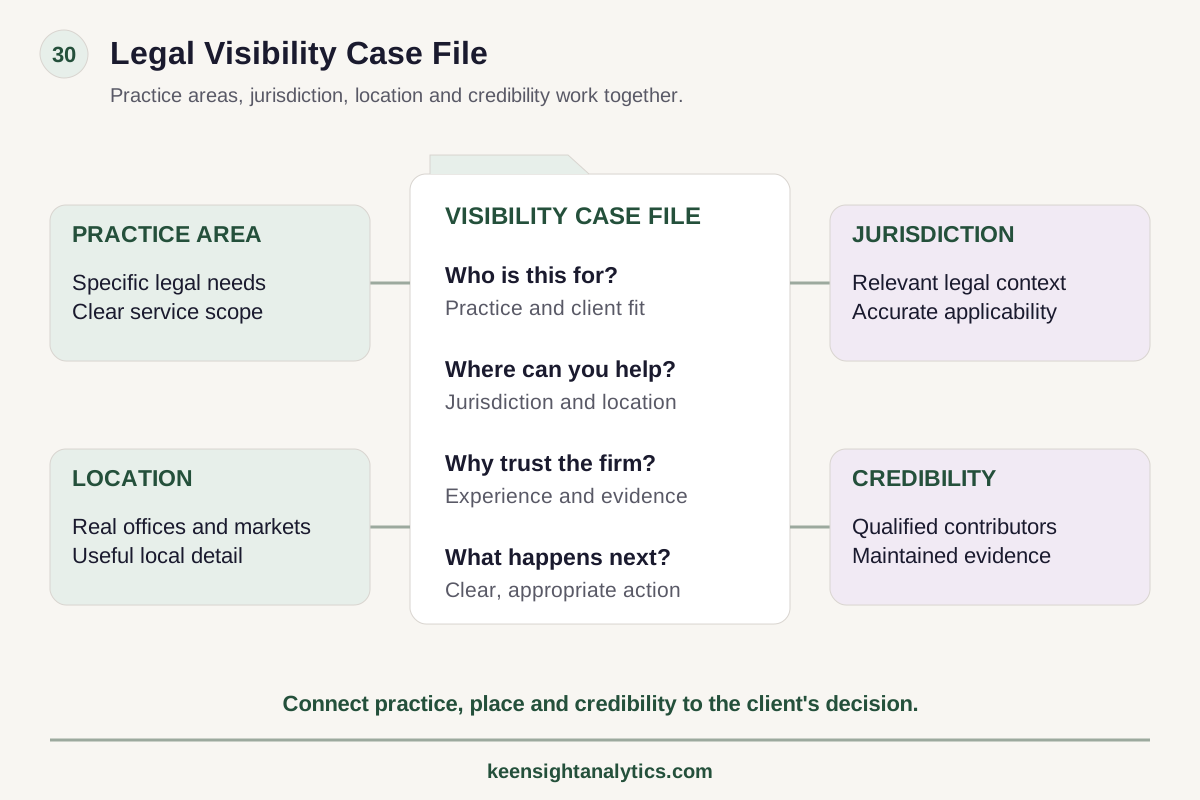
The framework
Legal visibility case file
Practice areas, jurisdiction, location and credibility work together.
Practice area
Specific legal needs and clear service scope.
Jurisdiction
Relevant legal context and accurate applicability.
Location
Real offices, markets and useful local detail.
Credibility
Qualified contributors and maintained evidence.
Client decision
Who is this for? Where can you help? Why trust the firm? What happens next?
Connect practice, place and credibility to the client's decision.
SEO next step
Apply the framework to a real commercial page set before adding more activity to the roadmap.Law-firm SEO is unusually unforgiving because the search market combines intense commercial competition with high-stakes information.
A prospective client may search a legal issue before they know what kind of lawyer they need. They may compare firms by practice area, jurisdiction, location, attorney background, reviews, fee structure, or prior experience. They may also ask AI systems for explanations or provider recommendations.
A durable legal-search strategy should make the firm’s actual practice, geography, professionals, and evidence easy to understand without making legal-outcome guarantees.
1. Put practice-area pages at the commercial center
Practice-area pages should be the canonical commercial destinations for the matters the firm actually handles.
Each page should explain:
- the type of legal matter;
- who the firm represents;
- relevant jurisdictional context;
- common stages or process;
- what information a prospective client may need to prepare;
- frequent questions;
- what the firm can and cannot responsibly claim;
- how to contact the firm.
A practice page should help a person decide whether the firm may be relevant, not promise an outcome.
2. Separate informational legal content from commercial pages
A legal explainer about a statute or process and a page describing the firm’s representation are different assets.
Use educational content to explain legal questions carefully. Use commercial pages to explain the firm’s service. Link them together where the relationship is useful.
This prevents long-form legal education from swallowing the conversion path and prevents service pages from becoming thin advertisements.
3. Keep jurisdiction explicit
Legal information can vary materially by state, court, agency, and time period.
State the relevant jurisdiction where it affects the analysis. Avoid writing national-sounding advice when the source supports only one state. For time-sensitive rules, use visible review dates and cite authoritative sources.
Readers should be able to understand the scope before acting on the information.
4. Build location pages only where geography is real
Location pages should correspond to real offices or genuinely distinct markets where the firm can provide useful local information.
Include office facts, attorneys working there, practice availability, contact details, parking or appointment information, jurisdictional context where relevant, and local proof.
Do not create hundreds of “practice area + city” pages that repeat the same text merely to target geographic keywords.
5. Use attorney pages as professional entity assets
Attorney pages should maintain accurate information about admissions, education, credentials, practice focus, professional affiliations, authored content, and office locations.
Where representative matters or awards are mentioned, the claims should be accurate, compliant, and appropriately qualified.
Strong professional profiles help prospective clients evaluate who may handle the matter and help the site express the relationship between attorneys and practice areas.
6. Build an editorial review process for legal content
Legal articles can become inaccurate when laws, agency rules, deadlines, thresholds, or case interpretations change.
Assign subject-matter review, source requirements, publication dates, and update triggers. Archive or revise pages that no longer reflect current law or firm practice.
SEO maintenance is secondary to information quality here.
7. Use FAQs to answer real client uncertainty
FAQs should reflect questions prospective clients actually ask: timing, process, evidence, documents, jurisdiction, fees where appropriate, consultations, and what happens next.
Avoid boilerplate FAQ blocks duplicated across every practice area. Specificity is more useful.
8. Build local search around real offices and eligible profiles
Maintain accurate Google Business Profiles for eligible firm locations and professionals where applicable under platform rules.
Govern categories, hours, URLs, phone numbers, photos, office moves, duplicates, and profile ownership. The website and local profiles should describe the same operating reality.
9. Measure legal local visibility by practice area
A firm can rank well for its name and still be weak for the matters it wants.
Track practice-area queries across the real client market. Measure local-pack coverage, organic visibility, and which competitors appear by location and practice.
Separate personal injury, family law, estate planning, employment, business litigation, criminal defense, or other practice groups rather than averaging the firm into one local score.
10. Treat reviews as reputation evidence
Reviews can influence how prospective clients evaluate firms, but they should not be manipulated or treated as outcome proof.
Monitor volume, recency, themes, response quality, and location-level variation. Use compliant processes for requesting feedback and avoid statements implying that prior client outcomes predict future results.
11. Build authoritative educational assets
Legal firms have opportunities to publish referenceable material: jurisdiction-specific guides, procedural timelines, filing checklists, statute explainers, regulatory updates, original research, or tools that help readers understand a process.
These assets should be accurate, maintained, and useful independently of the sales pitch.
12. Earn legitimate third-party references
Bar associations, legal directories, professional organizations, media commentary, universities, industry publications, community organizations, and other relevant sources can contribute to the firm’s independent evidence footprint.
The objective is real expertise and participation, not mass-produced backlinks.
13. Watch for cannibalization across practice pages
Law-firm sites often accumulate overlapping pages after years of content production.
Audit which pages target the same issue, statute, injury, claim type, or jurisdiction. Consolidate where several weak pages compete for the same intent. Preserve unique backlinks and useful sections during the merge.
14. Connect content to the intake journey
Measure qualified calls, consultation requests, forms, chat interactions, and landing-page paths where attribution is defensible.
Do not let large informational traffic volumes obscure whether commercially important practice pages are gaining or losing visibility.
15. Monitor AI-search visibility as a separate discovery surface
People increasingly ask AI systems to explain legal concepts, compare types of counsel, or suggest firms in a market.
Track representative prompts, visible sources, brand mentions, and recommendations. Review whether practice areas, attorneys, office locations, professional references, and educational pages are represented accurately.
AI outputs are variable. Do not promise inclusion, citation, recommendation, or legal outcomes.
16. Prioritize by practice economics and strategic fit
Search volume is not enough.
Prioritize practice areas by strategic importance, case fit, capacity, geography, visibility gap, competitive intensity, conversion quality, and the firm’s ability to create genuinely differentiated information.
A narrow high-value practice can deserve more investment than a large informational topic with little connection to the firm’s business.
Law-firm SEO should make expertise and fit discoverable
The search system should help prospective clients understand what the firm handles, where it operates, who practices there, what information is trustworthy, and how to take the next step.
That is a stronger long-term strategy than multiplying city pages or publishing generic legal definitions at scale.
When this becomes recurring search work
Managed Search fits when several constraints have to move together.
Use managed KeenSight Search when technical foundations, commercial architecture, content, authority, and measurement require ongoing ownership. Use Search Intelligence first when the dominant constraint is still unclear.Legal SEO has jurisdictional constraints
Attorney advertising, specialization language, testimonials, representative matters, outcome statements, disclaimers, and solicitation rules can vary by jurisdiction. Treat legal-content governance as a prerequisite to scaling practice-area or location pages.
The search team should not decide those boundaries alone. Use counsel or the firm's designated ethics/compliance reviewer before publishing claims that could change how prospective clients interpret qualifications or likely outcomes.
Build local and practice-area visibility inside the firm’s advertising rules
Use Local SEO when real office markets, practice-area geography, Business Profiles, reviews, and local landing-page architecture materially drive client acquisition. Use Search Intelligence when the firm first needs to understand which practice areas, jurisdictions, competitors, or page roles explain the visibility gap. Use Search Benchmarking when another team executes but leadership needs a stable recurring competitive market view.
Choose managed KeenSight Search when technical SEO, practice-area content, local markets, authority, and measurement require recurring coordination. Attorney marketing content still requires jurisdiction-specific review: ABA Model Rule 7.1 prohibits false or misleading communications and Model Rule 7.2 provides additional communications rules, but state and jurisdictional requirements control. KeenSight does not promise case outcomes, rankings, or Map Pack placement.
Decision checkpoint
Confirm whether the problem is a page decision, a diagnosis problem, or a recurring ownership problem.
Broad SEO symptoms often combine technical, content, architecture, authority, competitive, and measurement constraints.- 01Commercial roleCan you name the affected page set, buyer decision, or search segment rather than describing the problem only as “SEO”?
- 02Dominant constraintDo you have evidence for the primary failure layer and evidence that argues against the alternatives?
- 03Operating modelCan an internal team execute a prioritized plan, or do several constraints require recurring external ownership?
The Law Firm SEO Framework
Practice-area authority
Build clear canonical commercial pages for the matters the firm genuinely handles.
Jurisdictional accuracy
Scope educational content by jurisdiction and keep high-stakes legal information reviewed and current.
Attorney entities
Maintain accurate professional profiles that connect attorneys, offices, authorship, and practice areas.
Local + AI measurement
Track organic, Maps, competitive, and AI discovery separately without promising outcomes.
SEO next steps
Move from broad search symptoms to the right level of ownership.
Compare other ways to get help
See which practice areas and markets are losing search visibility
KeenSight Search Intelligence can benchmark practice-area, local, competitive, and AI-search visibility before the firm commits to a content, technical, or managed-search program.
Keep Reading
Service, Industry, and Location Architecture
Separate commercial and local page roles without creating doorway-page multiplication.
Read article →Topical Authority vs Content Volume
Build credible legal topic coverage instead of a library of repetitive definitions.
Read article →Why Competitors Get Recommended by AI Search
Analyze recommendation gaps through evidence rather than prompt tricks.
Read article →Make it specific
See what the market looks like for your company.
The free visibility preview turns a broad search topic into a limited personalized baseline.