August 28, 2026 · 12 min read
How Service Pages, Industry Pages, and Location Pages Should Fit Together
The goal is not to create every service × industry × city permutation. It is to give each page type a distinct job and connect them into a coherent commercial search system.
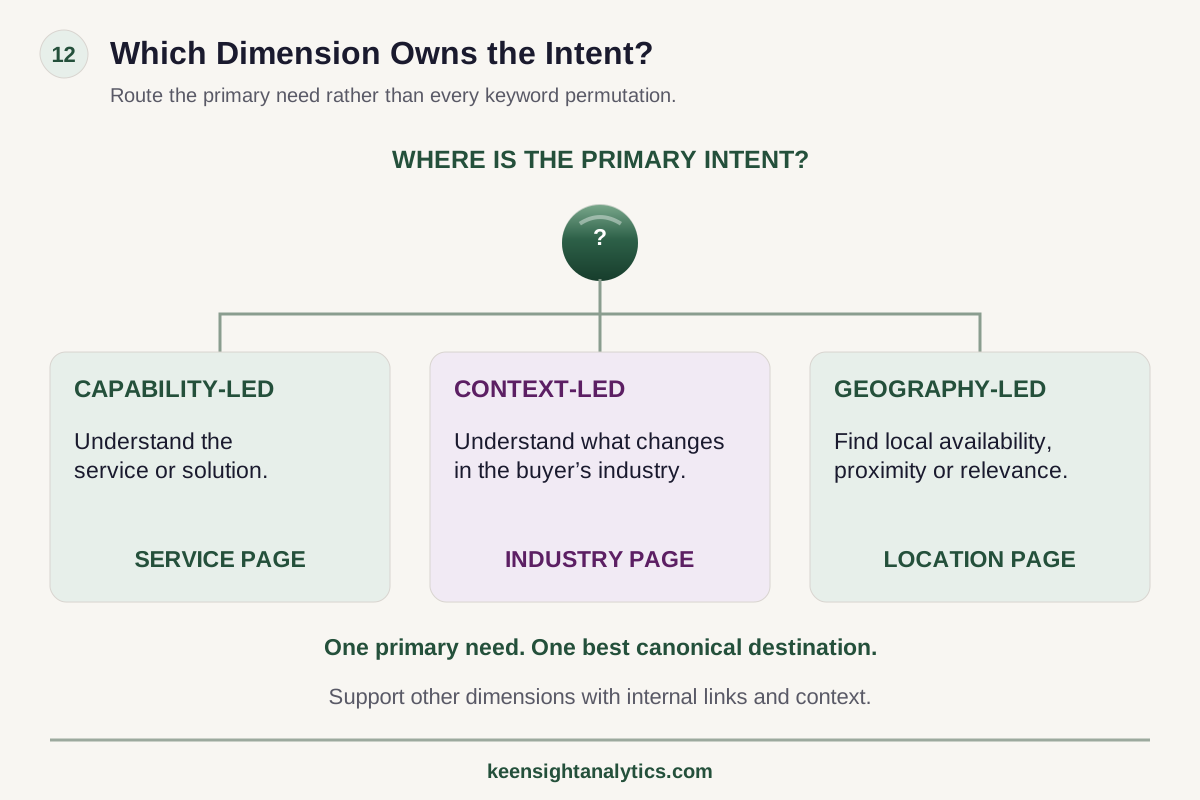
The framework
Which dimension owns the intent?
Route the primary need rather than every keyword permutation.
Capability-led → service page
Understand the service or solution.
Context-led → industry page
Understand what changes in the buyer's industry.
Geography-led → location page
Find local availability, proximity or relevance.
Support other dimensions with internal links and context.
SEO next step
Apply the framework to a real commercial page set before adding more activity to the roadmap.A company with ten services, eight industries, and twenty markets can create 1,600 possible service-industry-location combinations before anyone writes a single page.
That arithmetic is one of the most common traps in commercial SEO.
Segmentation is useful when the buyer's question genuinely changes. It becomes harmful when a website manufactures hundreds of near-duplicate pages because a spreadsheet says every combination is a keyword.
The architecture should answer three different questions:
- Service: What do you do?
- Industry: How does that work in my operating environment?
- Location: Can you serve this market, and what is locally relevant?
Those roles overlap, but they should not be interchangeable.
1. Start with canonical commercial destinations
Before adding industries or locations, identify the core commercial capabilities the business actually wants to sell.
Each major service or product family should have a clear canonical destination. That page should explain scope, fit, methodology, deliverables or capabilities, constraints, evidence, and next steps.
If the service layer is weak, creating dozens of industry and city variants can amplify ambiguity rather than solve it. Supporting pages need something authoritative to support.
2. Service pages answer the capability question
A strong service page should remain useful regardless of which industry or city the buyer came from, unless the service itself genuinely changes.
It should answer:
- What problem does the service solve?
- Who is it for?
- What is included?
- What is not included?
- How is the work performed?
- What inputs or client responsibilities are required?
- When is another service or operating model more appropriate?
- How is success measured?
This page should be the primary internal-link target when another page discusses the capability itself.
3. Industry pages answer the operating-context question
An industry page deserves to exist when the vertical changes the problem enough to create distinct buyer value.
Meaningful industry differences can include:
- regulatory constraints;
- different customer journeys;
- specialized terminology;
- different search surfaces;
- different local versus national dynamics;
- different evidence or trust requirements;
- unique product or service combinations;
- different competitor structures;
- distinct conversion actions;
- seasonality or demand patterns.
An SEO page for a multi-location dental group should discuss treatment-location architecture, Google Business Profiles, reviews, clinician entities, and geographic measurement. An SEO page for B2B SaaS should discuss category discovery, integrations, technical documentation, comparisons, and pipeline. Those are different operating environments.
If the only change is replacing the word "software" with "law firm," the industry page is not doing enough work.
4. Location pages answer a geographic decision
Location pages are justified when geography changes availability, evidence, competition, or the user's decision.
A legitimate location page may include:
- a real office or eligible location;
- services actually available in that market;
- local team or practitioner information;
- local proof, reviews, projects, or partnerships;
- market-specific service areas;
- local regulations or operating conditions;
- directions, hours, and customer access information;
- location-specific calls to action.
For service-area businesses, a city page should not imply an office that does not exist. Geographic relevance and physical-location claims are different things.
5. Do not multiply pages mechanically
The dangerous formula is:
services × industries × locations = landing pages
Use a decision test instead. Create a dedicated combination page only when the combined intent has enough distinct information and commercial value to justify a separate canonical page.
For example, "cybersecurity consulting for healthcare" may warrant its own page if healthcare changes compliance, procurement, risk, and delivery requirements substantially. "Cybersecurity consulting in Phoenix for healthcare" does not automatically deserve another page unless the location creates further meaningful differences.
6. Decide which dimension owns the primary intent
Some queries combine service, industry, and geography. The architecture still needs one best page.
Choose the canonical destination based on the dominant user need and the information the page can uniquely provide.
If geography is the primary constraint—"emergency dentist Scottsdale"—a location or location-service page may be appropriate. If the industry changes the operating model—"SEO for law firms"—an industry page may be stronger. If the user is evaluating the capability generally—"technical SEO services"—the service page should own it.
This reduces cannibalization and makes internal linking more intentional.
7. Use parent-child relationships where they help users
A practical hierarchy might look like:
/seo/→ primary search service;/seo/technical-seo/→ specialized capability;/industries/law-firms/→ vertical operating context;/locations/phoenix/→ geographic market page;/local-seo/multi-location-seo/→ specialized local capability.
The URL hierarchy does not need to encode every semantic relationship. Internal links, breadcrumbs, navigation, and page content can express relationships without creating deeply nested URLs.
8. Link service pages to representative industries
A service page should show where the capability applies without becoming an industry directory.
Link to industries where the operating context materially changes the problem or where the business has strategic relevance. Use descriptive anchors that explain why the reader may care.
Likewise, industry pages should link back to the capabilities that genuinely matter in that vertical. A law-firm page may connect to SEO, Local SEO, AI SEO, and Search Intelligence. It does not need to link to every service KeenSight offers.
9. Link location pages to services actually available there
Location pages should behave like local commercial hubs.
If a service is not available in a market, do not link as if it is. If service availability varies by office, the architecture should reflect that difference.
For multi-location organizations, this often requires structured governance: central templates and data standards with local facts supplied by regional teams.
10. Avoid doorway-page patterns
Doorway-like architectures often share recognizable characteristics:
- hundreds of city pages with nearly identical copy;
- pages that all funnel to the same destination without local value;
- industry pages created only by swapping nouns;
- service-location combinations unsupported by distinct evidence;
- pages generated because a keyword tool showed small variations;
- fabricated offices or misleading local presence.
The solution is not a word-count threshold. It is a page-role standard: does this URL resolve a distinct user decision better than the existing canonical pages?
11. Use templates for consistency, not sameness
Templates are valuable for page quality. They can enforce consistent metadata, calls to action, navigation, structured data, proof modules, and content requirements.
But the template should create slots for unique information rather than forcing identical paragraphs.
An industry template might require:
- industry search-market dynamics;
- common buyer journeys;
- relevant failure modes;
- appropriate service mix;
- industry-specific measurement considerations;
- related research or editorial content;
- a decision path into Search Intelligence or the relevant service.
That creates structural consistency while preserving actual vertical depth.
12. Use editorial content to deepen the graph
Industry pages should not carry every possible subtopic themselves.
A law-firm industry page can link to deeper articles on practice-area architecture, local measurement, AI recommendations, or content quality. An ecommerce page can link to articles about faceted navigation, product data, category architecture, and AI shopping discovery.
Those articles should link back to the relevant industry and service pages where appropriate. This creates a semantic graph instead of isolated landing pages.
13. Measure page groups separately
Service, industry, and location pages play different roles and should be measured accordingly.
Service pages may be evaluated on high-intent visibility and conversions. Industry pages may show their value through vertical query share, assisted paths, and connections into service pages. Location pages require geographic visibility, local conversions, Google Business Profile performance, and location-level competitor analysis.
Do not average all commercial pages together and assume the architecture is working.
14. Prune pages that lose their distinct job
Architectures evolve. A location closes. An industry is no longer served. Two services consolidate. A generated page never develops distinct demand.
Review whether each page still has a unique role. If not, consolidate, redirect, or retire it deliberately. Search architecture is a maintained system, not a permanent accumulation of URLs.
15. A practical decision tree
Before creating a new commercial page, ask:
- Is there a distinct user intent not adequately served by an existing page?
- Does the service, industry, or geography materially change the decision?
- Can we provide unique evidence or information for this page?
- Is there enough strategic or commercial value to maintain it?
- Which existing page should link to it?
- Which page should it link back to as the canonical service, industry, or location context?
- How will we measure whether the page performs its assigned role?
If those questions do not produce clear answers, the better move may be to improve an existing page rather than create another URL.
The best architecture reduces ambiguity
Service, industry, and location pages are not three ways to repeat the same sales copy.
They are three different lenses on a commercial decision. The service defines the capability. The industry explains operating context. The location explains geographic fit. Editorial content supplies supporting analysis and evidence.
When each layer has a distinct job and the internal links reflect those relationships, the site becomes easier to navigate, easier to maintain, and easier for search systems to interpret.
When this becomes recurring search work
Managed Search fits when several constraints have to move together.
Use managed KeenSight Search when technical foundations, commercial architecture, content, authority, and measurement require ongoing ownership. Use Search Intelligence first when the dominant constraint is still unclear.Do not multiply every dimension
A services company might legitimately have /seo/technical-seo/, /industries/law-firms/, and /locations/phoenix/ because each page has a different job. That does not mean it should automatically create /phoenix/law-firm-technical-seo/ and repeat the formula across every service, city, and industry.
Create combined pages only when the combined intent is independently useful and the business can provide meaningfully different evidence, process, constraints, or local information.
Separate architecture diagnosis from page production and technical implementation
Service, industry and location architecture should be based on distinct search intent, commercial value, geographic reality and evidence—not on multiplying every possible combination. If market overlap, page roles or demand are still unclear, use Search Intelligence before committing to a large URL system. A Free Visibility Preview can provide a limited signal about current market coverage, but it does not validate an information architecture.
When the architecture is decided and the remaining work is bounded routing, templates, canonicals, migration, or crawl remediation, use a Fixed Technical SEO Project. When the architecture is decided but the bottleneck is producing a finite set of differentiated pages, use Search Content Production. Choose managed KeenSight Search when architecture, content, local-market coverage, authority and measurement must evolve together. The visibility-audit framework is useful for deciding which branch deserves attention first.
Decision checkpoint
Confirm whether the problem is a page decision, a diagnosis problem, or a recurring ownership problem.
Broad SEO symptoms often combine technical, content, architecture, authority, competitive, and measurement constraints.- 01Commercial roleCan you name the affected page set, buyer decision, or search segment rather than describing the problem only as “SEO”?
- 02Dominant constraintDo you have evidence for the primary failure layer and evidence that argues against the alternatives?
- 03Operating modelCan an internal team execute a prioritized plan, or do several constraints require recurring external ownership?
Give Each Page Type One Primary Job
Service
Explain the capability, scope, fit, methodology, constraints, and commercial next step.
Industry
Explain how regulation, buyers, terminology, competition, and search behavior change inside the vertical.
Location
Explain real market availability, local evidence, services, access, and geographic relevance.
SEO next steps
Move from broad search symptoms to the right level of ownership.
Compare other ways to get help
Build an architecture around real search decisions
If the right structure is unclear, Search Intelligence can identify the query segments, competitors, and page roles that deserve investment before production begins.
Keep Reading
Build Content Around Revenue
Connect page creation to commercial destinations and buyer decisions.
Read article →Multi-Location SEO
See how central governance and local evidence should work across many markets.
Explore service →When a City Deserves a Location Page
Use a decision framework instead of generating every city permutation.
Read explainer →Make it specific
See what the market looks like for your company.
The free visibility preview turns a broad search topic into a limited personalized baseline.