August 28, 2026 · 11 min read
Ecommerce SEO: Building a Search System Across Categories, Products, Content, and AI Discovery
Ecommerce SEO is an architecture problem at scale. Search systems need to understand products, categories, variants, inventory, attributes, and editorial context without being trapped in uncontrolled duplication.
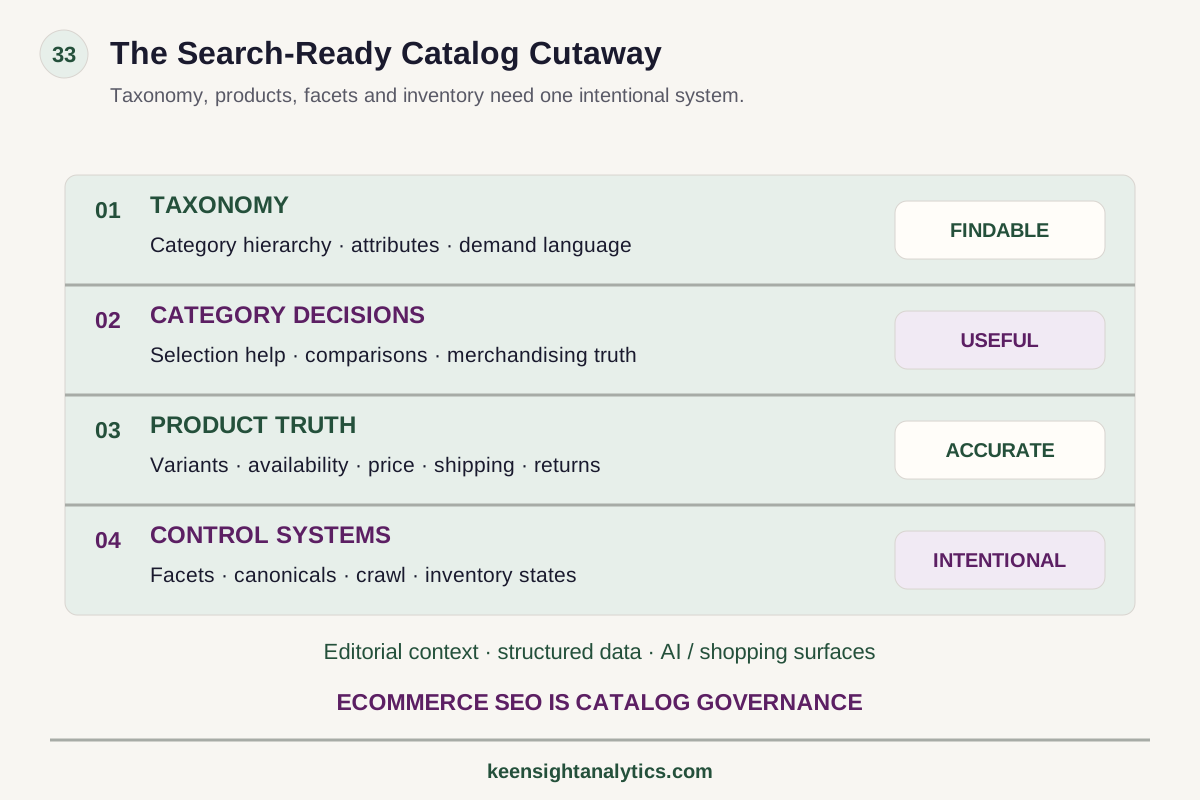
The framework
Search-ready ecommerce catalog
Taxonomy, products, facets and inventory need one intentional system.
Taxonomy → findable
Category hierarchy, attributes and demand language.
Category decisions → useful
Selection help, comparisons and merchandising truth.
Product truth → accurate
Variants, availability, price, shipping and returns.
Control systems → intentional
Facets, canonicals, crawl controls and inventory states.
Connect editorial context, structured data and AI/shopping surfaces.
Technical next step
If the issue is finite and reproducible, it may belong in a fixed technical project rather than an open-ended SEO program.Ecommerce SEO gets harder as catalog complexity increases.
A small store may have a few categories and dozens of products. A large retailer can have thousands of products, variants, attributes, filters, sorting options, discontinued items, seasonal inventory, and editorial buying guides. Every feature useful to shoppers can also create new URLs and new search decisions.
The objective is to make the commercial catalog understandable, crawlable, and useful without allowing the platform to generate an unlimited search index.
1. Start with the category taxonomy
Categories should reflect how customers shop and how the business merchandises products.
Build a hierarchy that moves from broad product families to meaningful subcategories. Avoid creating categories only because a keyword tool shows demand if the business cannot support the page with a useful assortment.
Each indexable category should have a clear product set and a distinct shopping intent.
2. Make category pages decision-support pages
A category page is more than a product grid.
Useful category information may explain major product types, selection criteria, fit or compatibility, size or material differences, common use cases, and links to deeper buying guidance.
Do not bury the products beneath thousands of words. The page should help shoppers choose while preserving the commercial experience.
3. Build product pages around product truth
Product pages need accurate names, descriptions, specifications, images, availability, price, shipping or fulfillment information where relevant, variant relationships, and merchant details.
Where possible, add decision information competitors cannot copy directly: original photography, fit guidance, compatibility notes, testing methodology, detailed measurements, real FAQs, care instructions, or unique product data.
Manufacturer copy reused across dozens of retailers creates little differentiation.
4. Decide how variants should be represented
Color, size, material, configuration, and model variants can create duplicate or near-duplicate URLs.
Choose a consistent strategy based on whether variants have distinct search demand, unique inventory, meaningful content, and independent landing-page value.
Align canonicalization, structured data, internal links, sitemaps, and user navigation with that strategy. Avoid a situation where each system expresses a different canonical product.
5. Control faceted navigation deliberately
Filters are essential for shoppers and one of the largest technical SEO risks in ecommerce.
A few filters can generate millions of combinations through color, size, price, brand, rating, material, availability, style, and sorting.
Classify facets into three groups:
- indexable landing pages: combinations with distinct demand, stable inventory, and useful commercial intent;
- functional filters: useful to shoppers but not intended as search destinations;
- crawl traps: permutations or sorting states that create no independent value.
Implement crawl, canonical, internal-link, and sitemap behavior accordingly.
6. Do not rely on site search for product discovery
Important categories and products need crawlable internal paths.
Use navigation, category pages, breadcrumbs, related products, merchandising modules, editorial links, and relevant cross-sells. A product accessible only after a search form or complex filter interaction is a weak search destination.
7. Manage inventory states intentionally
Out-of-stock and discontinued products need different rules.
If a product will return, keep the page useful and communicate availability. If it is permanently discontinued but has a close replacement, consider maintaining the page with alternatives or redirecting when intent genuinely maps to a successor. If no equivalent exists and the page has no continuing value, a clear unavailable state may be appropriate.
Do not redirect every discontinued product to a category homepage. Preserve useful intent and backlink value where possible.
8. Use structured data to describe visible commerce facts
Implement supported product, offer, review, breadcrumb, organization, and merchant-related markup where appropriate and accurate.
Structured data should match visible page content. It does not compensate for missing product information or poor architecture.
9. Build editorial content around buying decisions
Useful ecommerce editorial content includes buying guides, comparisons, sizing help, compatibility information, use cases, maintenance, materials education, gifting scenarios, and problem-solving content tied to real inventory.
Every editorial asset should have a clear relationship to relevant categories or products. Content traffic that never reaches commercial inventory has limited merchandising value.
10. Create comparison pages that help shoppers choose
Comparisons can be high-value because shoppers are already narrowing options.
Compare meaningful dimensions rather than declaring one product universally “best.” Include use case, size, features, materials, price tier, compatibility, tradeoffs, and who each option is for.
Transparent comparisons build more trust than disguised advertisements.
11. Protect crawl efficiency at scale
Large catalogs need control over parameters, sorting, duplicate routes, session identifiers, internal search pages, pagination, and generated collections.
Use crawl data and server logs to identify where bots spend time. Prioritize category and product inventory that matters commercially rather than optimizing an abstract crawl-budget score.
12. Handle JavaScript without hiding commercial content
Modern ecommerce interfaces often rely heavily on JavaScript.
Ensure key product names, prices, category content, internal links, canonicals, structured data, and status behavior are available reliably through the rendered experience. Test edge cases such as unavailable products, pagination, filters, and client-side routing.
13. Measure ecommerce SEO by page type
Category pages, product pages, editorial content, and brand pages perform different roles.
Track organic visibility, revenue, transactions, assisted journeys, product availability, query segments, and competitive share by page group. A traffic increase driven by low-converting editorial queries should not hide declining category visibility.
14. Track search competitors by category
Competitors can include direct retailers, marketplaces, manufacturers, publishers, review sites, and comparison platforms.
Build cohorts by query and page type. The domain dominating product reviews may not be the domain taking category revenue queries.
15. Prepare for AI shopping and recommendation surfaces
AI interfaces increasingly synthesize product information, comparisons, and shopping recommendations.
Strengthen product entities, merchant data, specifications, availability, reviews, category context, third-party references, and useful buying content. Monitor which sources and merchants appear across representative shopping prompts.
Do not treat one AI citation or recommendation as stable market share, and do not promise inclusion.
16. Prioritize by merchandise economics
Search volume alone can overvalue low-margin or frequently unavailable inventory.
Prioritize categories using demand, margin, inventory depth, strategic importance, conversion rate, visibility gap, competitive difficulty, seasonality, and lifetime value where relevant.
This turns SEO from a traffic exercise into a merchandising channel.
Ecommerce SEO is catalog governance
The strongest ecommerce programs align taxonomy, product truth, facets, internal linking, inventory lifecycle, editorial support, technical control, and measurement.
When those systems agree, search engines and shoppers can navigate the same commercial reality.
When this becomes implementation
Use a fixed project for a finite technical failure layer.
A Technical SEO Project fits when the root cause is bounded—such as rendering, canonicalization, indexation, migration, or template defects—and the remediation can be scoped. If the root cause is still uncertain or several failure layers interact, diagnose the system first.Four systems to keep aligned
Keep four layers consistent: site taxonomy (categories and facets), product truth (variants, availability, price, identifiers), merchant data (feeds and shopping surfaces), and search eligibility (canonicals, internal links, structured data, rendering, and status behavior).
A product can fail discovery because any one of those layers disagrees with the others, especially during out-of-stock, discontinued, or variant transitions.
Route ecommerce work by the constraint—not by a generic content calendar
For ecommerce, Local SEO is usually secondary unless physical stores, local inventory, or real geographic markets materially affect acquisition. Use Search Intelligence when the team first needs to determine whether the constraint is category demand, product coverage, product data, faceted navigation, indexation, competitor displacement, or another part of the commerce system.
Use Search Benchmarking when leadership needs a stable recurring category and competitor view while the commerce team executes. Choose managed KeenSight Search when category architecture, technical SEO, product and collection content, internal discovery, authority, and measurement need continuous reprioritization. The goal is not to manufacture indexable combinations; it is to make the valuable product and category system easier to crawl, understand, compare, and use.
Decision checkpoint
Decide whether the technical issue is bounded before choosing the engagement.
Technical defects can be finite projects, symptoms of a larger system problem, or merely observations that need validation.- 01ReproducibilityCan the failure be reproduced on a defined URL, template, rendering path, canonical rule, or release condition?
- 02ScopeIs the affected set bounded enough to define acceptance criteria and a finite remediation plan?
- 03DependenciesDoes fixing it require ongoing coordination with content, architecture, authority, or measurement beyond the technical layer?
The Ecommerce SEO System
Category architecture
Build indexable categories around real shopping intent and stable merchandise.
Facet control
Separate useful search landing pages from shopper-only filters and crawl traps.
Product truth
Keep product, variant, inventory, price, and structured data aligned.
Commercial measurement
Evaluate visibility alongside transactions, revenue, inventory, and category economics.
Technical SEO next steps
Use the smallest operating model that can actually solve the failure.
Compare other ways to get help
Find the category, product, and technical gaps limiting ecommerce search
Search Intelligence can separate catalog architecture, technical, content, authority, and competitive constraints before execution is prioritized.
Keep Reading
Technical SEO for JavaScript Websites
Audit rendering, routing, status codes, and links in modern ecommerce stacks.
Read article →Build Content Around Revenue
Prioritize buying guides and commercial content around merchandise economics.
Read article →What Makes a Website an AI Search Source?
Strengthen retrieval readiness without speculative optimization tricks.
Read article →Make it specific
See what the market looks like for your company.
The free visibility preview turns a broad search topic into a limited personalized baseline.