August 28, 2026 · 11 min read
How to Find the Competitors Taking Search Visibility From You
Your sales competitor list and your search competitor list are rarely identical. Search competition is defined by who captures the queries, formats, and markets your buyers use.
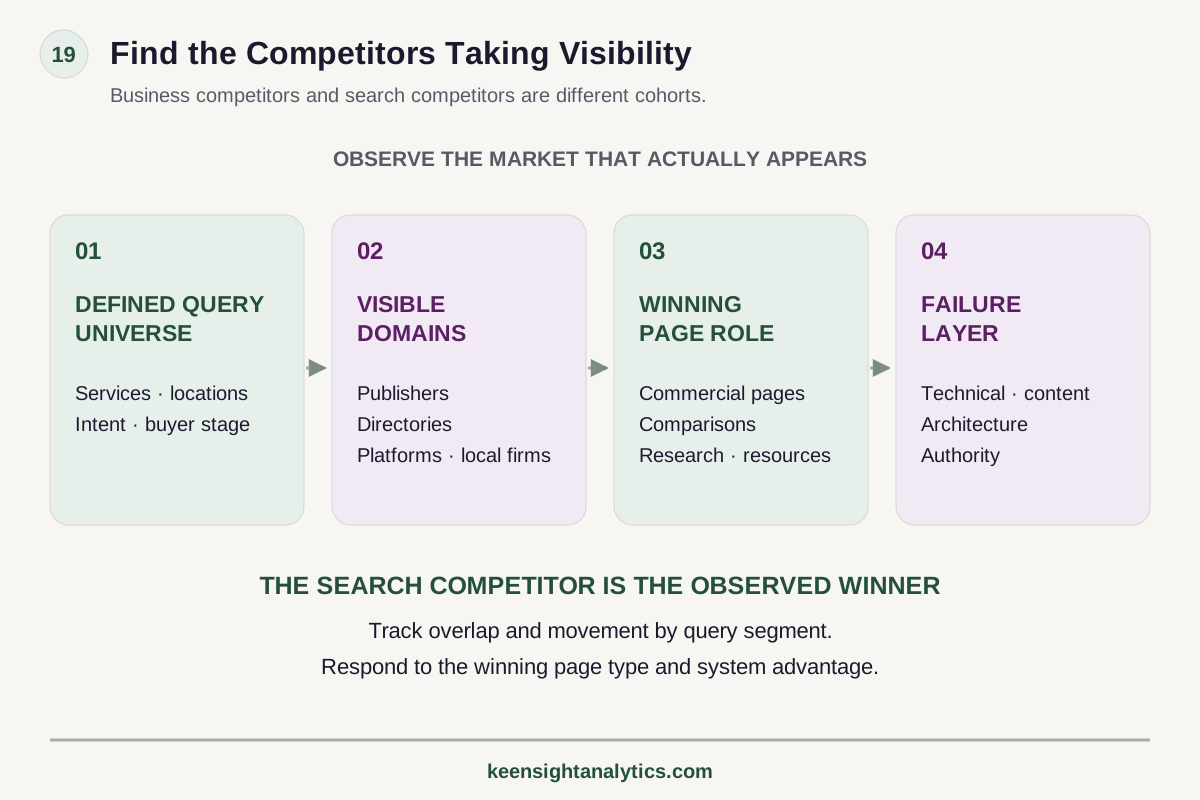
The framework
Find the competitors taking visibility
Business competitors and search competitors are different cohorts.
Define the query universe
Services, locations, intent and buyer stage.
Observe visible domains
Publishers, directories, platforms and local firms.
Identify winning page roles
Commercial pages, comparisons, research and resources.
Diagnose the failure layer
Technical, content, architecture or authority.
Track overlap and movement by query segment.
Measurement next step
Use a stable baseline and competitive frame before turning a reporting change into an implementation recommendation.A company can lose search visibility to a business it has never encountered in a sales cycle.
A software vendor can lose informational queries to a publisher, commercial comparisons to a marketplace, implementation queries to documentation sites, and branded-adjacent questions to review platforms. A local service business can lose map visibility to a smaller operator with stronger local evidence. An ecommerce brand can lose category discovery to a retailer or marketplace that carries competing products.
That is why competitive SEO should begin with observed search results—not the sales team's competitor slide.
1. Define the query universe first
You cannot identify search competitors without defining the market being measured.
Build a representative query universe across:
- services or products;
- commercial intent;
- problem-led searches;
- comparisons and alternatives;
- industry constraints;
- locations;
- brand and nonbrand demand;
- research and educational stages;
- strategically important long-tail questions.
The competitor set will change depending on which slice you examine.
2. Separate business competitors from search competitors
Business competitors sell a similar solution. Search competitors occupy visibility you want.
Those groups overlap, but not perfectly.
Classify ranking domains by type:
- direct competitor;
- adjacent provider;
- publisher;
- marketplace;
- directory;
- review site;
- community or forum;
- government or institutional source;
- partner or integration ecosystem;
- local competitor;
- your own alternate domain or subdomain.
This classification matters because different competitors require different responses. You do not compete with a government definition page the same way you compete with another agency's service page.
3. Calculate domain overlap by segment
Measure which domains appear consistently across each query segment.
A domain with modest overall overlap may dominate one strategically important category. Another may appear everywhere on broad informational queries but almost never on purchase-intent terms.
Report overlap separately for:
- commercial queries;
- informational queries;
- comparison queries;
- local queries;
- industry-specific queries;
- brand-adjacent queries.
This prevents a large publisher from being labeled the "top competitor" when it is irrelevant to the part of the market the business actually wants to win.
4. Weight visibility by strategic importance
Counting ranking keywords treats every query as equal.
A better model weights queries according to business importance, commercial intent, demand, and strategic priority. Then calculate which domains capture the largest share of that weighted opportunity.
This often produces a very different competitor ranking from generic SEO tools because the model reflects your market rather than the entire keyword footprint of the domain.
5. Analyze the winning page type
Once a competitor is identified, inspect the pages responsible for its visibility.
Are they winning with:
- service pages;
- product or category pages;
- location pages;
- industry pages;
- comparisons;
- original research;
- interactive tools;
- documentation;
- editorial guides;
- UGC or community threads?
The asset type often reveals the actual gap. If competitors win service queries with robust commercial pages, launching more blog posts may not help. If a marketplace dominates because buyers want comparisons, the response may require decision-support content or a different acquisition strategy.
6. Compare page roles, not just content length
Do not reduce competitor analysis to word count.
Ask what the winning page does better:
- matches intent more directly;
- provides clearer product or service scope;
- contains unique data;
- answers comparison criteria;
- has stronger internal links;
- provides local evidence;
- has better technical accessibility;
- is supported by stronger independent references;
- uses a page type better aligned to the SERP.
The goal is to understand the mechanism, not imitate the layout.
7. Track competitive movement, not only current leaders
The most dangerous competitor may be the domain gaining fastest.
Track visibility share over time and identify:
- new entrants;
- domains gaining across several segments;
- competitors expanding into new locations;
- publishers or marketplaces entering commercial SERPs;
- large page launches or architecture changes;
- competitors losing share you may be able to capture.
Velocity often creates a more useful strategic signal than static domain authority metrics.
8. Build a win/loss matrix by query group
For each strategic segment, summarize:
- your current visibility share;
- top competitor share;
- period-over-period change;
- queries gained;
- queries lost;
- winning competitor pages;
- likely failure layer;
- recommended response.
This turns competitive data into an operating artifact.
9. Separate ranking loss from demand capture
A competitor can gain traffic without directly displacing you if the market grows.
Likewise, you can gain rankings while losing relative share if a competitor expands across more queries. Track both absolute visibility and competitive share.
The key question is not "did Competitor A get more traffic?" It is "did Competitor A capture more of the search opportunity we defined?"
10. Include local competitors geographically
Local competitors change across a city or service area.
Use geographic measurement to identify which businesses appear across representative grid points and query groups. A competitor with one strong neighborhood may be less important than a brand with broad market coverage.
For multi-location organizations, competitor cohorts should be market-specific. The national competitor set may have little relevance to an individual location.
11. Include AI-search competitors separately
Brands recommended in AI search may not match the domains dominating classic organic results.
Use a stable commercial prompt set to track:
- brand mentions;
- recommendations;
- visible citations;
- source domains;
- recurring reasons given for selection.
Then compare those brands with the conventional search cohort. The overlap—or lack of it—can reveal different evidence ecosystems.
12. Inspect authority as evidence, not a single score
Third-party authority metrics can be useful directional signals, but they should not replace evidence analysis.
Review what actually supports the winning competitor:
- relevant referring domains;
- industry citations;
- original research;
- reviews;
- association memberships;
- expert authorship;
- partner ecosystems;
- press coverage;
- community references.
"They have a higher authority score" is not a strategy. "Their benchmark report is cited by 14 industry publishers and supports three commercial topic clusters" is much more actionable.
13. Identify the dominant failure layer
For each major competitor loss, classify the likely constraint:
- technical: your relevant page is not reliably eligible or accessible;
- content: the competitor better resolves the query or decision;
- architecture: the competitor has a clearer page type or internal-link system;
- authority: the competitor has stronger relevant evidence and references;
- local: competitor coverage and local proof are stronger;
- market: the SERP now favors a different class of result.
Do not prescribe the same fix for every loss.
14. Create a competitive response map
Translate the analysis into actions such as:
- strengthen a canonical service or category page;
- create a missing comparison or industry page;
- repair internal-link architecture;
- fix a technical eligibility issue;
- produce original research or a useful resource;
- improve local evidence;
- refresh outdated content;
- accept that a publisher or marketplace owns an intent better served by another channel.
Competitive analysis should produce a prioritized response, not a deck of screenshots.
15. A repeatable competitive review
- Maintain the query universe and strategic weights.
- Calculate current domain visibility by segment.
- Classify competitor types.
- Identify the largest win/loss movements.
- Inspect the pages responsible.
- Compare architecture, evidence, intent, and authority.
- Map the likely failure layer.
- Assign the smallest intervention that addresses the evidence.
- Measure whether share changes after implementation.
The true competitor is whoever owns the search decision
SEO competition is not limited to companies with the same pricing page.
It includes every domain that repeatedly captures the search visibility your buyers use to understand a category, compare options, choose a provider, or complete a local decision.
Once the competitor set is defined empirically, the SEO program can stop fighting abstractions and start responding to the assets actually winning the market.
When this becomes a measurement program
Choose the cadence based on the decision—not the dashboard.
Search Benchmarking fits recurring executive comparison. Monitoring fits continuous measurement when an internal team or incumbent executes changes. Search Intelligence fits a deeper one-time diagnosis when leadership needs to understand why visibility changed before choosing implementation.Build competitors from observed overlap
For each query segment, count how often a domain appears in the target result set and weight appearances by position or visibility opportunity. Normalize that overlap against the query set. A publisher may dominate informational intent while a vendor dominates comparisons and a directory dominates local queries.
Build the cohort empirically by segment, then track who is gaining—not only who sales already considers a rival.
Turn competitor discovery into a stable measurement cohort
The competitors leadership names are not always the domains taking search visibility. Use a Free Visibility Preview when you need an initial selected competitor signal. Use Search Intelligence when the market requires a one-time study of who wins by query class, page type, source ecosystem or commercial intent and why.
Once the relevant competitor cohort is defensible, move it into Search Benchmarking if leadership needs recurring share-of-visibility comparisons. Use Monitoring when another implementation team should receive recurring competitive change signals without KeenSight taking execution ownership. The companion search-visibility-share model shows how the cohort becomes a usable denominator rather than a static competitor list.
Decision checkpoint
Make sure the metric is tied to a decision before building another dashboard.
Measurement should establish a stable denominator, competitive frame, and cadence. It should not silently become implementation advice.- 01DefinitionAre the query set, competitor cohort, geography, weighting, page groups, and conversion definitions stable enough to compare over time?
- 02DecisionWhat action will leadership take if the metric moves materially up, down, or sideways?
- 03OwnershipDoes KeenSight only measure, or is there a separate requirement for diagnosis or managed implementation?
Build the Real Competitive Cohort
Observed competitors
Use the domains actually appearing across a defined query universe instead of relying only on sales rivals.
Segment the overlap
A competitor can dominate comparisons, local search, or informational demand without leading every query class.
Inspect winning assets
Analyze the page types, architecture, evidence, and authority behind the visibility gain.
Track movement
The fastest-growing search competitor can matter more than the domain with the largest historical footprint.
Search measurement
Choose the measurement product by the decision and cadence.
Compare other ways to get help
See who is actually taking search share—and where
Search Intelligence maps competitive visibility by query segment and page type so the response is tied to an observed market gap.
Keep Reading
Measure SEO Market Share
Build the weighted competitive framework used to quantify search share.
Read article →SEO Traffic Decline: Site or Market?
Use competitor movement to distinguish displacement from demand loss.
Read article →Competitive Win/Loss Reporting
Review an evergreen framework for translating competitor movement into decisions.
Read explainer →Make it specific
See what the market looks like for your company.
The free visibility preview turns a broad search topic into a limited personalized baseline.