August 28, 2026 · 12 min read
The Small Business Search Visibility Audit: A Practical Framework
Small businesses do not need a 200-page audit before they can act. They need a clear map of where customers fail to find them, why, and what deserves scarce time and budget first.
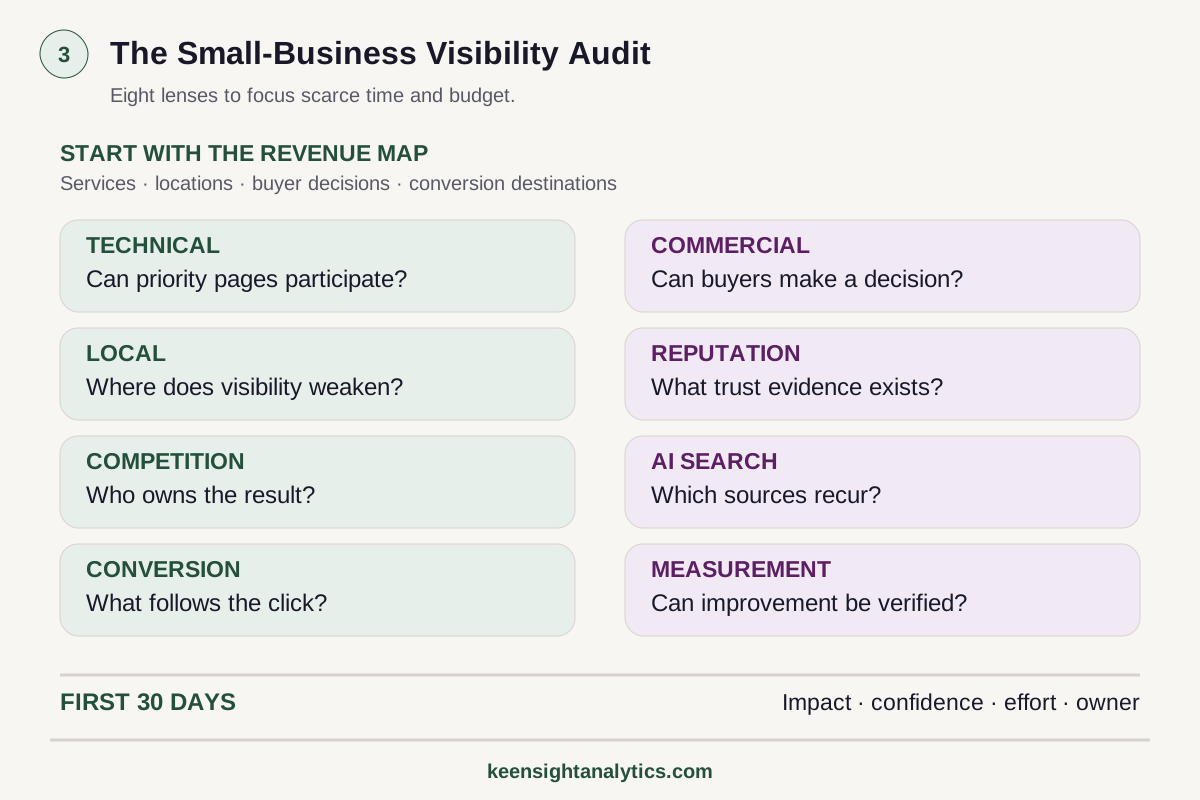
The framework
Small-business visibility audit
Start with services, locations, buyer decisions and conversion destinations.
Technical
Can priority pages participate?
Commercial
Can buyers make a decision?
Local
Where does visibility weaken?
Reputation
What trust evidence exists?
Competition
Who owns the result?
AI search
Which sources recur?
Conversion
What follows the click?
Measurement
Can improvement be verified?
First 30 days: prioritize by impact, confidence, effort and owner.
SEO next step
Apply the framework to a real commercial page set before adding more activity to the roadmap.Small-business SEO audits often fail in one of two directions. The first is too shallow: a score from a crawler, a few keyword screenshots, and a generic list of “optimize title tags” recommendations. The second is too large: hundreds of findings with no connection to revenue, ownership, or implementation capacity.
A useful audit should answer three questions: Where is the business losing discoverability? What is causing the loss? Which actions deserve priority?
That requires more than technical SEO. For many small businesses, search visibility spans Google organic results, Maps, reviews, location signals, service pages, category pages, AI-generated recommendations, and the conversion path after a visitor lands on the site. The audit should follow that commercial system.
1. Start with the revenue map, not the keyword tool
Before collecting keywords, list what the business actually wants to sell. Identify the highest-value services, product categories, locations, customer types, and seasonal priorities. A plumber may care more about emergency calls and water-heater replacement than broad “home maintenance” traffic. A law firm may care about a handful of practice areas in specific jurisdictions. An ecommerce business may make most of its margin from a small subset of categories.
For each commercial area, document the buyer decision: what problem starts the search, which alternatives exist, what geographic constraint matters, what evidence builds trust, and what action counts as a valuable conversion.
This revenue map prevents a common audit mistake: treating every ranking opportunity as equally important.
2. Build a compact search-demand universe
Next, create a representative query set. Include direct service or product terms, problem-led searches, local modifiers, comparison questions, high-consideration informational searches, and branded queries that reveal reputation or navigational issues.
Group them by commercial intent. A small business does not need to track every keyword variation. It needs enough coverage to understand whether it is visible for the decisions that matter.
Look at the result types as well as the ranking positions. Does the query trigger a local pack, shopping results, large directories, AI-generated summaries, video, or traditional organic listings? The surface determines what type of asset can compete.
3. Audit technical access on revenue-critical pages
Technical SEO should begin with the pages that matter commercially. Confirm that core service, product, category, and location pages return successful status codes, are indexable, use coherent canonical tags, appear in internal navigation, and are represented appropriately in XML sitemaps.
Check for accidental noindex directives, duplicate URL variants, redirect loops, broken internal links, thin parameter pages, rendering failures, mobile usability problems, and migration remnants. A five-page site can have serious technical defects if the wrong plugin, theme, CMS setting, or redesign changed how important pages are served.
Then separate defects from improvements. A broken canonical on the primary service page is a defect. A marginal page-speed improvement on an already usable page may be an optimization. The audit should not assign the same urgency to both.
4. Evaluate whether commercial pages can support a buying decision
Many small-business sites are technically indexable but commercially thin. The service page contains a headline, three paragraphs, a stock image, and a contact form. That may be enough to say the service exists, but not enough to compete for a buyer comparing options.
Review whether each important page explains scope, customer fit, service area, process, important constraints, pricing or pricing logic where appropriate, common questions, relevant proof, and a clear next step. For ecommerce, inspect category and product decision information. For professional services, inspect expertise, jurisdiction, credentials, methodology, and who the service is designed for.
Do not add words simply to make pages longer. Add the information customers repeatedly need before they call, buy, book, or request a quote.
5. Audit local visibility as a geographic system
For businesses that depend on local customers, one ranking checked from the office is not a measurement system. Local results vary by location, service, and competitive density.
Review Google Business Profile eligibility and accuracy, primary and secondary categories, services, hours, URLs, business description, photos, review activity, duplicate listings, and consistency with the website. Confirm that location pages represent real offices or meaningful service markets rather than fabricated city permutations.
Measure important searches from multiple points across the actual trade area. A business can rank strongly within one mile of the office and disappear across the rest of the market. Geographic sampling reveals where local coverage weakens.
For more detail, see the local search geographic measurement framework.
6. Treat reviews as reputation and conversion evidence
Review volume alone is an incomplete metric. Evaluate recency, distribution across locations, recurring themes, response practices, platform mix, and whether the reviews describe the services the business actually wants to grow.
Read the negative reviews as operating data. Repeated complaints about scheduling, communication, billing, or service quality may be more commercially important than a small ranking change. Search visibility that sends more customers into a broken experience does not create durable growth.
Do not manufacture, gate, or selectively solicit reviews in ways that violate platform rules. Build a legitimate request and response process.
7. Identify the competitors that actually own the results
Search competitors are not always the businesses the owner names first. A directory can dominate one service category. A marketplace can own product discovery. A publisher can outrank local companies for informational questions. A newer business can gain faster than the long-standing market leader.
For the query universe, record which domains and local businesses appear repeatedly. Compare their page types, site architecture, local coverage, review profiles, links, original resources, and commercial detail.
The objective is not to copy them. It is to understand what kind of asset or evidence wins each part of the market.
8. Add AI search as another discovery surface
For many small businesses, AI search should be evaluated as an additional recommendation and research surface—not as a replacement for Google Search, Maps, reviews, or the website.
Create a modest prompt set around real customer decisions. Record brand mentions, citations, recommendations, competitor appearances, and visible sources separately. Check whether the company’s website clearly explains the facts those answers would need: services, locations, customer fit, expertise, product data, pricing context, and differentiators.
If a company never appears, do not assume the solution is more AI-focused blog content. The cause may be weak first-party pages, poor local evidence, incomplete third-party profiles, technical access, or simply weak fit for the sampled prompts.
9. Audit the conversion path after the click
Search traffic has little value if the site loses the customer after discovery. Test important landing pages on mobile devices. Can the visitor understand the offer quickly? Is the phone number usable? Are forms functional? Does the booking path work? Are trust signals visible? Does the page explain what happens after submission?
Check analytics and conversion tracking before using performance data to judge SEO. A broken form event, consent change, call-tracking issue, or redesign can create false conclusions about lead quality.
For ecommerce, verify product availability, pricing clarity, shipping information, checkout continuity, and whether high-traffic informational pages connect to relevant commercial inventory.
10. Score findings by impact, confidence, effort, and ownership
The audit becomes useful when it stops being a list. Score each finding on four dimensions:
- Commercial impact: does the issue affect a revenue-critical page, location, service, or category?
- Confidence: is the relationship between the issue and lost visibility well supported, or merely plausible?
- Effort: can the fix be implemented in an hour, a week, or a full rebuild?
- Ownership: does it belong to the owner, developer, content team, agency, operations team, or another vendor?
A high-impact, high-confidence, low-effort defect should rise to the top. A speculative optimization requiring a platform rebuild should not.
11. Choose the right implementation model
Not every audit should become a retainer. If the dominant issue is a finite set of technical defects, a fixed Technical SEO Project may be the correct response. If the business needs a deeper one-time diagnosis across search, competitors, local visibility, and AI discovery, a Search Intelligence Report can define the problem before implementation.
If the business has capable internal or incumbent execution but lacks objective measurement, monitoring can remain measurement only. If the constraints are interdependent and require recurring ownership across technical work, content, authority, local search, and measurement, a managed search program may be more appropriate.
The engagement model should follow the failure pattern, not the agency’s preferred contract structure.
12. A practical first-30-days sequence
For many small businesses, the first month after an audit should look something like this:
- Fix anything blocking or misdirecting core commercial pages.
- Repair broken conversion tracking, forms, calls, or booking paths.
- Correct major local-profile and entity inconsistencies.
- Improve the one or two commercial pages closest to revenue.
- Establish a small, repeatable visibility baseline across organic, local, and AI surfaces where relevant.
- Only then expand content or authority work based on demonstrated gaps.
The order can change, but the principle should not: remove meaningful constraints before adding more activity.
The audit should reduce uncertainty
A small business does not need more SEO tasks. It needs fewer, better-prioritized actions tied to real customer demand. The audit should tell the owner what is broken, what is merely imperfect, what could create commercial upside, who should own the work, and how the business will know whether conditions improved.
If the final deliverable cannot support those decisions, it is a diagnostic inventory—not a useful audit.
When this becomes recurring search work
Managed Search fits when several constraints have to move together.
Use managed KeenSight Search when technical foundations, commercial architecture, content, authority, and measurement require ongoing ownership. Use Search Intelligence first when the dominant constraint is still unclear.Branch the audit by business model
After the common technical and measurement checks, branch the audit. A local service business should emphasize geographic coverage, Business Profile accuracy, reviews, service-area intent, and location/service architecture. An ecommerce business should emphasize categories, product eligibility, faceted navigation, feeds, inventory states, and merchandising links. A non-local service or B2B business should emphasize commercial pages, comparisons, expertise, integrations, proof, and search-to-pipeline measurement.
Use the audit to choose the smallest engagement that fits the evidence
A small-business audit should narrow the next decision, not automatically turn into a retainer. If you only need a limited outside-in signal, begin with the Free Visibility Preview. If the evidence is mixed and you still cannot tell whether the problem is technical, content, authority, competition, local visibility, or measurement, use Search Intelligence for a deeper one-time diagnosis.
Choose managed KeenSight Search when several failure layers need recurring ownership and prioritization. If the audit instead isolates a finite crawl, rendering, indexation, template, or architecture defect, scope a Fixed Technical SEO Project. If strategy and page roles are already clear but production capacity is the bottleneck, use Search Content Production. The companion failure-layer diagnostic provides the evidence test behind that choice.
Decision checkpoint
Confirm whether the problem is a page decision, a diagnosis problem, or a recurring ownership problem.
Broad SEO symptoms often combine technical, content, architecture, authority, competitive, and measurement constraints.- 01Commercial roleCan you name the affected page set, buyer decision, or search segment rather than describing the problem only as “SEO”?
- 02Dominant constraintDo you have evidence for the primary failure layer and evidence that argues against the alternatives?
- 03Operating modelCan an internal team execute a prioritized plan, or do several constraints require recurring external ownership?
The Audit Should Answer Four Questions
Where are we invisible?
Map the services, products, locations, and decision queries where customers fail to find the business.
Why are we invisible?
Separate technical, commercial-page, local, reputation, authority, competitive, and measurement causes.
What should happen first?
Prioritize by commercial impact, confidence, implementation effort, and the team that actually owns the change.
How will we know?
Establish a baseline before implementation so visibility, leads, and competitive movement can be evaluated afterward.
SEO next steps
Move from broad search symptoms to the right level of ownership.
Compare other ways to get help
Start with evidence before buying more SEO activity
The Free Visibility Preview is designed to surface an initial search problem without forcing a full engagement. Use deeper Search Intelligence when the diagnosis needs more evidence.
Keep Reading
Technical, Content, Authority, or Competition?
Use a four-layer diagnosis before choosing an SEO remedy.
Read article →Local SEO Audit Framework
Go deeper on local-profile, location-page, review, and geographic visibility analysis.
Explore local audit →Why More Blog Posts May Be the Wrong Fix
Diagnose whether content production is actually the next constraint to solve.
Read article →Make it specific
See what the market looks like for your company.
The free visibility preview turns a broad search topic into a limited personalized baseline.