August 28, 2026 · 11 min read
What to Fix First When a Technical SEO Audit Finds 100 Problems
A crawler can produce a long defect list. The valuable work is deciding which issues constrain search, which pages matter, what should happen first, and how the fix will be verified.
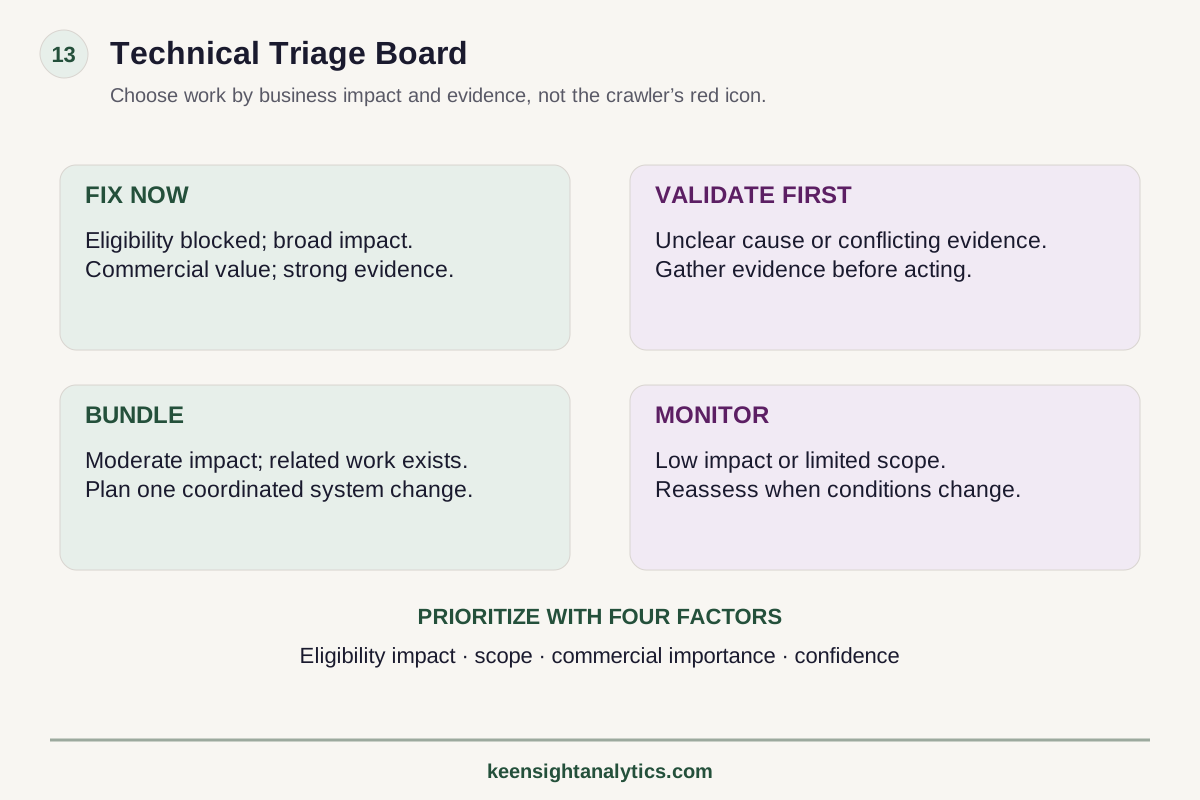
The framework
Technical triage board
Choose work by business impact and evidence.
Fix now
Eligibility blocked or broad impact, with commercial value and strong evidence.
Validate first
Unclear cause or conflicting evidence. Gather evidence before acting.
Bundle
Moderate impact with related work. Plan one coordinated change.
Monitor
Low impact or limited scope. Reassess when conditions change.
Prioritize by eligibility impact, scope, commercial importance and confidence.
Technical next step
If the issue is finite and reproducible, it may belong in a fixed technical project rather than an open-ended SEO program.A technical SEO audit that returns 100 findings has not finished the job.
Most websites contain imperfections. Some are genuine defects. Some are low-impact warnings. Some matter only on obsolete URLs. Some affect every revenue-critical page. Treating all of them as equivalent creates a backlog, not a remediation plan.
The useful output is a sequence: what should be fixed first, why it matters, who owns it, what it depends on, and how the team will know the fix worked.
1. Separate evidence from tool severity
SEO crawlers need severity labels because they scan large sites automatically. Those labels are starting points, not business priorities.
A tool may call a missing meta description an error while a broken canonical template affecting every service page creates a much larger search risk. A slow image on an archived page may be marked as severe while a JavaScript navigation defect keeps important products undiscoverable.
Do not inherit the crawler's priority system. Re-score findings against the site's actual architecture and commercial value.
2. Start with search eligibility failures
The highest-priority class usually includes issues that prevent or materially distort discovery, rendering, indexation, canonicalization, or the delivery of the intended page.
Examples include:
- important pages returning non-success status codes;
- accidental noindex directives;
- robots rules blocking required pages or resources;
- canonical tags pointing to incorrect destinations;
- redirect loops or chains affecting migrated pages;
- rendering failures that remove core content or links;
- sitewide navigation defects that isolate commercial sections;
- XML sitemap systems publishing the wrong canonical set.
An eligibility problem on a revenue-critical template usually outranks a polish issue everywhere else.
3. Score scope separately from severity
Ask how much of the site the issue affects.
A defect on one old article may be severe locally but insignificant globally. A weaker defect repeated across 20,000 category URLs can create meaningful crawl or indexation costs.
Classify scope as:
- single URL;
- small page group;
- template-wide;
- section-wide;
- sitewide;
- environment or infrastructure level.
Template-level fixes often deserve priority because one implementation can resolve hundreds or thousands of URLs.
4. Weight commercial importance
Not every URL has the same economic role.
Group pages by business function: core services, high-margin products, priority categories, locations, lead-generation pages, editorial content, account pages, utility pages, and legacy inventory.
A technical issue affecting checkout, high-intent category pages, or major service pages should be evaluated differently from the same issue on tag archives no one intends to rank.
This is why a technical audit needs business context. Pure crawl data cannot identify strategic importance on its own.
5. Measure demonstrated impact where possible
Some findings have direct evidence behind them.
Examples:
- pages dropped from the index after a canonical change;
- organic landing-page traffic declined after a migration;
- Google is selecting a different canonical than intended;
- rendered HTML is missing commercial content;
- server logs show repeated crawl waste on an uncontrolled faceted space;
- internal-link changes increased click depth for priority pages;
- broken redirects are receiving meaningful inbound traffic or links.
Evidence of actual search impact should increase confidence and priority. The absence of visible loss does not prove an issue is harmless, but it should affect how aggressively a theoretical risk is prioritized.
6. Distinguish defects from improvements
A useful audit labels findings by type.
Defects mean the system is not behaving as intended: wrong status codes, broken canonicals, accidental noindex, missing content, invalid redirects.
Improvements make a functioning system stronger: cleaner internal linking, richer structured data, more efficient crawl paths, better template metadata, or performance enhancements.
Investigations require more evidence before implementation: unexpected canonical behavior, possible content duplication, suspicious rendering differences, or unexplained crawl patterns.
Mixing all three into one urgency scale creates false emergencies.
7. Include confidence in the score
Not every recommendation has the same evidentiary strength.
A missing canonical that has demonstrably caused duplicate indexing is high confidence. A hypothesis that reducing crawl depth by one click will improve rankings may be directionally sensible but harder to quantify.
Use a simple confidence scale such as:
- High: clear defect and mechanism, supported by direct evidence or established technical behavior.
- Medium: plausible mechanism with partial evidence.
- Low: exploratory optimization or uncertain causality.
High-impact, high-confidence fixes usually belong near the top of the queue.
8. Include implementation effort—but do not let easy wins dominate
Effort matters because a roadmap must be executable.
A one-line template fix affecting 50,000 URLs may be an obvious priority. A major rendering architecture change may require weeks of engineering and careful regression testing.
But "easy" is not the same as "important." Teams sometimes spend a quarter clearing dozens of low-impact crawler warnings because they are simple while a difficult indexation problem remains untouched.
Use effort to sequence meaningful work, not to substitute convenience for impact.
9. Model dependencies
Technical SEO findings rarely exist independently.
A navigation rebuild may need to happen before internal-link cleanup. A CMS template fix may resolve canonical, metadata, and structured-data issues together. A migration redirect map may need to be approved before sitemap generation changes.
Build dependency chains so the team does not repeatedly touch the same system or implement a downstream fix that will be overwritten by a larger architectural change.
10. Identify blast radius
A fix can create its own risk.
Changing canonical logic, robots rules, rendering strategy, routing, pagination, or URL patterns can affect thousands of pages. High-impact changes require stronger staging, QA, rollback planning, and monitoring.
Priority is therefore not only "fix this soon." It can also mean "treat this as a controlled release because the consequences are broad."
11. Assign ownership before calling a finding actionable
A remediation plan should name the implementation owner.
Typical owners include:
- engineering;
- CMS or web development;
- content;
- SEO;
- analytics;
- infrastructure or DevOps;
- product;
- local operations.
If an issue has no owner, it is not prioritized—it is merely documented.
12. Define the verification test with the recommendation
Every technical recommendation should include a testable completion condition.
Examples:
- old URL returns one permanent redirect to the mapped new URL;
- rendered HTML contains the main content and crawlable internal links;
- canonical tag points to the intended indexable URL across the template;
- noindex is removed from production service pages;
- XML sitemap contains only canonical indexable URLs;
- structured data validates and matches visible page content;
- priority pages move back into the intended indexation state after recrawl.
This prevents "done" from meaning only that code was deployed.
13. Use a prioritization matrix
A practical score can combine:
- search impact — how strongly the issue can affect discovery, indexation, interpretation, or visibility;
- scope — how many important URLs or templates are affected;
- commercial importance — how strategically valuable those pages are;
- confidence — how strong the evidence and mechanism are;
- effort — implementation cost and complexity;
- dependency — whether other work must happen first;
- risk — potential blast radius of the change.
The formula does not need to be mathematically sophisticated. It needs to make tradeoffs explicit enough that stakeholders understand why issue #37 outranks issue #2 from the crawler export.
14. Batch by system, not only by severity
After scoring, group related fixes into coherent implementation batches.
For example, one CMS-template batch might address titles, canonicals, breadcrumbs, structured data, and pagination behavior together. A migration batch might cover redirects, sitemaps, internal links, and legacy URL retirement.
This reduces engineering churn and makes QA more coherent.
15. Know when a fixed project is enough
If the problem is a finite set of technical defects with clear ownership and a bounded implementation window, a fixed Technical SEO Project can be the right operating model.
If technical issues interact continuously with content, authority, competition, measurement, and changing business priorities, the organization may need recurring managed search instead.
If the incumbent team will execute and only independent measurement is needed, monitoring or benchmarking is a different service entirely.
Do not turn every technical audit into an indefinite retainer by default. Match the engagement model to the failure pattern.
16. A technical audit should end with decisions
The final deliverable should answer:
- What is actually broken?
- Which failures affect the most valuable pages?
- Which issues have demonstrated impact?
- What should be fixed first?
- What can wait?
- Which findings are only hypotheses?
- Who owns each fix?
- What does successful remediation look like?
Technical SEO value comes from removing meaningful constraints. The number of red icons that turn green is not the objective.
When this becomes implementation
Use a fixed project for a finite technical failure layer.
A Technical SEO Project fits when the root cause is bounded—such as rendering, canonicalization, indexation, migration, or template defects—and the remediation can be scoped. If the root cause is still uncertain or several failure layers interact, diagnose the system first.A repeatable technical-priority score
One practical model is (commercial impact × affected scope × confidence) ÷ effort, each scored from 1–5. A canonical template defect affecting all service pages might score 5 × 5 × 5 ÷ 2 = 62.5. A cosmetic warning on one low-value page might score 1 × 1 × 2 ÷ 2 = 1.
The score does not replace judgment; it forces the team to explain why one finding outranks another.
Turn the audit backlog into the smallest viable operating model
A 100-item audit is not a 100-item implementation plan. If the highest-priority findings resolve to a bounded set of rendering, canonical, indexation, migration or template defects with clear acceptance criteria, scope them as a Fixed Technical SEO Project. If several findings may be symptoms of a different root cause, use Search Intelligence before committing engineering capacity.
The Free Visibility Preview can add a limited market signal when you need to know whether the technical backlog appears to coincide with material visibility weakness. Use managed KeenSight Search when technical fixes must be continuously coordinated with content, architecture, authority and competitive priorities. For incident-level evidence, pair this with the indexed-page decline diagnostic.
Decision checkpoint
Decide whether the technical issue is bounded before choosing the engagement.
Technical defects can be finite projects, symptoms of a larger system problem, or merely observations that need validation.- 01ReproducibilityCan the failure be reproduced on a defined URL, template, rendering path, canonical rule, or release condition?
- 02ScopeIs the affected set bounded enough to define acceptance criteria and a finite remediation plan?
- 03DependenciesDoes fixing it require ongoing coordination with content, architecture, authority, or measurement beyond the technical layer?
Prioritize by Business Impact
Eligibility first
Prioritize defects that block crawling, rendering, indexation, canonicalization, or intended delivery on important pages.
Template scope
A repeatable defect across a commercial template can outrank a severe issue on one low-value URL.
Confidence + evidence
Separate demonstrated failures from plausible improvements and low-confidence hypotheses.
Verification built in
Define how every fix will be tested after deployment before calling the recommendation complete.
Technical SEO next steps
Use the smallest operating model that can actually solve the failure.
Compare other ways to get help
Turn the audit into a remediation sequence
If the constraint is finite and technical, a fixed Technical SEO Project can move from diagnosis through verification without turning the work into an open-ended engagement.
Keep Reading
Diagnose the Failure Layer
Determine whether technical SEO is the dominant constraint before prioritizing the backlog.
Read article →Diagnose an Indexation Drop
Use a step-by-step process when the symptom is a sudden loss of indexed URLs.
Read article →SEO Prioritization Across Failure Layers
Connect technical findings to content, authority, competition, and measurement constraints.
Read explainer →Make it specific
See what the market looks like for your company.
The free visibility preview turns a broad search topic into a limited personalized baseline.