August 28, 2026 · 10 min read
How Multi-Location Companies Should Structure Their SEO Program
The strongest multi-location programs centralize standards while preserving real local evidence. They operate as one search system, not hundreds of improvised location campaigns.
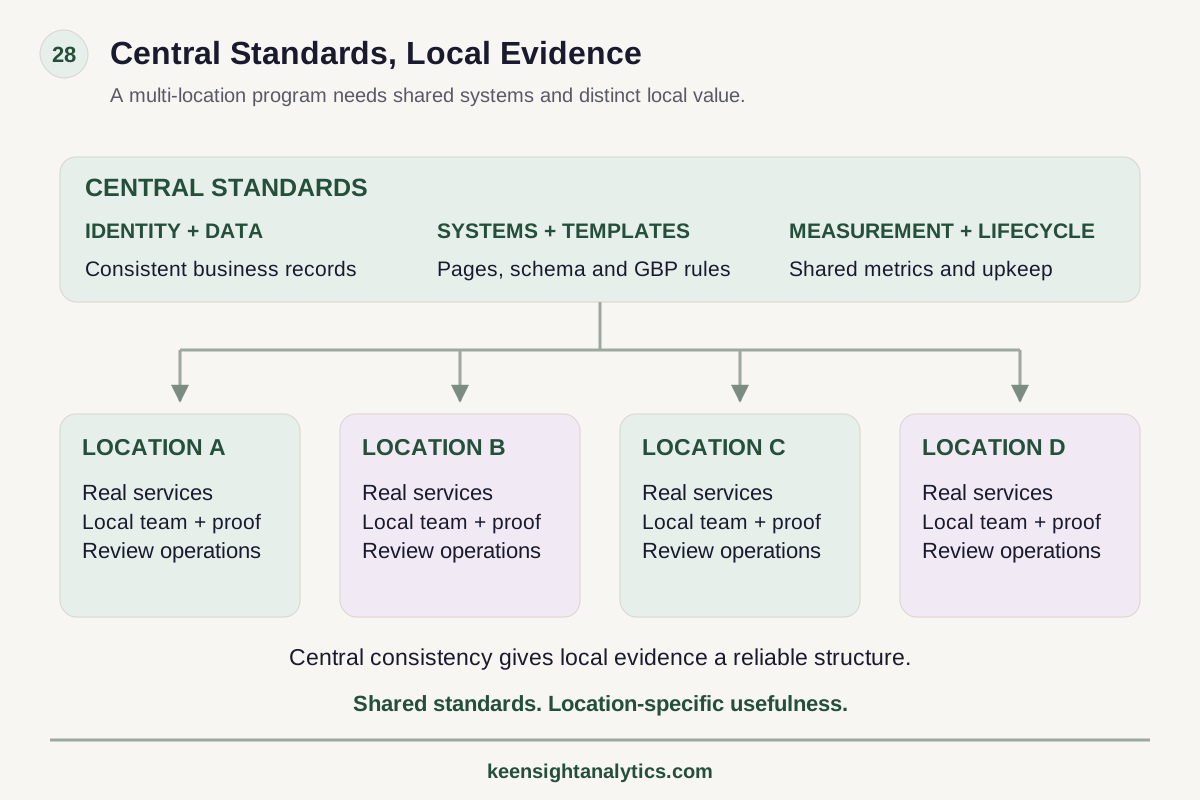
The framework
Central standards, local evidence
Shared systems need distinct local value.
Identity and data
Maintain consistent business records.
Systems and templates
Coordinate pages, schema and Business Profile rules.
Measurement and lifecycle
Use shared metrics and upkeep.
Each location
Contribute real services, local team and proof, and review operations.
Shared standards. Location-specific usefulness.
Local search next step
Local visibility has to be measured across the market you actually serve—not from one device or ZIP code.Multi-location SEO breaks in two opposite ways.
In one model, every location improvises independently: inconsistent pages, duplicate listings, conflicting hours, different vendors, and no common measurement. In the other, headquarters standardizes everything so aggressively that every location page becomes the same template with a city name swapped in.
A scalable local-search program needs central governance and local truth at the same time.
1. Define the canonical identity of every location
Create a location registry that identifies each real operating location and its canonical facts: name, address, phone, hours, URL, status, service availability, opening date, closure status, and relevant business identifiers.
This registry should be the reference point for the website, local listings, structured data, analytics, and internal reporting.
Location ambiguity becomes expensive at scale. A small inconsistency repeated across 200 locations becomes a systems problem.
2. Separate headquarters responsibilities from local responsibilities
Headquarters should usually own:
- site architecture and URL standards;
- location-page templates;
- structured data implementation;
- analytics and conversion definitions;
- Google Business Profile governance process;
- duplicate prevention;
- review and reputation policy;
- brand standards;
- measurement methodology;
- opening, moving, merging, and closure workflows.
Location or regional teams should provide facts that genuinely vary: staff, services, local photos, local proof, local partnerships, market-specific FAQs, events, hours, and service-area context.
3. Give every location page a real job
A location page should help a prospective customer evaluate that specific location.
Useful elements can include:
- address and contact information;
- hours and appointment or service instructions;
- services actually available there;
- staff or practitioner information where relevant;
- parking, access, delivery, or service-area details;
- local photos;
- reviews or local proof where appropriate;
- links to relevant service pages;
- clear conversion paths.
An address plus 200 words of generic corporate copy is not a useful local destination.
4. Avoid location/service multiplication without distinct intent
Ten services across 100 locations can tempt teams to create 1,000 near-duplicate city/service pages.
Only create separate pages where the intent, evidence, service availability, or local market justifies a distinct destination. Otherwise, use strong service pages connected to useful location pages.
The architecture should scale with meaningful search needs, not with every possible database permutation.
5. Govern Google Business Profiles centrally
Google Business Profiles are operational assets, not side projects.
Define who can edit profiles, who approves changes, how categories are selected, how temporary hours are updated, how new locations are verified, how duplicates are handled, how URLs are assigned, and how closures or moves are processed.
Local teams can supply current information, but governance should prevent conflicting edits and identity drift.
6. Treat categories and services as business facts
Profile categories and service descriptions should reflect what the location actually does.
Do not force every location into identical categories when offerings differ. Likewise, do not add categories simply because they appear commercially attractive if the location does not genuinely match them.
The same principle applies to the website: local pages should represent real availability.
7. Build a review operating system
Reviews affect reputation, conversion, and local discovery. At scale, they need ownership.
Track volume, recency, rating distribution, themes, response rate, response quality, and location-level anomalies. Establish a compliant process for requesting reviews and escalating serious issues.
Do not evaluate locations only by average star rating. A location with a high rating but very little recent feedback may have a different reputation profile from one with sustained current review activity.
8. Standardize local structured data and technical implementation
Use consistent templates for titles, canonicals, robots directives, structured data, breadcrumbs, internal links, and location identifiers.
Structured data should describe visible facts, not invent new ones. The technical layer should make each location unambiguous while keeping templates maintainable.
9. Design internal links around customer movement
Corporate service pages should connect to representative or relevant locations. Location pages should link to services genuinely available there. Regional hubs can help when they correspond to real browsing or market needs.
Avoid sitewide blocks that dump hundreds of location links onto every page. Use hierarchical navigation and contextual links instead.
10. Build explicit workflows for openings, moves, mergers, and closures
Location lifecycle events create search risk when operations and SEO are disconnected.
For every event, define what happens to:
- the website URL;
- redirects;
- Google Business Profile;
- other local listings;
- structured data;
- navigation;
- sitemaps;
- analytics labels;
- local reviews and customer communication.
A location move is a small migration and should be managed accordingly.
11. Measure local visibility geographically
One ranking checked from the corporate office cannot represent a metro area.
Define commercially meaningful query groups and sample search visibility across representative geographic points. Measure local-pack coverage, organic visibility, competitor presence, and market gaps by location.
Summarize geographic coverage rather than only average rank.
12. Create a local competitive cohort per market
The strongest competitor in one city may not exist in another.
Build competitor cohorts from the businesses that actually appear across the location’s target query set and trade area. Then compare review strength, local pages, categories, services, authority, and search coverage.
Corporate competitor lists are often too broad for local decision-making.
13. Use central dashboards with local drill-down
Leadership needs a portfolio view: how many locations are gaining coverage, where major gaps exist, which markets are declining, and where reputation or technical risk is concentrated.
Regional and local operators need detail. The same measurement system should allow drill-down without changing definitions between teams.
14. Decide what requires central execution versus local action
Template defects, analytics, architecture, listing governance, and measurement methodology usually belong centrally. Local photos, staff facts, community partnerships, service changes, and operational details require local input.
Write the ownership model down. SEO programs stall when everyone assumes someone else owns the update.
15. Add AI-search monitoring without replacing local fundamentals
Consumers increasingly use AI interfaces for recommendations and comparisons. Multi-location brands can monitor whether locations, services, and brand entities appear accurately in relevant prompts.
But AI monitoring should sit on top of strong local identity, reviews, service information, third-party references, and website architecture. It is an additional discovery surface, not a replacement for Maps and organic local search.
A multi-location program is an operating model
Scale comes from centralized standards, reliable data, clear ownership, and repeatable workflows. Local relevance comes from facts only the location can provide.
Combine the two and the brand can grow without choosing between chaos and templated sameness.
When this becomes a local-search operating problem
Connect locations, services, entities, reviews, and geography.
Use Local SEO when KeenSight needs to own the implementation across website and local-search layers. Use Search Intelligence when the market-level failure is still unclear, especially across multiple locations or service areas.Local-search work cannot guarantee Map Pack or local ranking outcomes.Who owns what in multi-location SEO
Central team: templates, technical standards, analytics, structured-data rules, duplicate prevention, location lifecycle, and portfolio measurement. Regional/location team: hours, local services, staff, photos, local proof, review response, and operational changes. Shared approval: openings, moves, closures, major service changes, and claims that affect brand or compliance.
Choose the local operating model before multiplying location work
If the organization still needs to determine which markets, page roles, local entities, or governance model matter, use Search Intelligence for a one-time diagnosis before rolling out a portfolio-wide program. Use Local SEO when KeenSight should actively manage location architecture, Business Profiles, reviews, local content, and market-level implementation across real operating locations.
Use Search Benchmarking when the internal team or incumbent already executes and leadership primarily needs a stable recurring comparison across markets. Choose managed KeenSight Search when local work cannot be separated from broader technical SEO, commercial architecture, content, authority, AI-search visibility, and competitive priorities. Pair this with the service-area measurement framework so the portfolio has a defensible geographic denominator rather than a collection of isolated rank checks.
Decision checkpoint
Define the actual local market before prescribing local SEO work.
A single ranking from one device is not enough to diagnose a geographic visibility problem.Local SEO can improve the system around local discovery but cannot guarantee Map Pack placement or a specific local ranking.- 01MarketAre the relevant locations, service areas, neighborhoods, and high-value local queries defined?
- 02EvidenceDo you have geographic visibility, profile/entity, review, website, and competitor evidence rather than one Map Pack screenshot?
- 03ExecutionIs the gap a measurement problem, a one-time diagnosis, or recurring local implementation across listings, pages, reputation, and entities?
The Multi-Location Operating Model
Central standards
Govern templates, listings, analytics, structured data, architecture, and lifecycle workflows centrally.
Local evidence
Locations supply real service availability, staff, photos, reviews, and market-specific information.
Geographic measurement
Measure coverage across the actual trade area rather than from one rank-check location.
Clear ownership
Define who updates website facts, profiles, reviews, local content, and remediation.
Local SEO next steps
Connect geographic evidence to the right local operating model.
Compare other ways to get help
Measure local markets as a portfolio
KeenSight local SEO and benchmarking can show where locations are gaining or losing geographic search coverage while your operating teams retain execution ownership where appropriate.
Keep Reading
Measure Local SEO Across a Service Area
Build a geographic coverage model instead of relying on one local rank.
Read article →Service, Industry, and Location Architecture
Separate page roles without creating thousands of near-duplicate permutations.
Read article →Local Search Geographic Measurement
Review the underlying methodology for measuring geographic search coverage.
Read explainer →Make it specific
See what the market looks like for your company.
The free visibility preview turns a broad search topic into a limited personalized baseline.