August 28, 2026 · 10 min read
SEO for HVAC Companies: Building Visibility Beyond ‘HVAC Near Me’
HVAC demand is fragmented across emergencies, equipment, symptoms, replacements, maintenance, brands, financing, and geography. The search strategy needs to reflect the full buying system.
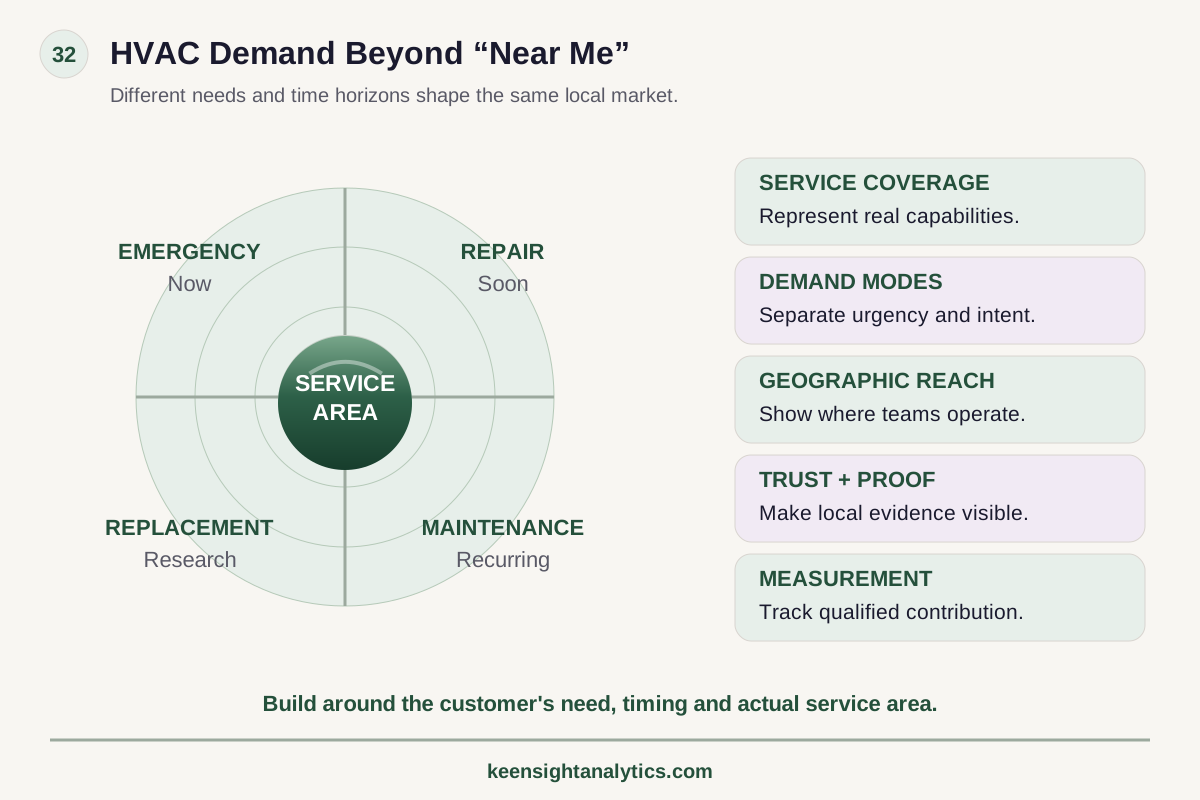
The framework
HVAC demand beyond “near me”
Different needs and time horizons shape the same local market.
Emergency → now
Immediate service needs.
Repair → soon
Problem and symptom-led needs.
Replacement → research
High-consideration equipment decisions.
Maintenance → recurring
Ongoing service needs.
Supporting system
Real service coverage, demand modes, geographic reach, local proof and qualified contribution.
Build around the customer's need, timing and actual service area.
Local search next step
Local visibility has to be measured across the market you actually serve—not from one device or ZIP code.HVAC search is often reduced to one phrase: “HVAC near me.” That misses most of the market.
Customers search because an air conditioner stopped working, a furnace is making noise, a heat pump needs replacement, energy bills are rising, a system is undersized, a home needs maintenance, or a buyer is comparing equipment and financing options.
The SEO program should organize those needs into clear service pages, useful local coverage, reputation evidence, and measurement that accounts for geography and seasonality.
1. Map the service portfolio by commercial intent
Separate repair, replacement, maintenance, installation, emergency work, and specialty offerings.
Common high-value categories may include:
- air conditioning repair;
- heating or furnace repair;
- system replacement;
- heat pumps;
- ductless systems;
- maintenance plans;
- indoor air quality;
- commercial HVAC;
- emergency service;
- brand-specific service where the company is genuinely qualified.
Each major service should have a page strong enough to support a customer decision.
2. Build service pages around problems customers actually face
A service page should not read like a keyword inventory.
Explain common symptoms, what the service includes, when repair versus replacement may be considered, what factors affect scope, service availability, relevant equipment types, and what happens after the customer contacts the company.
Do not manufacture exact pricing or savings claims the company cannot support. Where costs vary, explain the variables.
3. Separate urgent demand from research demand
Emergency repair and system replacement are different journeys.
An emergency page should make availability, response process, service boundaries, and contact options clear. A replacement page should help buyers understand equipment choices, efficiency considerations, sizing, financing or rebate considerations where current and applicable, installation process, and maintenance.
Matching the page to the decision improves both relevance and conversion.
4. Use problem-led content to support commercial pages
Customers often search symptoms before they know which service they need.
Useful editorial topics might explain why an AC freezes, why a furnace cycles frequently, what causes uneven temperatures, when a heat pump may be appropriate, or how maintenance affects system performance.
These articles should link to the relevant service destination without pretending a web article can diagnose a specific mechanical problem remotely.
5. Build service-area architecture carefully
A service-area business should not fabricate office locations to create local relevance.
Create city or market pages where geography reflects real commercial service, meaningful local search demand, and enough unique information to support the page. Explain service availability, neighborhoods or communities served, local operating considerations, and relevant proof where legitimate.
Avoid hundreds of near-identical city pages that exist only to swap place names.
6. Give Google Business Profile operational ownership
Maintain accurate categories, service areas, hours, phone, URL, services, photos, and other visible business information.
Define who owns updates for seasonal hours, temporary closures, moves, category changes, and new services. A stale profile during a heat wave or cold snap can create both search and customer-service problems.
7. Treat reviews as a conversion and quality signal
Track review volume, recency, rating distribution, recurring themes, and response practices.
For HVAC, review language can reveal what customers value: responsiveness, technician communication, cleanliness, repair transparency, installation quality, scheduling, or follow-up.
Use legitimate review-request processes. Do not filter for only happy customers or offer prohibited incentives.
8. Measure local visibility geographically
A contractor may appear near its business address while losing visibility across much of its real service area.
Use representative geographic points and service-level query groups. Measure local-pack coverage, organic visibility, and which competitors appear across the market.
Prioritize gaps based on customer density and service economics, not map aesthetics.
9. Build local competitor cohorts by service
One competitor may dominate repair while another dominates replacement. A large franchise may be visible broadly while a specialist owns heat-pump queries.
Compare the businesses actually winning the relevant result sets, their service pages, profile categories, reviews, local coverage, authority, and commercial messaging.
10. Account for seasonality in every performance review
HVAC demand can swing sharply with weather and season.
Compare year over year, segment by service type, and use visibility share to understand whether traffic changed because demand changed or because competitors captured more of it.
A month-over-month traffic decline from July to October may be normal. Losing local coverage year over year during the same demand window is a different problem.
11. Connect SEO to call and booking quality
HVAC conversion paths are often phone-heavy.
Measure qualified calls, booked appointments, forms, chat leads, replacement consultations, and service-plan interest where attribution is defensible. Separate wrong-number or low-fit calls from real commercial outcomes.
High traffic to a generic “what is HVAC?” article should not outweigh modest but high-quality replacement demand.
12. Build trust into high-consideration pages
Replacement decisions can involve substantial household spending.
Make licenses, certifications, warranties, financing options, maintenance expectations, brands serviced, service process, and company policies clear when they are accurate and current.
Specific operational information is more useful than generic “trusted experts” language.
13. Use technical SEO to keep the local system clean
Watch for duplicate city pages, parameter URLs, inconsistent canonicals, orphan service pages, broken redirects after site changes, slow mobile experiences, and important contact elements that depend on fragile scripts.
Home-service websites often evolve through years of vendor and CMS changes. Technical debt can suppress otherwise strong local content.
14. Monitor AI-search recommendation behavior carefully
Homeowners may ask AI systems for provider comparisons, maintenance guidance, or equipment recommendations.
Track relevant prompts, visible sources, brand mentions, and recommendations. Strengthen service clarity, business entities, reviews, third-party references, and useful technical content where evidence is weak.
Do not treat AI visibility as a replacement for local search or claim guaranteed recommendation placement.
15. Prioritize by search economics
Not every keyword or city deserves equal investment.
Prioritize service/market combinations based on revenue potential, capacity, seasonality, visibility gap, competitive intensity, close rates, and strategic growth goals.
A smaller heat-pump query set can be more valuable than a large informational topic if the business is actively expanding that service line.
HVAC SEO is demand capture across time and geography
The strongest program connects urgent repair, planned replacement, maintenance, education, reputation, local coverage, and conversion measurement.
That is a much larger system than “rank for HVAC near me”—and a more commercially useful one.
When this becomes a local-search operating problem
Connect locations, services, entities, reviews, and geography.
Use Local SEO when KeenSight needs to own the implementation across website and local-search layers. Use Search Intelligence when the market-level failure is still unclear, especially across multiple locations or service areas.Local-search work cannot guarantee Map Pack or local ranking outcomes.HVAC demand is not one funnel
Separate at least four search journeys: urgent repair (“AC stopped working”), planned service (tune-ups and maintenance), replacement (equipment and financing research), and system education (heat pumps, efficiency, indoor air quality). Each journey needs different pages, response expectations, and conversion measurement.
Match the search operating model to service urgency, seasonality, and geography
HVAC demand behaves differently across emergency repair, planned maintenance, system replacement, indoor-air-quality work, and seasonal peaks. Use Local SEO when KeenSight should manage service-area visibility, local entities, Business Profiles, service/location pages, reviews, and market-level implementation. Use Search Benchmarking when an internal or agency team already executes and the company needs a stable recurring view across service areas and competitors.
Use Search Intelligence when the team cannot yet tell whether a weak market is caused by demand, service coverage, page architecture, local competition, or measurement. Choose managed KeenSight Search when local execution must stay coordinated with broader technical, content, authority, and competitive work. Pair this with the service-area measurement framework so urgent and planned demand are not collapsed into one misleading local score.
Decision checkpoint
Define the actual local market before prescribing local SEO work.
A single ranking from one device is not enough to diagnose a geographic visibility problem.Local SEO can improve the system around local discovery but cannot guarantee Map Pack placement or a specific local ranking.- 01MarketAre the relevant locations, service areas, neighborhoods, and high-value local queries defined?
- 02EvidenceDo you have geographic visibility, profile/entity, review, website, and competitor evidence rather than one Map Pack screenshot?
- 03ExecutionIs the gap a measurement problem, a one-time diagnosis, or recurring local implementation across listings, pages, reputation, and entities?
The HVAC Search System
Service intent
Separate repair, replacement, maintenance, emergency, and specialty journeys.
Real service areas
Create location content where the business genuinely operates and can provide unique local information.
Seasonal measurement
Use year-over-year and service-level visibility context instead of reacting to raw monthly traffic.
Qualified conversion
Measure booked work and high-fit calls, not traffic volume alone.
Local SEO next steps
Connect geographic evidence to the right local operating model.
Compare other ways to get help
Find the HVAC markets and services with the biggest search gap
A Free Visibility Preview can show where the business is being found today before deeper Search Intelligence or execution is considered.
Keep Reading
Measure Local SEO Across a Service Area
Map local coverage across the market instead of relying on one pin.
Read article →Service Area vs Physical Location SEO
Understand the architectural difference between real offices and service-area markets.
Read explainer →Small Business Search Visibility Audit
Use a practical diagnostic framework before choosing an SEO workstream.
Read article →Make it specific
See what the market looks like for your company.
The free visibility preview turns a broad search topic into a limited personalized baseline.