August 28, 2026 · 10 min read
SEO for Dental Groups: Connecting Location Pages, Services, and Google Business Profiles
Dental SEO becomes an architecture and operating problem as a practice grows. The site has to make both treatment expertise and local availability clear without creating hundreds of thin city-service pages.
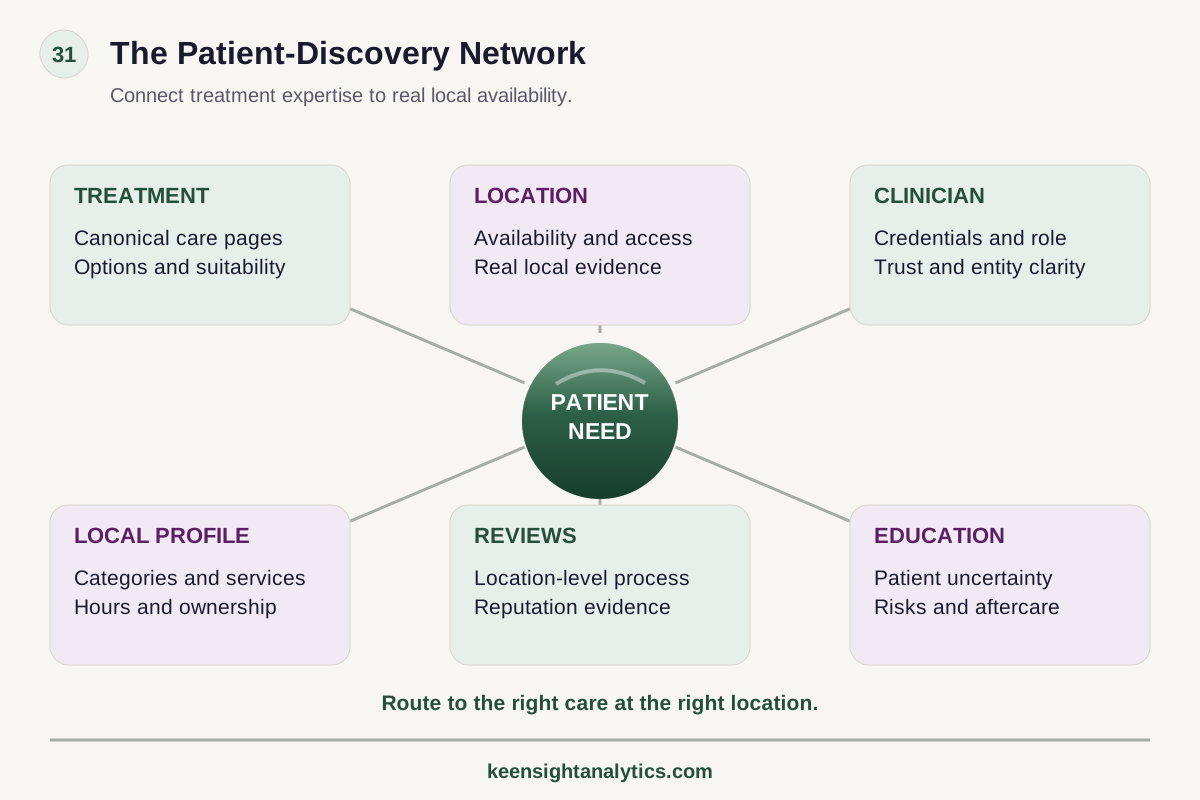
The framework
Patient-discovery network
Connect treatment expertise to real local availability.
Treatment
Canonical care pages, options and suitability.
Location
Availability, access and real local evidence.
Clinician
Credentials, role, trust and entity clarity.
Local profile
Categories, services, hours and ownership.
Reviews
Location-level process and reputation evidence.
Education
Patient uncertainty, risks and aftercare.
Route to the right care at the right location.
Local search next step
Local visibility has to be measured across the market you actually serve—not from one device or ZIP code.A single-location dental practice can often manage search visibility with a relatively simple site. A dental group or DSO cannot.
Once the organization has several locations, many clinicians, and a broad treatment mix, search becomes a matrix: what care is offered, where it is offered, who provides it, and why a patient should trust that location for that need.
The strongest dental SEO programs solve that matrix with clear page roles, accurate local entities, strong reputation systems, and measurement across the patient trade area.
1. Start with the treatment portfolio
List the services the group genuinely wants to grow and can consistently deliver. Separate general dentistry from strategically important treatments such as implants, emergency dentistry, cosmetic procedures, orthodontics, pediatric care, sedation, periodontal care, or oral surgery where applicable.
Not every service needs a dedicated page. Create a separate treatment destination when the service has distinct search demand, decision criteria, clinical scope, and conversion path.
2. Build strong canonical treatment pages
A treatment page should explain the service, who may be a candidate, common reasons patients consider it, what the consultation or process generally involves, relevant limitations, and what happens next.
Medical and dental information should be reviewed for accuracy and should not make outcome guarantees. The page should inform a patient without pretending to replace individualized clinical advice.
Strong central treatment pages reduce the need to repeat the same medical explanation on every location page.
3. Give location pages a distinct local job
Location pages should answer whether the patient can receive the relevant care at that office and what makes the location operationally distinct.
Useful local information includes:
- address, hours, phone, and appointment path;
- treatments actually available at the office;
- clinicians working there;
- insurance or payment information when accurate and appropriately scoped;
- parking, accessibility, and practical visit details;
- local photos;
- review and reputation context;
- links to central treatment information.
4. Avoid treatment × location doorway-page multiplication
A group with 20 locations and 25 services could theoretically generate 500 location-service pages. Most should not exist.
Create a unique location-service page only where there is enough distinct search intent and local information to justify it. Otherwise, let the location page confirm service availability and link to the canonical treatment page.
This keeps the architecture useful instead of templated.
5. Treat clinician pages as trust and entity assets
Maintain accurate provider pages with name, credentials, education, areas of focus, locations, professional affiliations, and authorship where relevant.
Provider pages should not be inflated with expertise claims that cannot be supported. Their value comes from clear, maintained facts that help patients understand who may provide care.
6. Govern Google Business Profiles centrally
Dental groups can accumulate duplicate profiles, inconsistent categories, outdated hours, incorrect URLs, and provider/location confusion quickly.
Define a central process for profile ownership, categories, services, URLs, photos, hours, opening/closure changes, duplicate resolution, and local updates.
Profile information should match operational reality and the website’s canonical location identity.
7. Build a review system by location
Reviews are both reputation evidence and a major conversion input.
Track volume, recency, rating distribution, recurring themes, response practices, and location-level outliers. A group-level average can hide a weak office or a location with excellent current patient sentiment.
Use compliant review-request processes and avoid incentives or practices that distort patient feedback.
8. Publish patient education where it resolves real uncertainty
Educational content should support treatment decisions: differences between procedures, recovery questions, maintenance, cost drivers, eligibility considerations, urgent symptoms, what to expect at a consultation, and when a dentist or specialist should evaluate the issue.
Keep content medically responsible, reviewed, dated where appropriate, and linked to the relevant treatment and location pages.
9. Separate general information from local commercial intent
A national informational article about dental implants and a local implants service page do different jobs.
Use editorial content to educate. Use treatment pages to describe the service. Use location pages to establish local availability. Clear page roles reduce cannibalization and create a better patient path.
10. Measure local visibility across the actual patient market
A practice can rank strongly near its building and be invisible across neighborhoods from which it expects patients.
Track important treatment queries across representative geographic points. Measure local-pack coverage, organic visibility, and competitor presence by treatment category.
For multi-location groups, compare locations using the same measurement methodology while preserving local competitor cohorts.
11. Connect search visibility to patient conversion
Track calls, online bookings, forms, appointment requests, and qualified patient journeys by landing page where privacy and attribution systems allow.
Do not optimize only for traffic. Broad health-information traffic may be much less commercially useful than modest visibility on a high-value treatment query in the right geography.
12. Protect technical consistency across the DSO
Centralize URL patterns, canonicals, robots directives, structured data, internal navigation, location templates, redirects, sitemaps, and analytics.
New acquisitions, rebrands, office moves, and closures should follow a search migration process rather than ad hoc page edits.
13. Use structured data to reinforce visible facts
Structured data can help express organization, location, practitioner, breadcrumb, and other supported relationships where appropriate. It should reflect information users can see and should not be treated as a shortcut for weak pages.
14. Monitor AI-search recommendation surfaces
Patients increasingly ask AI systems comparative and recommendation-style questions about providers, treatments, and local options.
Build a representative prompt set and track mentions, sources, and recommendations separately. Inspect whether the group’s services, providers, locations, reviews, and third-party references are represented accurately.
Do not promise AI recommendations. Treat AI visibility as another discovery surface layered on top of strong local and organic fundamentals.
15. Prioritize the highest-value gaps
A DSO rarely needs every possible SEO project at once.
Prioritize treatment/location combinations with meaningful patient demand, strong commercial value, operational capacity, and measurable competitive gaps. Fix technical portfolio problems before multiplying content. Strengthen reviews and local identity where Maps is the constraint. Build deeper treatment content where commercial pages are weak.
Dental SEO is a patient-discovery system
The website, Google Business Profiles, clinician entities, reviews, local visibility, and educational content should all answer the same patient questions consistently: what care is available, where, from whom, and what evidence supports the decision.
When those systems agree, growth becomes much easier to manage across locations.
When this becomes a local-search operating problem
Connect locations, services, entities, reviews, and geography.
Use Local SEO when KeenSight needs to own the implementation across website and local-search layers. Use Search Intelligence when the market-level failure is still unclear, especially across multiple locations or service areas.Local-search work cannot guarantee Map Pack or local ranking outcomes.Healthcare content needs operational review
Dental groups should assign ownership for clinician credentials, treatment descriptions, financing claims, before/after imagery, testimonials, and medically sensitive content. Pages should identify who reviewed clinical information and when material facts changed.
Do not expose patient information to create local proof or review content. Search visibility does not justify weakening privacy, consent, or professional standards.
Separate practice-level local execution from group-level search governance
For dental groups, Local SEO is the primary execution path when each real practice needs location/entity alignment, Business Profile work, differentiated service coverage, reputation priorities, and market-level implementation. Use Search Benchmarking when the group already has an execution team and leadership needs recurring practice-by-practice market comparison instead.
Use Search Intelligence when the group first needs to diagnose which practices, services, markets, or page types are responsible for the visibility gap. Choose managed KeenSight Search when local visibility, technical architecture, content, authority, and AI-search visibility must be managed together. For practices subject to HIPAA, patient information and marketing uses should remain inside the applicable privacy framework; HHS marketing guidance explains when PHI use or disclosure for marketing generally requires authorization and the relevant exceptions. KeenSight does not replace healthcare privacy or legal review.
Decision checkpoint
Define the actual local market before prescribing local SEO work.
A single ranking from one device is not enough to diagnose a geographic visibility problem.Local SEO can improve the system around local discovery but cannot guarantee Map Pack placement or a specific local ranking.- 01MarketAre the relevant locations, service areas, neighborhoods, and high-value local queries defined?
- 02EvidenceDo you have geographic visibility, profile/entity, review, website, and competitor evidence rather than one Map Pack screenshot?
- 03ExecutionIs the gap a measurement problem, a one-time diagnosis, or recurring local implementation across listings, pages, reputation, and entities?
The Dental SEO Architecture
Treatment authority
Build canonical pages for strategically important services rather than duplicating treatment copy by city.
Location truth
Each office should clearly state real services, clinicians, hours, access, and conversion paths.
Reputation operations
Measure and manage reviews by location instead of relying only on a group-level average.
Geographic measurement
Track treatment visibility across the patient trade area, not only from the office address.
Local SEO next steps
Connect geographic evidence to the right local operating model.
Compare other ways to get help
See where dental search visibility is actually constrained
KeenSight can benchmark treatment, location, local-pack, organic, and AI-search visibility before deciding whether the next step is content, technical remediation, local execution, or ongoing management.
Keep Reading
Multi-Location SEO Program Structure
Build centralized governance across many local entities.
Read article →Measure Local SEO Across a Service Area
Use geographic coverage instead of one local rank.
Read article →Google Business Profile Categories
Review category strategy as an operational local-search decision.
Read explainer →Make it specific
See what the market looks like for your company.
The free visibility preview turns a broad search topic into a limited personalized baseline.